Tales of Infinite Sadness
I started my expedition through all the units of the National Park System to satisfy my fascination with all aspects of nature (flora, fauna, geology, aquatics, atmospherics). I did not expect to quickly fall in love with the other side of the parks: the historical side. As I began to tour each of those smaller sites, reading up on the history of each and their placement in the overall scheme of things, I also began to see the Great American Narrative forming, piece by piece, and was inspired to blog about it. It is only by seeing all these bits and pieces, filling in all the gaps created by our own, pufferied view of history, can one really see who we are and what we’re all about.
Yes, we are writing the Great American Narrative. And oh, what a narrative! We have heroes and villains, success and failure, trauma and reprieve, disaster and rebuilding, winning and losing. But through it all, there is something that is clear: we are making forward progress. Oh, sure, we’ve had setbacks. Right now, between lingering recession, erosion of certain civil liberties, the War on Terror and a culture that pits right against left in a Kobayashi Maru of political degradation, it feels like we’re going backwards. But really, we’d have a long way to go before we fall back to where we’ve been. Think about it: there’s no way any of our founding fathers would ever have imagined us having a half-black President. Like him or not, that’s a massive advancement from our formation over 225 years ago, when we held nearly 700,000 souls in lifelong bondage (a number that would swell to nearly 4 million by the time the War of Emancipation).

OK, so maybe progress is a little stalled …
That’s the interesting part of the Great American Narrative: we always seem to come out ahead, one way or another. The slaves were freed, but then they had to suffer through Jim Crow segregation, racial discrimination, institutional poverty, entrapping government subsidy programs, and bad educational systems, yet are finally coming out the other side. Sure, we’re not post-racial yet, but you can tell we’re really, really close (I’m guessing one more generation and we’re done with it — the recent Trayvon Martin murder debacle notwithstanding). Women also have made gains, from being the Great Unseen to becoming the major breadwinner in 40% of households and damn near winning the Presidency themselves. We’ve seen advances everywhere else, from sanitation & health to science & technology to occupational safety and even how we treat our children. Yep, we’re winning everywhere.
Well, we’re winning everywhere, unless you’re talking about the American Indian. When it comes to the Native American, there are no tales of victory. There is no Appomatox. There is no Seneca Falls or Nineteenth Amendment. There is no VE Day or the fall of a Berlin Wall. There is no eonomic security or energy independence. When it comes to the Native American, there is only one narrative, and that is a long tale of misery and betrayal and hardship and defeat and pain and infinite sadness.
The Parks reflect this in spades. Every park has some tiny, preamble segment of its visitor center museum dedicated to “early inhabitants”: always some native tribe who “lived off the land” only to, inevitably, be driven out of their homeland, be defeated in battle, be wiped out by some disease or pushed into starvation through overhunting or economic blockade. The lucky would be stuck on some downtrodden reservation, their pride replaced by the plagues of alcoholism, obesity and diabetes.

North Dakota reservation house, circa 2009
Horseshoe Bend is just one of hundreds of chapters in this sad, sordid book of misery. In this case, it is a tale pitting one side (the Cherokee tribal nation) against the other (the Creek) for the benefit of the middle (white Southerners). This particular Creek tribe wanted to keep their lifestyle and land and resisted American assimilation. White European settlers wanted the land for their own expansion. The Cherokee were allies of the U.S. and joined up with the militias of several states (led by future New Orleans hero and President, Andrew Jackson) to take Creek land through “justifiable” retaliation for some Creek raids on farms and forts throughout Alabama. The Creek, despite fortifications that impressed even Old Hickory, were eventually surrounded and horribly defeated. Out of a thousand Creek warriors, only about 200 escaped to south Florida to join up with the Seminoles. They had to surrender 23 million acres of land to Alabama and Georgia (2 million of which would go to the same Cherokee who turned their back on their brethren). It would end up being a short-loved victory for the duplicitous Cherokee: within 25 years those same people were expelled from Georgia & Alabama and forced to march down the Trail of Tears to dusty, infertile Oklahoma, where they would lead a hardscrabble life for generations. In the end, the only victor would be the white Europeans who used trickery, deception and long-standing inter-tribal rivalries to defeat the natives and take their land.
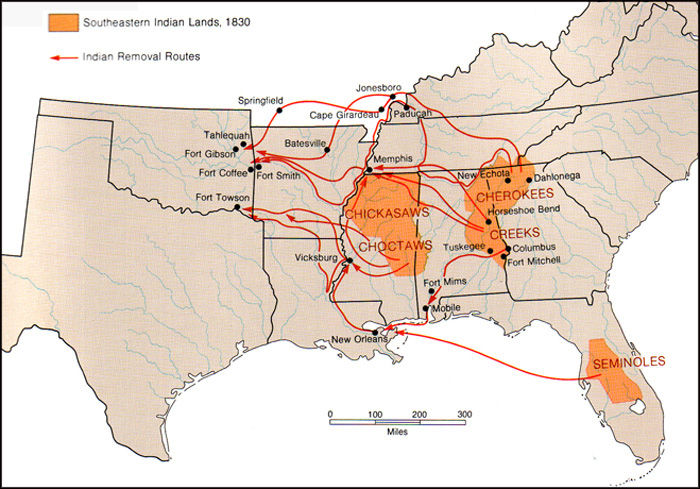
Only those with the bleakest heart can travel through Horseshoe Bend and the rest of the 400+ units of the National Park Service, and not be touched by the Tales of Infinite Sadness of the Native American.
[Unfortunately, I did not own a digital camera when I visited Horseshoe Bend.]
=========================
Links:
Horseshoe Bend National Military Park
Creek-Cherokee War
Scientific analysis of the demise of the Native American
Google map of Horseshoe Bend
Read Full Post »


 America In Context