Feeds:
Posts
Comments

Archive for the ‘Kentucky’ Category

Mammoth Cave National Park, Kentucky

I was a freshman in high school when I was introduced to Dungeons & Dragons. I was smack in the middle of the target demographic for Gary Gygax’s brainstorm. I read a lot of Greek myth as a boy (I was more fascinated by Odysseus and Bellerophon than I was by dinosaurs). Rankin-Bass’ 𝘛𝘩𝘦 𝘏𝘰𝘣𝘣𝘪𝘵 introduced me to Tolkien’s 𝘓𝘰𝘳𝘥 𝘰𝘧 𝘵𝘩𝘦 𝘙𝘪𝘯𝘨𝘴, which I read voraciously and repeatedly. The 𝘚𝘪𝘯𝘣𝘢𝘥 movies came out in the prior decade and hit rerun television so often I almost knew them by heart. Then, of course, there was 𝘔𝘰𝘯𝘵𝘺 𝘗𝘺𝘵𝘩𝘰𝘯 𝘢𝘯𝘥 𝘵𝘩𝘦 𝘏𝘰𝘭𝘺 𝘎𝘳𝘢𝘪𝘭 (Ni!). Between a deep understanding of these pop-culture references, my coke-bottle glasses, and a total lack of athleticism, it was inevitable I’d play D&D. It was the perfect fit: a social activity that required imagination, a propensity for dick jokes, and math. Lots of math.

Lots of other things, too.

One of D&D’s milieus is the underground. “Dungeons” is in the name, after all. Not just creepy basements under spooky castles, but vast networks of deep tunnels; expansive caverns housing fantastic cities; underground rivers filling huge underground lakes; all filled with horrific monsters and evil civilizations. One of my favorite adventures was Descent Into the Depths of the Earth. You play a band of heroes (of course), hot on the trail of evil underground-dwelling elves called “drow”. Traversing miles of tunnels, wide enough for trade caravans, you search for clues in warrens of troglodytes, and negotiate with schools of walking, cannibalistic fish-men called “kuo-toa”. Danger lurks around every dark corner. Adventurers succeed or die gruesome, horrible deaths. Great fun.
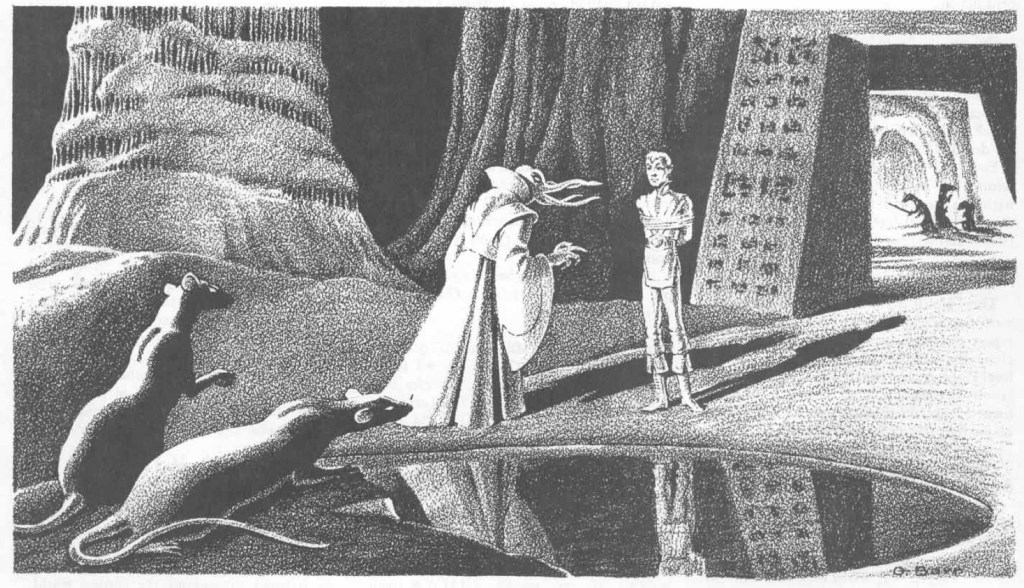
:slrrgrrlph: Have you read “The Watchtower”? :slrrgrrlph:

Of course, it’s all fantasy. All these fictional worlds, whether Dungeons & Dragons, or Riftworld, or Middle Earth, or Pandora, or whatever, are fantastic places that can’t possibly exist. Physics, gravity, geology, hydrology: they simply don’t work that way. You can’t have flat planets, you can’t have floating islands, you can’t fly a dragon to the moon, and you can’t have huge underground cities connected by caravan-wide tunnels.

Or can you?

Websites around the world proclaim this or that to be the “world’s biggest” or “world’s best”, but you rarely believe such exaggerations. There’s always disappointment, always overselling, always that feeling of being let down, just around the corner. But when I went to the original natural entrance of Mammoth Cave, a gaping maw at least 30’ wide, I knew this was, indeed, something special.
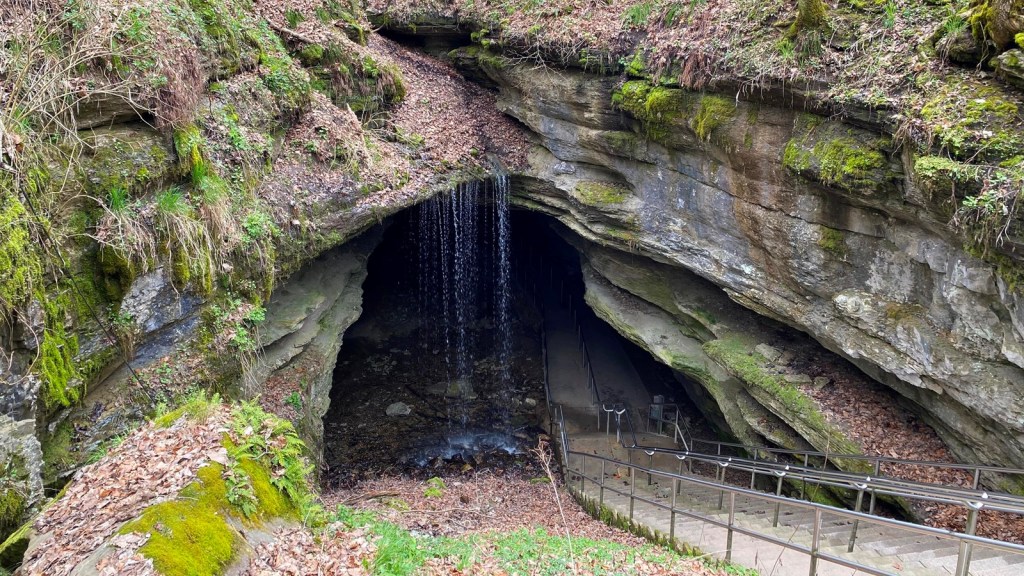
Natural Entrance

The cave system contains over 400 miles of passages, with more being discovered every year. Some of these passageways are 30’ wide, and tall enough for a school bus. Many of them are easy walking (constructed walkways mostly for accessibility and protecting fragile formations). Deeper down are the windy, spelunk-worthy crawl-ways, but there’s also an underground river where they used to offer boat tours! It’s hard to explain how large and fantastic these caves are without seeing them, and unfortunately I didn’t have a digital camera all those years ago when I toured. I’ll throw links at the bottom of this post, you can see for yourself the scale of the thing.
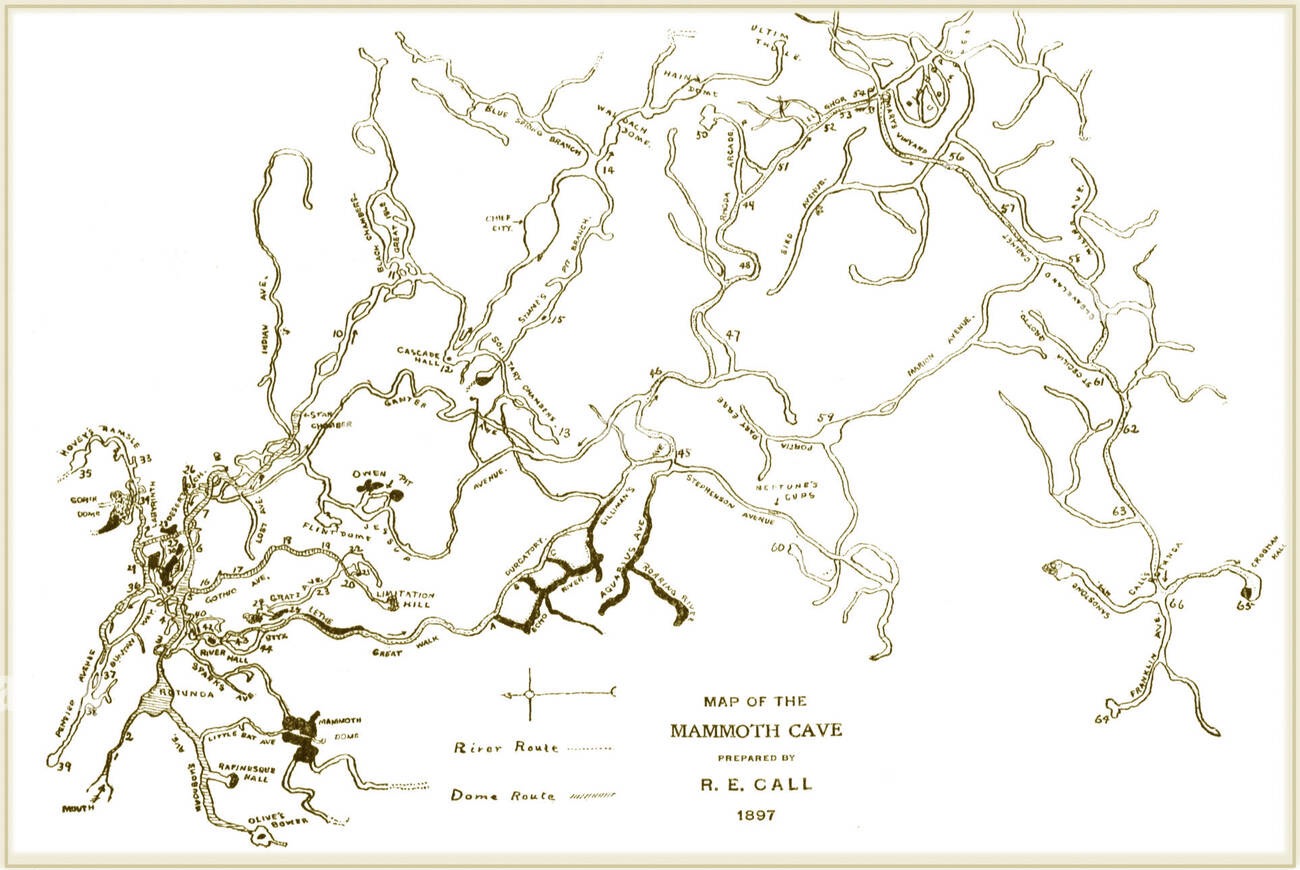
You Are Here

I love letting my imagination run wild when I go to these places. How can you not envision pre-Columbian Lakota buffalo hunting when you visit Big Sky Country? How can you not imagine great whaling ships when you visit New Bedford, or the struggles of Martin Luther King when you walk the streets of Birmingham, or immense alien spaceships while standing in the shadow of Devil’s Tower? Or drow and kuo-toa whilst inside Mammoth Cave?

I still play D&D from time to time. It hits differently than it used to, of course, but it’s still fun to get together with a bunch of like-minded nerds to roll dice and tell dick jokes and swing vorpal swords at green dragons. It’s cheaper than playing poker, beats sitting around a bar ruining your liver, and there’s nothing but crap on all these streaming services anyway. If you can’t be in the woods, on a mountain overlook, or deep in a cave system, grab some dice and roll up a gnome illusionist.

================

Links:

Mammoth Cave National Park

MCNP: Natural World Heritage Site

Google Maps: MCNP

Nerds Only

Read Full Post »

Competitive Religion and the All-You-Can-Eat Buffet

Daniel Boone Escorting Settlers through the Cumberland Gap

Nobody talks about Daniel Boone anymore. Folks my age remember Fess Parker as Daniel Boone on NBC between 1964 and 1970, and there was some interest during the Bicentennial in 1976. But now, no one cares or probably even knows who he was. Unless there’s a Hollywood movie about someone, no one knows or cares. If no one knows about Daniel Boone anymore, it’s doubtful anyone knows about the Cumberland Gap, that pass through Appalachia exploited by Boone, resulting in the nation growing beyond the Original 13. Nowadays, the Gap is both paved over by Hwy 25, and a chain of crappy clothing stores stretching all across Generica.

Cumberland Gap is in the Appalachian region of eastern Kentucky. True to stereotype, Appalachia is poor, there’s no doubt about it. Driving around the region, I was unsurprised to see economic distress & ramshackle housing. If you drive by with the windows down, you can practically smell the meth cooking. It’s pretty sad, really, for when I went (late 1990’s), the country was at the height of its economic cycle. Nowadays, with the nation on the precipice of the next Depression, I can’t imagine what’s going on down there. Of course, those nearest to the bottom don’t have as far to fall, but I digress.

Jesus Saves

There is one business in high gear in Appalachia: religion. I’m not a religious man, but I do acknowledge and respect religions. I think if I didn’t collect National Park sites, I’d drive around the country and take photos of churches. Large stone churches or modern glass-and-metal churches or one-room stick buildings, I wouldn’t care. Say what you will about all the controversies: the history, diversity, and evolution of religion in America is fascinating.

In eastern Kentucky, the story of religion is the story of competition. Throughout the region, you’ll see small stick church after small stick church, each having one of those quick-change trailer-towed portable billboards in front, mismatched letters stating “Newcomers Welcome”. It’s not just “Jesus Saves”, it’s “Jesus Saves Quicker Here Than the Church Around the Corner, They’re Really Pagans Disguised as Christians Anyway.” I wonder if there are Save-Offs, where the various hardscrabble churches meet and compete on which church wipes away sin quicker?

These quick-build churches really are competing for parishioners, each one scratching around for followers in a sparsely populated area. There’s a lot of poverty and a lot of want, but there aren’t a lot of folks. Hard conditions foster hard-core fanaticism, and it appears that hard-core fanaticism fosters hard-core soul-saving competition. A smart sociologist could have a field day here, studying religious competition in Appalachia. There’s definitely a cool doctoral thesis in there somewhere.

Golden Corral

There is one topic that has received much study, and that’s of obesity amongst the nation’s poor. Shortly before I took my trip to Kentucky, I heard of the theory that the poor are more likely to be obese than the rich, primarily because of bad food choices in local restaurants and grocery stores. Our twisted application of agricultural policies coupled with the borderline unethical practices of the nation’s fast-food chains makes it cheaper to eat fatty, corn-syrupy garbage that will surely kill you, than to eat fresh vegetables and lean meats.

On my trip to Cumberland Gap, these two factors: bad food choices and competitive religion, threatened to steamroll me into oblivion. Hungry after hiking through the park, I headed to nearby Middletown, KY, for dinner. Choices were, of course, crap. Fast-food outlets and all-you-can-eat buffets as far as the eye can see. I hate buffets almost as much as I do fast-food outlets, they’re usually bland as hell and festooned with pasta, meatballs, over-fried chicken and mashed potatoes, not exactly healthy eating.

I finally sucked it up and headed to one (buffets beat out starvation, that’s for sure). I pulled into the parking lot … right behind a church bus carrying half a dozen 300-lb. Bible Baptists. I had to politely let them go first (I tend to avoid fire-and-brimstone moments as much as possible), and was worried there wouldn’t be much left for me. I headed to the salad bar, figuring it’d be totally avoided by the locals (it was), for a feast of brown iceburg lettuce & rock-hard cherry tomatoes. Mmmm, feast of champions.

Honestly, I managed to get a sizable dinner there, and survived the post-processing. I only had “firsts”, surely I looked like an outcast, one of them there rich folks that don’t likes fatty vittles. I didn’t care what they thought, I was confident I could outrun them all.

[I didn’t own a camera when I visited Cumberland Gap. All photos are,  I believe, in the public domain. If you know any differently, please let me know and I’ll get the owner’s permission or remove them outright.]

[Special note to readers: I was contacted by http://chriscrawfordphoto.com/index.php about my use of one photo that belonged to him. I honestly don’t remember where I found that photo in the first place (this post is five years old), but I was clearly in the wrong and have removed the photo. My apologies to Mr. Crawford.]

====================================================================

Links:

Cumberland Gap National Historical Park

Frontline: Why Poverty Persists in Appalachia

Child Obesity in Poor Neighborhoods

Church Sign Generator

Google map to Cumberland Gap

Read Full Post »

Stupid Questions

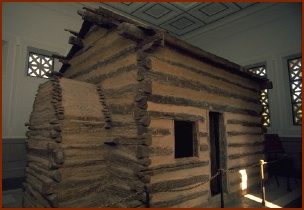
“So, this is original, right?” I asked, pointing to the log cabin inside the granite mausoleum.

“No, it’s a replica.”

Cabin (courtesy of National Park Service)After this almost mandatory exchange, I asked the ranger how many people ask her this stupid question every day. “A lot”, she replied. Of course the log cabin at Lincoln’s Birthplace isn’t original. The original one was surely torn down and replaced by the next residents after the Lincolns moved to Indiana (log cabins were not known for their longevity). The ranger did proceed to discuss what was really important: the thoughts and writings of our greatest President, Abraham Lincoln.

One of my regrets during my NPS travels is I never get the names of the rangers and volunteers who staff these sites. Some of them, including this woman at Lincoln’s Birthplace, are truly stellar. She was very smart, and a very good communicator. She also knew a lot about Lincoln. Not just the contents of some script for park employees to parrot out on command, but she really studied and respected the man. She read a great many books on the subject, and spoke with a fluidity that only true knowledge can sustain. I was absolutely captivated when she spoke. It didn’t hurt that she was attractive as well, brilliant and beautiful is a great combination.

It’s a shame to hear that the Park Service doesn’t pay particularly well, nor do they adequately fund or staff these parks (the fault of an uninterested Congress). Even with those obstacles, some of their employees are terrific.

The Man, The Legend

It’s amazing how well liked, or even loved, our 16th President is in the U.S. There are no less than five National Park Service sites dedicated to Lincoln, and many educational and cultural institutions (and more elementary and secondary schools than you can shake a stick at) are named after him. Of course I’m looking at this through Yankee eyes (having been born and raised in Massachusetts), but I think he’s even loved in the south, although probably not as thoroughly.

Lincoln (public domain photo courtesy of Wikipedia)We should ask ourselves “why?” Why would a man who presided over the one and only War Between the States (the worst human bloodletting ever witnessed on the North American continent), a man who initiated the first widespread draft in America (leading to riots in New York City and other places), a man who suspended many legal rights (an act used years later as justification for Japanese interment and the Patriot Act), still be so loved by the American people? Not only loved, but perhaps even deified.
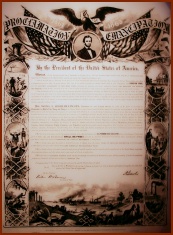
“Honest Abe”. “The Great Emancipator”. “The Man Who Saved the Union”. Lincoln was not always honest, he had to lie often during his Presidency (a wartime President is rarely blessed with opportunities to be honest). Lincoln’s Emancipation Proclamation was done to turn the heat up on the Confederacy, and had a great many flaws. And was it simple Northern arrogance driving him to maintain the Union (under Northern control, of course) at such a heavy price?

I offer up three reasons why Lincoln, of all the Presidents, is held in the highest regard, and has so many marble structures bearing his name:

He Won.

Americans love a winner. We always have. Washington. Jackson. Grant. Eisenhower. Colin Powell. The 2007 New England Patriots. We love those who win, and will imbue them with talents far beyond reality. Winners can do no wrong. In the end, Lincoln won. Yes, he wasn’t a direct military commander, but it was his war, his battle. It was his dogged determination, and eventually his appointment of Grant as commander of the army, that led to victory over the Confederacy. And it was a true, military victory, not some negotiated settlement or stalemate. We salute Lincoln because he was the victor.

He Died.

It’s a horribly cynical thing to say we only admire people who are struck down early. In the case of our Presidents, it’s not always true (who knows anything about William McKinley or James Garfield these days?). But it is true enough that we put people on pedestals after they die, especially when they die before their time. Was James Dean really that good of an actor? Was Kurt Cobain more talented than Eddie Vedder? Was Abraham Lincoln really the best President ever? Or do we put a better spin on those who leave us before they really should? The story of Lincoln’s death is tragic, but it came at such a special moment – days after Lee’s surrender at Appomattox – that it will forever be held as the stuff of legend.

He Was Right.

Above all else, I feel Abraham Lincoln is worthy of mention as America’s greatest President for one simple fact: he was right. He was right to free the slaves, even though his Proclamation was half-baked. He was right that the Union should stay together, for divided the nation would have been weaker. And he was right that the Confederacy should be defeated and not bargained with. There would have been conflict on our soil between two nations (or perhaps more) for generations afterward (witness the strife that plagued Europe for hundreds of years).

Emancipation Proclamation (public domain photo courtesy of Wikipedia)But there is another meaning to the word “right”. Lincoln was also the right President at the right time. People tend to forget the mess this country was in before Lincoln. The “slave problem” was a menace, a canker, a tumor on the very heart of America. It ate at the very core of our beloved Constitution. America, a nation supposedly founded on freedom, held hundreds of thousands in thrall, was a nation of hypocrites.

This canker led to a cancerous government, for we not only had a collection of weak-willed, spineless Presidents (from Harrison to Buchanan, find me one worth a damn), we also had a divided, rudderless Congress, and a court whose decisions were at times abhorrent (the infamous Dred Scott decision). We even had riots in the states and territories (Bleeding Kansas, John Brown’s Raid). I will even suggest that slavery was harming Southern culture; it enabled a decidedly undemocratic aristocracy, more interested in pomp, grandeur, and socializing than education, social betterment, industrialization, or agricultural advancement.

The American Civil War was such a tremendous turning point for the United States. We became a much better nation after Appomattox than we ever were before Fort Sumter. The transfiguration is glaring, in fact it’s shocking. The elimination of slavery, and the resolution of the simmering North-South conflict, revitalized this nation and sent us on the path to becoming a true powerhouse, and Abraham Lincoln was there, right when he needed to be, a nexus between barbarity and enlightenment.

In the end, we are right to deify the man named Lincoln, faults and all.

Memorial (courtesy of the National Park Service)

[The photos on this entry are public domain, and come courtesy of the National Park Service and Wikipedia] 

Links:

Abraham Lincoln Birthplace National Historic Site

An Analysis of the Emancipation Proclamation

An Essay on Pre-Civil War Southern Stagnation

Google map to Lincoln’s Birthplace

Read Full Post »