American Classics
Edgar Allen Poe is a true American classic. I suspect that Poe is the second most recognized 19th Century American author (behind perennial favorite Mark Twain). Most everyone has heard of Poe through his well-known works like “The Raven”, “The Pit and the Pendulum”, “The Masque of the Red Death”, and that grade-school reader staple, “The Tell-tale Heart”. Some folks may have read one book by Herman Melville or Louisa May Alcott, and only college-level literature students have read anything by Emerson, Longfellow, or Thoreau, but most of us are familiar with Poe’s work and his influence on mystery and the macabre. I suppose it’s sad that he’s better known than his contemporaries (critically speaking Poe’s works pale in comparison to Emerson, Longfellow and Thoreau), but his visceral take on humanity made a huge impact on popular culture. You can trace so many mystery-thrillers directly back to Poe. It’s hard to imagine Hitchcock or Stephen King or even CSI would be here today without his influence.
But a visit to Poe’s old homestead in Philadelphia evokes a different sort of American classic.
 Philadelphia wasn’t the only city Edgar Allan Poe called “home”. Never a wealthy man, Poe and his family led a fairly hardscrabble life. They travelled a lot, always trying to find a new opportunity in another city. Consequently, they lived in many places, from Boston to Richmond to New York. The only Poe home that has been preserved is an old, faltering row house north of Independence Park, on the bad side of I-676. Yes, that’s right: the former home of Edgar Allan Poe, one of the premier poets and authors of his time, is a shitty house in a shitty part of town. And I find that terrific.
I visited Poe NHS on a crappy, drizzly day. I spent the prior gorgeous, sunny day strolling Independence NHS, the well-manicured core of touristy Philadelphia, with its horse-drawn carriages and Ben Franklin impersonators. But the day I visited Poe’s House was sodden and sopping. Rain doesn’t bother me, I threw on a raincoat and headed out. Of course, I didn’t realize I’d be walking about a mile into the slums of Philadelphia. Honestly, that part of town isn’t that bad, but I clearly stood out like a sore thumb. I have to admit I was pretty nervous, but I didn’t run into any trouble. In hindsight, I think it was a very appropriate walk. Too many of us, myself included, stick to the “good” parts of America, and daren’t venture into the rougher sections. A brilliant thing about my National Park Site collection is you see virtually all of America, including some slums. You get a pretty complete picture that way, in my opinion.
 By the time I got to the Poe house I was pretty soaked. I entered and took off my coat, leaving puddles in my wake. A retired couple were there, their Lincoln parked in the lot, water beaded from a fresh waxing. We were just in time for a tour. Our guide (a really sharp and well-versed lady, a credit to the NPS) took us through the outwardly rickety building, and told us of Poe. A troubled man, a restless man, a man who struggled with success (both commercial and in life). A man who always tried to find his way, a man who seemingly lost his mind and eventually died a very mysterious death, yet a man who left us with some of the most beloved works in American literary history.
Poe’s story was intriguing, but what I found more intriguing was the relationship the Poe site and the NPS has with the local residents. Obviously that part of Philadelphia has a typical, urban, African-American population: undereducated, underemployed, living their own hardscrabble lives built on single-parent households, gang warfare, drug abuse, and a collage of government entities that don’t give a crap about them. But the folks at Poe NHS have worked really hard to get in touch with the community. They are constantly hosting children from local schools for tours and storytelling and events, and that ranger clearly loved to do it. There was no pretension or hypocrisy in her voice when she told those stories, even when she was talking to three Whiteys from the ‘Burbs. Her love of her job and the locals was pretty evident, and appreciated. She also pointed out the brilliant mural of Poe on a nearby building, and the fact that it has never been defaced by graffiti in all the years it’s existed. That is a telling factoid and really shows that either Poe’s works unites us on a fundamental level, or that if you respect people, they will respect you back.

Poe NHS doesn’t just tell the story of a famous American author, it tells the story of a rough life, a life led by many millions of Americans before and many more millions who came after. Rough living in a rough house in a rough neighborhood, a life lived by more of us than we care to think about. I doubt my tour companions really got the point of Poe NHS. The retired gentleman, who was supposedly making a coffee table book about “homes of great Americans”, clearly missed it when he said “I doubt this house will make my book.” We all didn’t grow up in marble mansions, doofus.
If you want to experience America, you need to experience all of it, including tilting houses in seedy neighborhoods. That is an idea worthy of a coffee table book.
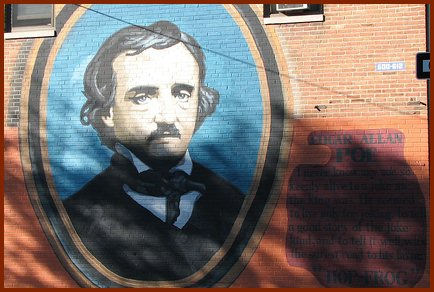
[Pics on this post are mine and copyrighted thusly, except for the mural. I didn’t get a good picture of it (crappy photog that I am), so I had to pirate one.]
========================================================
Links:
Edgar Allan Poe National Historic Site
Poe Museum (Richmond, Virginia)
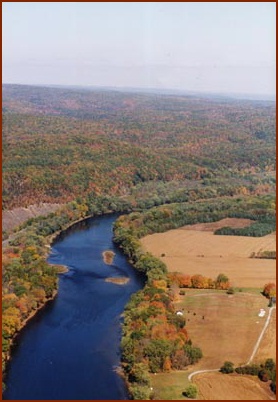 I had no grandiose plans for my Water Gap visit. I had an exciting, inspiring trip the prior autumn when I visited Alaska for the first time (a subject for my next post), but for my trip through Pennsylvania the following spring, I wanted to tone it down (although some might say you have no alternative but to ‘tone it down’ when you visit Pennsylvania, but, well, moving on …).
 Now I have to be careful here: I am calling it “soulful laziness” for a very specific reason. It’s the ability to just stop, for a few minutes or a few hours or a few days, and relax. Find a quiet spot, at the beach or in a field or on your own back patio, and take a breather. Get away from the noise. Stop and smell the roses. Free your mind and the rest will follow. Let not only your body and your mind but the very fiber of your being, your soul (in both the theological and non-theological meanings of the word) take a rest.
 Part and parcel with physical laziness is intellectual laziness, as evidenced by excessive TV watching, vapid internet surfing, pointless shopping sprees or chronic videogaming. Many people are too intellectually lazy to even ask questions of our leaders or their bosses or even their spouses. Fewer and fewer people read or write effectively, or even try to think their way out of problems, instead depending on others to bail them out or praying to God for salvation while having another box of Ring-Dings and watching Monday Night Football. How many people can’t even count change? Lots and lots.
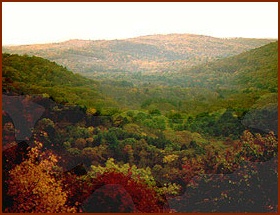 What we need to do as individuals is occasionally enter that state that allows one to set aside all the petty, self-created stresses, and just sit there in a quiet, low-key space and watch the world go by for a few hours on the weekend, or a few days while on vacation. This type of laziness is a wonder and a marvel. It shuts off all the noise and all the crap that we either willingly enter or (far worse) create for ourselves. Now this brand of laziness must be earned and can’t be abused (you can’t live your life staring out into space or gazing into your own navel, that’s what puts you into “the home”), but, in moderation, this is what we need, what we all need, the entire country, for our own sanity and our own survival.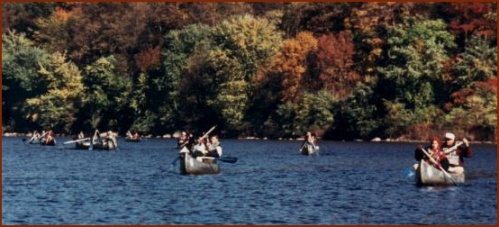
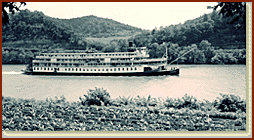 In the early 1800’s, westward expansion was really gearing up. The frontier represented opportunity. For settlers, it was the opportunity to find a new life. To the merchants in the eastern states, the frontier represented money. Settlers needed tools, and supplies, and seed. Settlers needed to sell their own products (timber, crops, cattle) to buy those tools, supplies, and seed. The merchants were ready to handle both sides of the equation. The nation, as today, ran on commerce. There were riches to be had on the frontier, that much was certain. But how do you transport all these people and goods back and forth? The answer was water.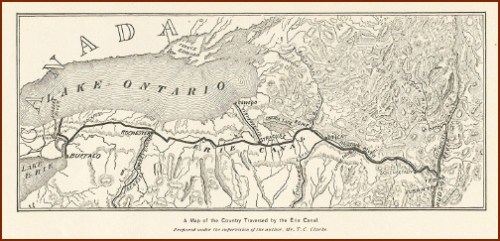


 America In Context