Feeds:
Posts
Comments

A Game-Changer? Hopefully

Yesterday, the U.S. Supreme Court decided not to intervene in several appeals of same-sex marriage equality. There are reams and reams of analysis on the ramifications of this decision all over the Interwebs, all of it better than mine, so I won’t even try.

I think this is great news. I support same-sex marriage and general equality for the LGBT community. Part of this is my own system of values. I just don’t see anything wrong with it amongst consenting adults.

But beyond that, I think this is great news for the principle of a limited government. I think even conservatives should rejoice. It really boils down to good, limited governance of a free society.

I know staunch libertarians will disagree with me on this, but a free & prosperous society actually requires a strong, functioning government. The key is strong & functioning with regards to what a good government should be doing.

In my view, the good government of a free society needs to provide these functions:

  • defending the nation from external attacks
  • keeping the internal peace when individuals cannot do so themselves
  • providing a legal framework for conducting business and settling disputes
  • ensuring all citizens have equal voice and are subject to fair treatment; and that the weak are protected from being abused by the strong
  • funding and implementing beneficial public works projects that cannot effectively be completed by the private sector

And … that’s it. Sure, one can quibble on exactly how these functions should be done, but this is really the list on what a government should do for its people.

OLYMPUS DIGITAL CAMERA

The problem many social conservatives have is they add this sixth bullet, in one form or another:

  • be the guardian of a moral code

This is what the gay rights limiters, the “no sodomy” lawmakers, the abortion deniers really want: they want the U.S. government to be the enforcer of a moral code (specifically, their moral code).

Ugh, what a horrid thought. It amazes me that these folks don’t see this as a horrid thought!

It’s not too hard to imagine a world where governments enforce moral codes. It’s happened ever since the dawn of civilization. Tyrannical regime after tyrannical regime has done everything from slavery to ethnic/religious cleansing to forced castration to progroms and ghettoization, all to enforce their “moral code”. These are all terrible things, and to think some people don’t see it this way is immensely troubling. A government, even the U.S. government, enforcing moral codes is a bad idea!

Plus it’s just a waste of money, if you’ll permit me to be so crass. Do we really want to pay taxes to enforce this stuff? I don’t

This ruling should be taken as a signal that laws governing behavior solely for the enforcement of a moral code, and for no other valid reason covered by good governance, should be overruled.

The Other Reason This Is Right

Awareness.

Enlightenment.

Piety.

Oneness.

Grace.

Ascendancy.

All are terms, terms across so many religions and belief systems. Toss in Heaven, or Nirvana, or Bodhi, or any of a number of more specific words. All words connoting the apex of spiritual existence.

Now look at all the greats across all these religions or philosophies. St. Thomas Aquinas. John the Baptist. Siddhārtha Gautama. Mohandas Ghandi. Mother Theresa. There are lots, lots more.

Do you think any of them needed a government entity to enforce their moral code upon them? No. They believed it, took it to heart, made it their own, and based their lives upon it. Oh, and what lives they led! Such lives, that we we still speak their names with reverance, even millenia later!

Religion, spirituality, philosophy: these are all things that are yours. They are personal to you. Your journey to whatever the apex of your own belief system is yours, your own, no one else’s.

And it is a hard journey. I don’t know of any major religion that claims it’s easy. It’s difficult, and it is intended to be difficult. Heaven isn’t just something that you can stroll into, you have to earn it, through good works, or a pious life, or self-sacrifice, or whatever your beliefs call for. It requires strength of will and strength of character.

if you need a government to enforce your morality upon you or another, you may want to consider not only what, exactly, that morality means to you, but also what your character lacks that you can’t lead the good, clean life you want on your own, without the government enforcing it for you.

This is a good ruling, no matter how you look at it.

A Monument to the Politically Crazy

Somewhere in Mentor, Ohio, sits the well-kept home of our 20th President, James A. Garfield. Few Americans know anything about James Garfield, or perhaps their only knowledge of this man is through the lyrics of a Johnny Cash song:

Mr. Garfield been shot down shot down shot down

Mr. Garfield been shot down low

President Garfield was assassinated by spurned office-seeker and political nutbag, Charles Guiteau, on July 2nd, 1881, a mere 160 days after his inauguration. As far as assassinated Presidents goes, Garfield is simply one of four, an afterthought on a list that also contains one great (Abraham Lincoln) and one beloved (John F. Kennedy).

Few remember James Garfield, but I think the story of Garfield is tremendously valid today, and should be read and understood by anyone and everyone with a political leaning, whether left or right, whether they follow Fox News or the Huffington Post or even the Onion. The story of President Garfield is the story of dangerous political extremism.

Assassination of President Grant (www.authentichistory.com)

Anatomy of an Assassin

If I was to ask a panel of experts or non-experts, “what makes a presidential assassin”, I’m sure the bulk of them would say, in language academic or mundane, “they’re crazy”. By and large, anyone who would assassinate POTUS would have to be crazy. When you think about it, there’s not really a lot of point to it: our system of government isn’t particularly susceptible to change or overthrow in that manner. Between our tripartite government, our well-defined system of presidential succession, our deeply entrenched two-party politics, and the ponderous inertia of a democracy, the assassination of our President won’t really make much of a difference, other than to put the nation in a state of mourning. It could even steel our resolve to “stay the course” more than simply waiting until the next election to instigate change.

So if there’s no value in assassinating the president, then why do it? Well, John Wilkes Booth killed Lincoln in retaliation for the Confederate loss in the Civil War, and the abolishment of the institution of slavery. Leon Czolgosz, the man who shot William McKinley, was a turn-of-the-century anarchist inspired by a slew of assassinations in Europe. Lee Harvey Oswald was a Communist sympathizer (or maybe a patsy for the mob, or for the FBI, or by grey aliens, or who-knows-what). Slavery. Anarchy. Communism. Heavy, deeply philosophical ideas. Crazy, but deep crazy.

Charlie Guiteau? Charlie Guiteau killed James Garfield because his particular wing of the GOP (the Stalwarts) lost to Garfield in the Republican convention of 1880.

Um, seriously? That’s shallow crazy right there.

Charlie Guiteau (wikipedia)

The Drudgery Grudgery of Politics

There is a long, complicated story surrounding the 1880 Republican Convention. To summarize, there were two favorites. The Stalwarts stood behind former President Ulysses S Grant, and the Half-Breeds stood behind Senator James Blaine of Maine. During the convention (a weird affair, like all other 18th century conventions), dark-horse  James Garfield — a compromise candidate offered when neither favorite carried a majority — surprisingly won the nomination. He would then go on to defeat Democrat William Hancock in the general election.

There’s a lot more to this, of course, but it would probably bore you to tears. Which is kinda the point: all these inner workings of the two-party system, all the legerdemain cast by the party machines, it’s all fairly petty stuff. It’s all about favoritism, and patronage, and civil service, and all this other nonsense. None of it is “deep”, none of it is particularly soul-renching. None of it is, even in a madman’s eyes, cause for assassination! Unless, of course, you’re a person with the shallowness of purpose as Charlie Guiteau.

Political shallowness is exactly the point, and hence the subtitle of this post, “A Monument to the Politically Crazy”. Garfield was killed for no reason other than some whackjob took offense over a political process. There was no other reason! Sure, Guiteau also felt slighted for not getting the patronage job he wanted, but he also knew killing the president would result in him being hanged! There was no purpose to it, whatsoever. Just the total waste of a life, and the lost potential of a President. I think Garfield was on his way to being a very good President when he was shot, but we’ll never know that now.

Soccer Riot or Election Day? (http://www.thetimes.co.uk)

Crazy: Then and Now

Charlie Guiteau was a political nut-job. He was so fixated on his own faction that he took it upon himself to murder a president. He wasn’t fixated on a cause, but on a team. How shallow is that? But let’s look at this madness: this is exactly the type of bent most politically-minded Americans have today! How many people only vote for their own political party? How much punditry on 24-hour cable news, talk radio, or the blogosphere is really “our team is great, the other team sucks”? Listen carefully to what goes on in today’s popular media outlets, you’ll see this to be true most of the time. We are all being trained to be Charlie Guiteaus: not concerned with the facts or philosophies of governance, but wholly concerned about our “team” beating the other “team”?

None of this is good, none of this is wise. We need to stop playing team politics, and start paying real attention to real issues and the real results of our decisions, before we all end up crazy like Charlie Guiteau.

—————————————–

Links:

James A. Garfield National Historic Site

How Our Partisan Loyalties Are Driving Polarization

Dark Horse: The Surprise Election and Political Murder of President James A. Garfield <– an excellent book and my key source for this post.

Google map

Liberty Enshrined

Everyone believes in something. Even agnostics and atheists believe in something. Some put blind faith in money, thinking it will make them happy. Some put blind faith in material possessions, because, well, *sparklies*. Some put blind faith in their political party or right-left-center talking points. Some put blind faith in celebrity, buying Bieber cologne or other ludicrous claptrap. Some put blind faith in themselves, being so arrogant as to think they are infallible and therefore beyond question. Some even put blind faith in science, as odd as that sounds, believing that any and all studies that cross their path must be true (this leads to a lot of fad diets as well as other errors).

Copyright America In Context

Liberty’s Shrine

In my own case, I tend to put blind faith in the American ideal. For folks like me, Independence Park in Philadelphia is the Temple Mount, the Ganges River, the Mecca of our own beliefs. It’s a place of extreme importance, a shrine commemorating the place where the founding principles of this country were put to paper and approved by an assemblage of great minds and strong characters. A place where heretofore un-codified principles were defined and written into law and principle, grandiose notions such as “[w]e hold these truths to be self-evident, that all men are created equal”; “whenever any Form of Government becomes destructive of these ends, it is the Right of the People to alter or to abolish it”; or “[t]he privilege of the writ of habeas corpus shall not be suspended, unless when in cases of rebellion or invasion the public safety may require it”. Fabulous ideas, amazing ideas, ideas that would inspire nation after nation to rebel against tyrants and kings and establish democracy. It’s the Great American Way that Independence Park symbolizes, the Great American Way that I hold most dear.

Unfortunately.
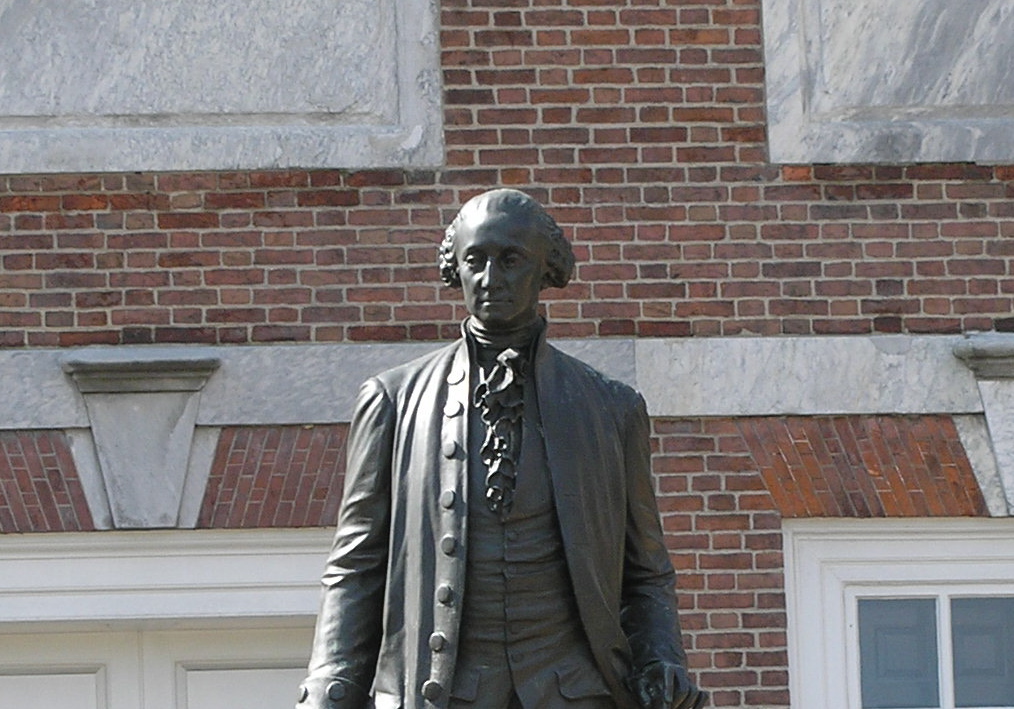
Folks are going to worship me someday, aren't they? :sigh:

“Folks are going to worship me someday, aren’t they? :sigh:”

If there’s one thing I’ve learned, ideals aren’t real. They don’t exist, and you can’t count on them. If you do, you will be betrayed. Every time. The American Ideal is the same: it’s full of betrayal. The original Constitution says that certain people are only worth 3/5ths of other people, and also said that those in bondage who escape to another state must be returned into bondage. Basically, it protected the vile institution of slavery for nearly 100 years. Even today, long after that particular abomination was wiped out by amendment, there is betrayal. These documents have been subverted, abused and weakened, leaving a system of government so devolved it barely represents the will of the people at all, and our nation is in a fine ruddy mess because of it.

Then again, it’s still important to hold onto ideals. It’s vital, actually. They are the goal, the dream, the vision, and without our goals, dreams and visions, we are a dead species. And to keep goals, dreams and visions alive, it is important that kids be indoctrinated (for lack of a better word) with ideals that are truly valuable, else they, too, will grow up to be tyrants and monsters; and you can’t do any worse than indoctrinating them into the important American ideals of equality, liberty, self-governance, and independence.

And naked statuary, of course

And naked statuary, of course

There is also no better element of that indoctrination than a trip to Independence Park in Philadelphia. I really like Philadelphia for one simple reason: the park is dedicated not to rebellion (like Boston, with it’s homage to the Boston Massacre, Faneuil Hall, and Paul Revere), nor to warfare (like Valley Forge or Yorktown), nor to marble monoliths (like Washington, DC) but to ideas, thought, consideration, and debate. It’s a site that contains meeting rooms, and convention halls, and judicial chambers;  not cannons, trenches, or cemeteries, but desks. It is a truly remarkable place in that aspect, it’s dedicated to ideas, and I find that refreshing.
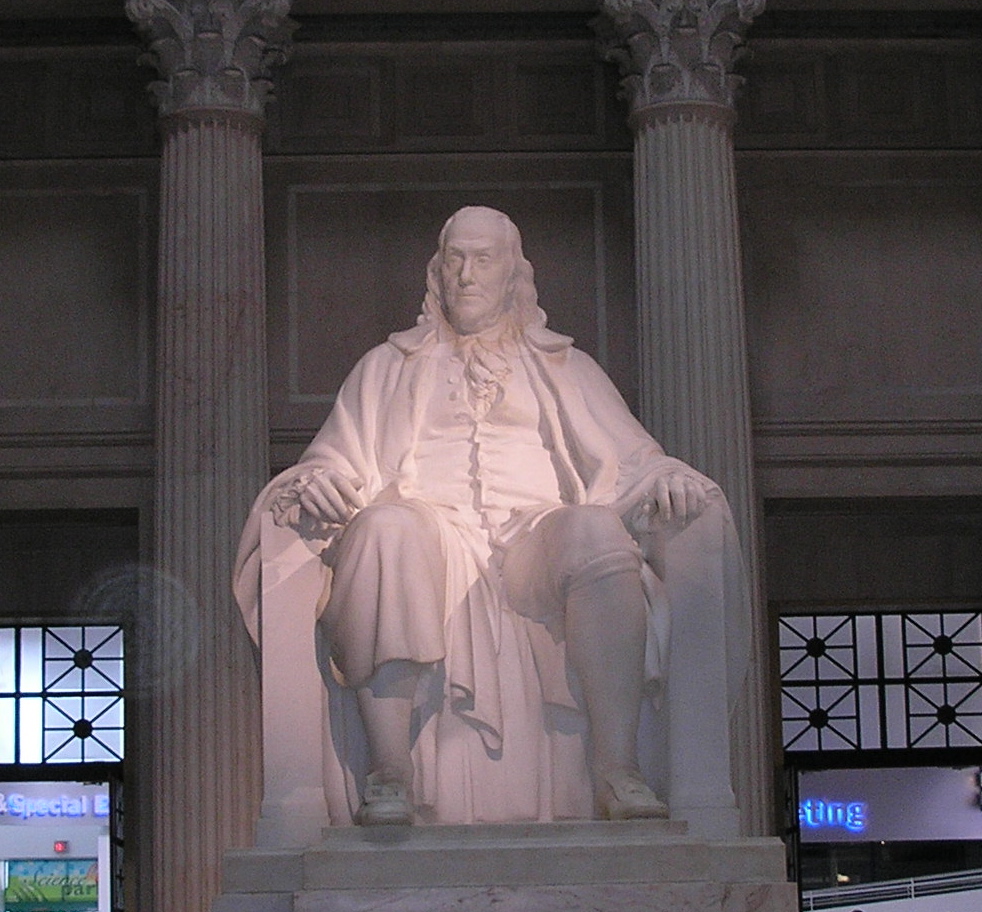
But he's just sitting there! THINKING!

But he’s just sitting there! THINKING!

Liberty Imprisoned

I first visited Philadelphia in the 90’s. At that time, the Liberty Bell was in a non-descript glass enclosure inside Independence Hall. Anyone could see it. I never bought into Bell lore myself (like most American legends, it’s more tall tale than fact), but I kinda liked the presentation: subdued, no drama, viewable by everyone, kinda like I envision liberty itself. Freedom should not be a big deal, it should not be something we put on a pedestal. It should just “be”. You don’t pay attention to it when it’s there, you just live your life, yet everyone notices when it’s absent.

Then 9/11 happened, our liberties were sacrificed to the Lords of Fear, and The Liberty Bell became a symbol of our shift to madness.

In the grief-stricken days after 9/11, we were all expecting more terrorist attacks. We went bat-shit crazy protecting everything.  We improved airport security, then we “improved” airport security, then we began the systematic groin-groping known as the TSA. We started monitoring financial transactions, then started monitoring foreign communications, and now the NSA has a full-blown domestic spy program best suited for watching cheating spouses and stealing credit card numbers. We placed Jersey barriers in front of government buildings, we put metal detectors at the entry of every government building and landmark, and we built a prison for the Liberty Bell.

Liberty's Prison

Liberty’s Prison

On my second visit to Independence Park, I spotted the Liberty Bell Center, and it saddened me. The Liberty Bell is no longer just “there”, like our liberties should be. It is encased in a steel and glass structure, surrounded by guards and various security devices, reminiscent of a prison. It also, oddly, has the look of a high-end shopping mall, meaning not only is Liberty imprisoned but it’s also commercialized (they should call it Liberty Disney). I was so repulsed by the appearance of the Liberty Bell Center from afar, I didn’t have it in me to go there. Liberty was imprisoned and I didn’t want to be stuck on the outside, pressing my face against the glass in the hopes she’d remember me in her confinement.

I think the NPS has toned down the security in the intervening years, and I’ve heard from others that the Center is actually a pretty nice facility. But for me, the illusion has been shattered. The Liberty Bell, like the very civil liberties it represents, is not just cracked but contained, with an admission fee, groin groping, and gift shop.

[Photos on this blog entry are mine and thusly copyrighted.]

——————————————————

Links:

Independence National Historical Park

Founding Fathers Fetish (slate.com)

3D Tour of the Liberty Bell

Google Map of Independence National Historical Park

Heavily recommend listening to Bill Moyer’s interview with poet & author Sherman Alexie. Alexie was born & raised on the Spokane Indian Reservation, and has written about his life as a man of two worlds (both racially and as a man who suffers from bipolar disorder).

I have a great deal of hollow empathy for the Native American. I want to call it real, I really want to know & understand tribal culture past & present, but honestly I can only I call it “hollow”, for I’m a white New England suburbanite whose only connection to Native Americans is through the co-opting of Indian stereotypes I enjoyed as a Boy Scout and a handful of books I’ve read. So other than growing up in an alcoholic household, I can only imagine the pain of growing up Native American in a country that tried to exterminate your forefathers.

Sherman Alexie certainly sounds like that gateway, that bridge between cultures. I found the interview compelling & powerful in its sadness & humor. I think I’ve figured out my next Kindle read ….