It was late spring in the mid-90’s. The world had not yet discovered the convenience of smartphones, nor had the general public made avail of navigation by GPS. There I was, in the woodlands of east-central Alabama, in a shoddy minivan (thanks Avis), Rand-McNally road atlas open on the passenger seat.
Totally lost.
I planned out the rest of that trip very well. I was going to Horseshoe Bend, I was going to Tuskegee, I was going to Chattanooga and Chickamauga and Plains, Georgia and Andersonville and the Ebeneezer Baptist Church. All were wonderful, informative, educational, and even moving. But for some, dumb reason, I phoned in the plan for Little River Canyon, and fell flat on my face.
Well, I didn’t literally fall on my face. What I literally did was drive around various backroads, trying to find the canyon. There was nary a sign to be seen, I just keep flitting around various windy roads, taking random left turns like a blithering jackass. Then, the storms rolled in.
First there were flashes of light, followed by the rumble of distant thunder. Then the sky turned black as night. The wind picked up, the rain fell, then went sideways, and then the flash of the lightning and the crash of the thunder occurred nearly simultaneously. I was in the eye of the maelstrom, in a shitty rented minivan, surrounded by 100’ tall loblolly pines. I was waiting for that one tree to give up its ghost, forcing me to give up mine.
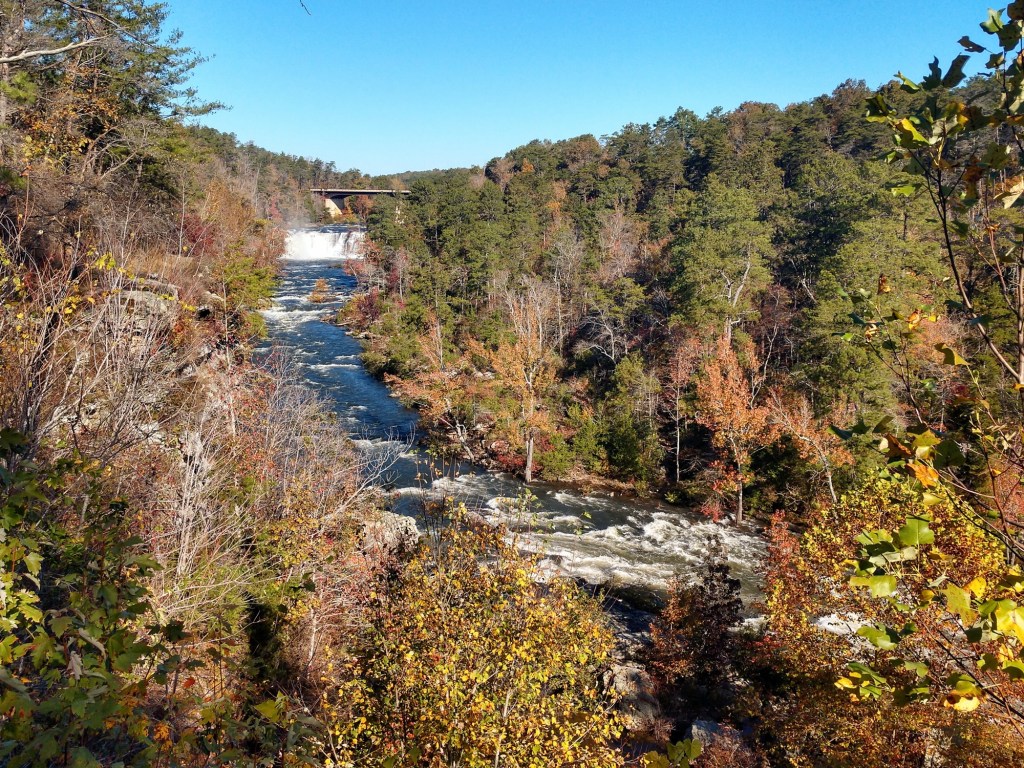
In about 15 minutes, the storm passed and the sky cleared. Heart pounding, I pressed on, and there, on my right, revealed by the sunlight, was the Little River Canyon. It was cool and all, and incredibly photogenic in that moment, but all I wanted to do was go back to my hotel and have a drink.
I haven’t made too many boneheaded mistakes in my visits to over 200 National Park sites, but my short visit to Little River Canyon was one of the dumbest.
I didn’t own a digital camera when I visited the canyon. The photo is from the National Park Service website: https://www.nps.gov/liri/index.htm
I was very fortunate when I visited Lincoln Home NHS. Due to some unknown confluence of circumstance, I toured the park when there were virtually no other visitors. There were maybe a dozen in all, including the four who accompanied me on a tour of the house.
I am a little sad when important historical sites have no visitors. I worry that Americans are failing their children by ignoring their own history, being otherwise enrapt in their video games or casinos or cruise ships. But I’m also more than a little grateful, for it gives me time to experience the importance of place, ponder the passage of time, and contemplate the importance of it all.
The site covers a scant four blocks, but the houses therein are well-preserved in 1860 style. The effect is quite immersive: sans many other tourists, it is easy to imagine yourself in 1846, walking towards 413 S. 8th St., dressed in your finest frock coat and sporting your best cane, so you can wish the newly-elected Representative Abraham Lincoln a fine good morning and sincere congratulations on his recent victory. Perhaps you truly believe the sentiment, perhaps you are hoping to curry favor, but regardless, you have performed proper pleasantries as is expected of a gentleman, and now must visit the mercantile to see if your package has arrived.
I believe that vacations should include not only excitement, awe, and wonder, but also quiet, and also contemplation. With summer upon us, here’s hoping you find all five during your next vacation.
Nestled in the middle of rural Spencer Country, Indiana, west of Christmas Lake Village, and just off State Route 162, is a small, unassuming bit of parkland. Inside, you’ll find meandering trails; a replica of a 19th century farm (complete with live animals!), and yet another shrine to Abraham Lincoln. And why not? Here, on this plot of land, the 16th President of the United States grew from a boy into a man. Here, young Lincoln worked the farm, built fences, attended school, went to church, was inspired to practice law, and lost his mother to milk sickness.
It took about 40 years for the country to fully appreciate and honor Abraham Lincoln, and boy did they appreciate him! The Lincoln Head Penny was first struck in 1909, the Lincoln Memorial was funded by Congress in 1910. Lincoln, Nebraska was early to the game, renaming itself from Lancaster in 1869, but dozens of counties and innumerable schools, streets, avenues, and parks weren’t renamed until that first decade of the 20th Century.
There apparently was a fight for “hometown rights” amongst several towns and states. He was born on Feb. 12, 1809, in LaRue Country, Kentucky. But his father, Thomas, packed up the family and moved them to Indiana in 1816 (partly to avoid competing with slaveholding farmers, and partly because land titles in Kentucky were, shall we say, flexible). Lincoln lived in Indiana for the next 14 years of his life, and then went on his own, moving to New Salem, Illinois. Illinois would remain his home state until he made his fateful move to the White House some thirty years later. Once “Lincoln fever” struck, all three states & towns wanted a piece of the action, and tried to claim the President as their own. Each of them built their own shrines, and claim they were “Lincoln’s home”. All are now in the National Park System, and hey, the more parkland and historic properties we can preserve, the better.
There is a bit of philosophy buried in this saga: what marks the life of a person? Is a person’s life dictated by the circumstances of their birth? Or is it in childhood, those most formative of years, whilst under the care of one’s parents? Or is a person truly formed in adolescence, when one learns to work and function in society? Or is a person what they made themselves into as adults, through labor or service or duty? The pragmatic answer, of course, is a life is in continual formation, from birth in a continuum through to death, but that seems like a dull answer, as 19th century philosophy goes.
Up next: an exploration of Franz Joseph Gall’s developments in phrenology.
(No, not really, but we will talk more about Lincoln in the next post).
The Lincoln Memorial might be our greatest national symbol. It’s everywhere: our currency, our iconography, our culture. Presidents have spoken in front of it. Martin Luther King gave one of his most moving speeches from its stairs. Numerous musical artists including, famously, opera singer Marian Anderson, performed to massive crowds gathered there. It’s appeared in everything from Mr Smith Goes to Washington to Forrest Gump to Planet of the Apes. There’s not much I can add to the lore of it, other than to say every American should make the pilgrimage at least once.
Instead of posting some weak trivia list about the Lincoln Memorial, I’m going to write about The 1619 Project.
Marian Anderson, 1939 (Library of Congress)
————————
The 1619 Project was a collection of essays published by the New York Times in 2019, and again in book form in 2021. I’ll let historian and journalist Lerone Bennett, Jr. explain:
A year before the arrival of the celebrated Mayflower, 113 years before the birth of George Washington, 244 years before the signing of the Emancipation Proclamation, [a] ship sailed into the harbor at Jamestown, Virginia, and dropped anchor into the muddy waters of history. It was clear to the men who received this “Dutch man of War” that she was no ordinary vessel. What seems unusual today is that no one sensed how extraordinary she really was. For few ships, before or since, have unloaded a more momentous cargo.
Bennett, Lerone Jr, Before the Mayflower, 1962
That ship was the White Lion, the year was 1619, and its cargo was “twenty and odd” captives from west Africa.
The central premise of The 1619 Project is this: the collective history Americans hold dear grossly underrepresents the impact and long-lasting effect of slavery on this country. In a series of long-form essays, a variety of authors, journalists, and historians lay out the case that slavery affected America’s viewpoint on everything from property rights to citizenship to economics to the very definition of democracy. These essays are hard-hitting, blunt, and brutal, and together assemble a very sobering read. Of course, they cover the obvious, like the 3/5th clause of Constitution and the collaboration between the KKK and law enforcement in the Jim Crowe South. But they also make links that might not be so obvious, including throwing some shade on our best president, Abraham Lincoln.
Before I go on, let me state up front that this is not intended to demean or degrade the Great Emancipator. Frederick Douglas called him “Tender of heart, strong of nerve, of boundless patience and broadest sympathies, with no motive apart from his country. […] Take him for all, in all Abraham Lincoln was one of the noblest, wisest and best men I ever knew.” Booker T Washington said “[M]ay I say, you do well to keep the name of Abraham Lincoln permanently linked with the highest interests of the Negro race. He was the hand, the brain, and the conscience that gave us the first opportunity to make the attempt to be men instead of property.“ But W.E.B. Dubois was probably more accurate in his own assessment: “Abraham Lincoln was perhaps the greatest figure of the 19th century. Certainly of the five masters – Napoleon, Bismarck, Victoria, Browning and Lincoln, Lincoln is to me the most human and lovable. And I love him not because he was perfect but because he was not and yet triumphed.”
Laborer with Lincoln Memorial (Library of Congress)
Lincoln, as great as he may have been, had one small problem, a bit of a character flaw, or at least a lapse in judgement. That problem was the American Colonization Society. Founded in 1816, the ACS was an unlikely group of early abolitionists, Southern slaveholders, and politicians of all persuasions. These men felt the chief concern of the time had a solution, and that solution was the repatriation of freed Blacks to Africa.
The abolitionists were afraid freed Blacks would simply never fit in, becoming a permanent underclass throughout the North. Slaveowners felt these freedmen would work tirelessly to free their brethren, perhaps engaging in violence or insurrection or even murder. Politicians were afraid they would taint voter rolls, influence elections, and threaten established power. Honestly, it’s hard to say their fears were unjustified, and Lincoln himself seemed to share those fears. Although he was not a member of the ACS, Lincoln espoused the idea of Black relocation as early as 1851. By 1862, he created the position of Commissioner of Emigration, and convinced Congress to appropriate $600,000 to ship freed Blacks to another country.
Black freedmen were appalled. They wanted to be free, yes, but not like that. By this time, some 240 years had passed since the White Lion docked. Generations of their forebears lived in houses, worked the soil, raised their children, all on these shores. They knew not of other lands, knew not of Africa, nor of any other land but America. Repatriation was a deplorable option. The United States, as flawed as it was, as dangerous and hostile as it was to slaves and freedmen alike, was still their home.
They would prove this in short time. After Lincoln’s official Emancipation Proclamation — which did not include any references to repatriation — some 200,000 Black men served in the Union army. That’s an astounding 78% of military-aged men! They took the Civil War personally, it was their fight, for their freedom, in their country.
Colored Troops, Port Hudson, LA, 1864 (National Archives)
———
Lincoln was an imperfect man. His emigration plan was a terrible idea. But he listened to the criticisms, dropped it, and changed the course of American history. Unfortunately, we still stumble across repatriation now and again. In this country, we debate the disposition of the Dreamers, young people smuggled into this country when they were very small, at no fault of their own, who are often threatened with deportation to countries they’ve never known. And right now, in the Middle East, ancient animosities are used as excuses to forcibly evict people off lands they’ve inhabited for decades if not centuries. In these cases, and many, many others, nobody cares. These “intolerables” would be better off gone, some would think.
But no one should be forced from the only home they’ve ever known. This has to be a fundamental precept of freedom.
———
I highly recommend The 1619 Project. I consider it vital reading for anyone wishing to understand this country, past and present.
Many years ago, I started on a personal quest to visit every site in the U.S. National Park System. This is not an easy task, there are over 400 of them!! The journey has been a fascinating one. I have learned more about the natural world, American history, and the breadth and depth of our culture, than I ever thought I could have. On this blog, I’ll share experiences, observations, and insights from my trips. I hope you’ll enjoy your stay here, and I appreciate your comments and feedback!
States
America in Context Post Progress
NPS Sites: 406 (see FAQ)
Sites Visited: 249
Sites Blogged on AiC: 71