Competitive Religion and the All-You-Can-Eat Buffet

Nobody talks about Daniel Boone anymore. Folks my age remember Fess Parker as Daniel Boone on NBC between 1964 and 1970, and there was some interest during the Bicentennial in 1976. But now, no one cares or probably even knows who he was. Unless there’s a Hollywood movie about someone, no one knows or cares. If no one knows about Daniel Boone anymore, it’s doubtful anyone knows about the Cumberland Gap, that pass through Appalachia exploited by Boone, resulting in the nation growing beyond the Original 13. Nowadays, the Gap is both paved over by Hwy 25, and a chain of crappy clothing stores stretching all across Generica.
Cumberland Gap is in the Appalachian region of eastern Kentucky. True to stereotype, Appalachia is poor, there’s no doubt about it. Driving around the region, I was unsurprised to see economic distress & ramshackle housing. If you drive by with the windows down, you can practically smell the meth cooking. It’s pretty sad, really, for when I went (late 1990’s), the country was at the height of its economic cycle. Nowadays, with the nation on the precipice of the next Depression, I can’t imagine what’s going on down there. Of course, those nearest to the bottom don’t have as far to fall, but I digress.

There is one business in high gear in Appalachia: religion. I’m not a religious man, but I do acknowledge and respect religions. I think if I didn’t collect National Park sites, I’d drive around the country and take photos of churches. Large stone churches or modern glass-and-metal churches or one-room stick buildings, I wouldn’t care. Say what you will about all the controversies: the history, diversity, and evolution of religion in America is fascinating.
In eastern Kentucky, the story of religion is the story of competition. Throughout the region, you’ll see small stick church after small stick church, each having one of those quick-change trailer-towed portable billboards in front, mismatched letters stating “Newcomers Welcome”. It’s not just “Jesus Saves”, it’s “Jesus Saves Quicker Here Than the Church Around the Corner, They’re Really Pagans Disguised as Christians Anyway.” I wonder if there are Save-Offs, where the various hardscrabble churches meet and compete on which church wipes away sin quicker?
These quick-build churches really are competing for parishioners, each one scratching around for followers in a sparsely populated area. There’s a lot of poverty and a lot of want, but there aren’t a lot of folks. Hard conditions foster hard-core fanaticism, and it appears that hard-core fanaticism fosters hard-core soul-saving competition. A smart sociologist could have a field day here, studying religious competition in Appalachia. There’s definitely a cool doctoral thesis in there somewhere.
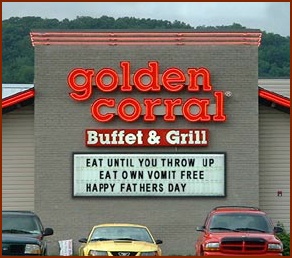
There is one topic that has received much study, and that’s of obesity amongst the nation’s poor. Shortly before I took my trip to Kentucky, I heard of the theory that the poor are more likely to be obese than the rich, primarily because of bad food choices in local restaurants and grocery stores. Our twisted application of agricultural policies coupled with the borderline unethical practices of the nation’s fast-food chains makes it cheaper to eat fatty, corn-syrupy garbage that will surely kill you, than to eat fresh vegetables and lean meats.
On my trip to Cumberland Gap, these two factors: bad food choices and competitive religion, threatened to steamroll me into oblivion. Hungry after hiking through the park, I headed to nearby Middletown, KY, for dinner. Choices were, of course, crap. Fast-food outlets and all-you-can-eat buffets as far as the eye can see. I hate buffets almost as much as I do fast-food outlets, they’re usually bland as hell and festooned with pasta, meatballs, over-fried chicken and mashed potatoes, not exactly healthy eating.
I finally sucked it up and headed to one (buffets beat out starvation, that’s for sure). I pulled into the parking lot … right behind a church bus carrying half a dozen 300-lb. Bible Baptists. I had to politely let them go first (I tend to avoid fire-and-brimstone moments as much as possible), and was worried there wouldn’t be much left for me. I headed to the salad bar, figuring it’d be totally avoided by the locals (it was), for a feast of brown iceburg lettuce & rock-hard cherry tomatoes. Mmmm, feast of champions.
Honestly, I managed to get a sizable dinner there, and survived the post-processing. I only had “firsts”, surely I looked like an outcast, one of them there rich folks that don’t likes fatty vittles. I didn’t care what they thought, I was confident I could outrun them all.
[I didn’t own a camera when I visited Cumberland Gap. All photos are, I believe, in the public domain. If you know any differently, please let me know and I’ll get the owner’s permission or remove them outright.]
[Special note to readers: I was contacted by http://chriscrawfordphoto.com/index.php about my use of one photo that belonged to him. I honestly don’t remember where I found that photo in the first place (this post is five years old), but I was clearly in the wrong and have removed the photo. My apologies to Mr. Crawford.]
====================================================================
Links:
Cumberland Gap National Historical Park
Frontline: Why Poverty Persists in Appalachia
Child Obesity in Poor Neighborhoods
Church Sign Generator
Google map to Cumberland Gap
 Cuyahoga is a park that preserves a small valley cut in the Appalachian Plateau. The Cuyahoga itself is a meandering river, most notable for a series of canals used as transport in the late 18th to early 19th century (before railroads took over). It’s nice that preservationists lobbied to protect this patch of river. I believe that we should strive to protect all natural areas (not just those with spectacular flora, fauna, or geology) wherever possible.
 But does government money spent on natural preservation count as “pork”? Many believe so. I don’t. See, I believe that natural preservation is the gift that keeps on giving. Natural lands help clean the air and water, and provide habitat for wildlife and plants. They also act as carbon sinks, something the world needs a lot more of right now. Parks also provide venues for recreation and a chance for urbanites and suburbanites to experience nature (something heavily needed in the manufacturing-laden cities of the Old Northwest Territories).
 Some, especially those who want to profit off land development, think these “benefits” are a crock of tree-hugging bullshit. It’s just getting in the way of progress and economic development. But think about it: do we really need to carve up more of our fields & woodlands? Do we really need to divert more rivers or fill in more swamps in the name of “economic development”? Take a look around: everywhere you travel, you see abandoned properties, empty factories, vacant strip malls. Do we really need to pave over nature to build more crap, when we have thousands, if not millions, of already-paved land just sitting there, doing nothing? Couldn’t we, shouldn’t we, redevelop these existing stains on the landscape for economic development? Do we really need to make new stains? That’s what I think is bullshit.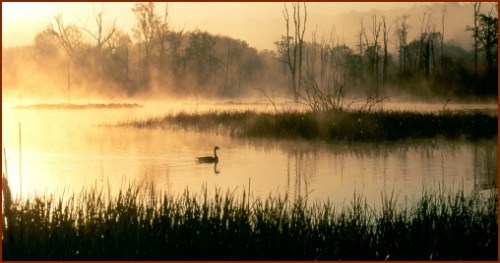


 America In Context