Feeds:
Posts
Comments

Barky Faces Death

I have traveled all over the country. I’ve hiked in forests and mountains and brush and swamps and beaches. I almost always hike alone, therefore I have to be very well prepared. I plan my trips carefully, carry the right gear, dress for the weather (current and potential), and stick to the trails. I’ve seen too many idiots hiking in flip-flops, and read too many stories of people getting lost in blizzards. There are many ways I may end up leaving this world, but dying in the wilderness due to unpreparedness, that’s not for me.

(c) 2007 Roger Hall www.inkart.net

At least, that’s what I used to think.

My trip to Arizona was the first time I took two consecutive weeks’ vacation and visited multiple park sites on a grand tour. I was excited, of course. Arizona would be great. It has the most NPS sites of any state in the country and, best of all, it has deserts! One of the great joys in touring this country is walking terrains one normally doesn’t see. New England is known for rolling hills, deciduous forests, urban jungles, and snow. There are no deserts in New England, and there probably won’t be any in our lifetimes, unless we initiate a global apocalypse or something. My trip to Arizona would be the first time I’ve ever walked in a desert.

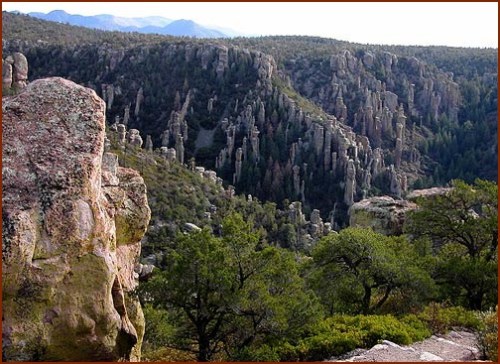
After weeks of planning, I landed in Tucson, checked into the hotel, and hit the sack. First on the list for the AM: Chiricahua National Monument, home of fantastic rocky spires, eons worth of erosional glory. I had plenty of water, salty snacks, light clothing, sunscreen, wide-brimmed hat, good shoes, and a dogged determination that I would walk at an uncharacteristically gentle pace, fully in line with the challenges of the environment. I hit the Echo Canyon loop trail (only 3.1 miles long, much shorter than my normal day hikes, again being cognizant of the heat) with great excitement.

(c) 2007 Roger Hall www.inkart.netAfter less than a mile on the trail (the downhill leg no doubt), I thought I’d die.

Something was seriously wrong. I was drinking enough water. I was pacing myself. I was just exhausted! I had never felt so bad walking on a trail in my life. I had to stop every 100′ and catch a breather. Nearly every step was a chore. I finally hit a point of near-panic when the thought hit my head: beautiful scenery be damned, I was going to die on this very trail. Here, thousands of miles from home, far away from family and friends, a stranger in a strange land, I was going to die. At least the next hiker would find me, perhaps my sunburnt corpse would be saved from the buzzards.

It was at that very moment that I heard the sound, a sound that I’ve only heard on television and in the movies …

Some time ago, I heard this theory: “There are two ways to hear a rattlesnake. If you hear it and see the tail, you have a story to tell your friends. If you hear it and see the head, no one will ever hear your story.”

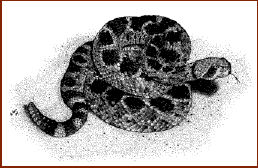
As you have undoubtedly guessed, I spotted the tail. It was about a foot from my left shoe, darting into some low shrubbery.
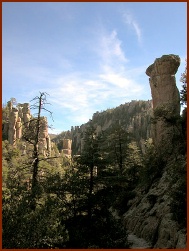
(c) 2007 Roger Hall www.inkart.netI think most people would have panicked. For some odd reason, I found this comforting. If my time was up, it would have been the head of that rattlesnake, not the tail, and I would be dead. I was not going to die that day, I was convinced of that. All that was left was getting my head back into the game and focus my attention on getting out of the bad situation.

Slowly I continued my way up the trail. Fortunately, the way back up was shady. It was still trouble going but, eventually, I plodded my way back to the rental car and headed to the hotel. A foot-long Subway sub and a gallon of water later, I hit the sack and slept 13 hours straight. I felt great the next morning, and headed to Fort Bowie, Saguaro, and all of the rest of the parks in Arizona without incident over the next two weeks.

It wasn’t until much, much later that it came to me. I live in Connecticut, mean altitude a whopping 500′ above sea level. Altitude at the entrance of the Echo Canyon Trail? 6,780 feet! Oof, no wonder I almost collapsed & died amidst the rocky spires of Chiricahua!

Nowadays, when I travel to high-altitude areas, I always take at least a full day to acclimate before taking to the trails. Fortunately, I’ve lived long enough to apply that hard-taught lesson.
(c) 2007 Roger Hall www.inkart.net

[I travelled to Arizona before I bought a digital camera. These pics are courtesy of, and used with permission of, Roger Hall at photography.inkart.net. He has nice photos of other NPS sites, I may ask him to use more in the future. But don’t just check out his photos, he does some really cool pen-and-ink scientific illustrations. Check them out at www.inkart.net. I hope he doesn’t begrudge me posting his western diamondback rattlesnake … I’ve actually ordered a copy for my den.](c) 2007 Roger Hall www.inkart.net
==================================================================

Links:

Chiricahua National Monument

Roger Hall Scientific Illustrations & Wildlife Art
Backcountry Advice from Retired Park Rangers

Google map to Chiricahua National Monument

Dull Is Good

Chickasaw, located in south-central Oklahoma, is part of the transition zone between eastern woodlands and the great plains, and contains campgrounds, hiking trails, horse trails, and the large, artificial Lake of the Arbuckles. Like Catoctin Mountain, Chickasaw is sparse on natural wonders and unremarkable in flora and fauna, but it serves a purpose in providing recreation to the hard-working folks of Oklahoma.

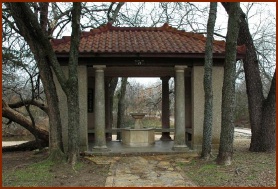
Black Sulfur Springs Pavilion -- Public Domain Photo Courtesy of National Park ServiceIt does have some funky natural springs. There’s something exotic in the geology of the area that causes half a dozen or so natural springs of differing qualities. Some are infused with sulfur (hence the name of the nearby town of Sulphur) and are therefore highly poisonous. Others have similarly nasty high levels of arsenic, or high levels of copper, or are perfectly safe mineral springs. For amateur geologists in the audience, the place is pretty interesting for these features. The Chickasaw Nation Native Americans saw the value of these springs soon after they were relocated from Alabama & Mississippi, and preserved it for decades before deeding it to the National Park Service.

Chickasaw NRA was originally called Platt National Park, which brings up a different topic. If one looks at the range of spectacular sites called National Parks, from the Everglades to Yellowstone to the Gates of the Arctic, most of them have truly spectacular vistas, abundant & rare wildlife, or grand natural features. But some preserved sites in the NPS, like Chickasaw, Catoctin Mountain, Cuyahoga Valley, and others, aren’t particularly grand or exciting. I’m sure it begs the question: why are these lackluster sites part of the National Park Service?

Travertine Creek -- Public Domain Photo Courtesy of National Park ServiceIn my opinion, one of the big problems with this country is its evolution from the United States of America to the United States of Generica. From sea to shining sea, almost without fail, you’ll see the same strip malls, the same chain restaurants, the same big box retailers. Even regional slangs & accents are starting to disappear, thanks to mass media. It’s nice in one way, you can travel across this whole country without getting into serious cultural trouble. But it has also made the country less interesting, blander, more vanilla.
Unfortunately, in a world of cookie-cutter cul de sacs, abusive irrigation, strip mining, and invasive plant species, the nation’s natural diversity is also at risk of “genericization”. People tend to want to preserve grandiose vistas, but aren’t particularly interested in preserving boring things like hardwood forests, meandering rivers, or expansive grasslands. These things are boring, so, why bother, right? Well, all of these things help keep America beautiful, keep it from becoming one great swath of vanilla blandness.

It’s nice that the people of Oklahoma can experience a natural blend of eastern deciduous forest and prairie grassland at Chickasaw. It’s nice to see the people of Maryland can experience a natural mountain forest at Catoctin. It’s nice to see the people of Ohio can experience a natural river ecosystem. Yes, these things aren’t particularly interesting to tourists, but they keep the country from truly becoming the United States of Generica in a natural sense. These sites act as anchors to the world as it used to be, and provide the variety our country needs.

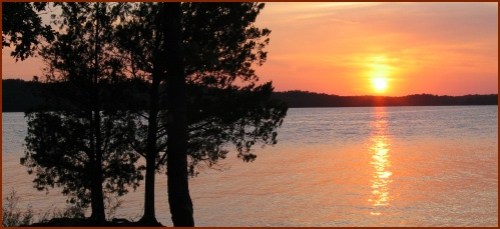
Sunset Over Lake of the Arbuckles -- Public Domain Photo Courtesy of National Park Service

[Sadly, I didn’t have a digital camera when I visited Chickasaw. Public domain photos courtesy of the National Park Service]

Links:

Chickasaw National Recreation Area

Chickasaw Indian Nation

Support Generica!

Google Map to Chickasaw

Mother Nature Gives a Sign

Imagine you’re part of a wagon train during the great westward migration. For days on end you’ve seen nothing but flat grassland prairie. You’re only marker on the trail is the rising and setting sun, and the North Star. You wonder if you’re even making any progress, of if you’ll even manage to keep your sanity amongst the boredom.

Suddenly, it looms before you. Chimney Rock, sticking straight up into the sky, visible for miles around. The first sign that the plains are ending, the first sign that the next phase of the journey – the crossing of the great Rocky Mountains – is coming. At least it represents change.

Chimney Rock © 2008 America In Context

The story of Chimney Rock is the story of westward migration, but (like most of the nation’s natural landmarks), it was also of sacred importance to the native people of the land. Then again, like almost everything else, that meant little to the newcomers, the white man. Just like the land and the environment, Chimney Rock was a cast-off on the way to prosperity, something to be used and then discarded. The sacred pillar was even used for target practice by army gunners during the Indian Wars, how’s that for a slap in the face?

When I see Chimney Rock, I don’t see the spire as a pointer to riches in California. I see the Great Nature Spirit giving us all the finger.

The Finger © 2008 America In Context

[A short post for a small site. Pics are mine & copyrighted thusly.]

Links:

Chimney Rock National Historic Site

Google map to Chimney Rock

An Independence Day Essay

This is going to come as no surprise to anyone who knows me, or to anyone who has read a few pages of this blog, but I love American history. Care needs to be taken, however. I am not a rabid “rah rah” American, parading myself around swathed in red, white & blue, attacking all critics and keeping myself oblivious to the dark side. I love American history because American history makes a great story.

Let’s take a look at what makes a great narrative. In my view, a great story revolves around a flawed main character. Typically, this is a person who constantly wrestles with any number of personal weaknesses. The story is the struggle, the struggle by a troubled soul to accomplish something meaningful in a troubled world. Sometimes the story ends happily, sometimes the story ends badly. The thrill is in the story. Can Joe Malfunction make it to his goal without destroying himself in the process?

Gadsden Flag

America is the perfect Joe Malfunction. It was founded on great principles: that absolute power is bad; that the people deserve a say in their government; that people, all people, have a fundamental right to life, liberty, and the pursuit of happiness. This was a wholly novel concept, especially applied on a scale as large as the original thirteen colonies. Never before have just principles such as these been applied across an area as wide and a population as large.

Betsy Ross Flag

But this character, the United States of America, is a flawed character. Right off the bat, America, our hero, had a slave problem to deal with. How does one proclaim one’s liberty whilst enslaving an entire race of man? With hypocrisy, that’s how. Slavery was the drunken, abusive father of Our Hero. Slavery would keep the country down, keep it weak, keep it from coming into its own greatness. The pressures of this chronic abuse would fester, and fester, until, like a teen-ager finally fighting back, America would explode during the great Civil War, leaving disastrous carnage in its wake. The old America would go through a painful puberty, beat the abusive father into submission, and become an honorable man.

Confederate Flag

But that was not the end of the story. Our hero struggled to get on his feet. America faced the difficult task of Reconstruction which, although horribly flawed and poorly implemented, would end with America facing the historic 1890s. This was adulthood, this was America finally trying to live up to the ideals on which it was founded. It made a lot of mistakes, including native American genocide and Jim Crowe, but blacks would vote, women would vote, economic prosperity would be wide-spread, and America would venture into the Great Unknown: the Industrial Age and the era of global influence.

38 Star Flag

Soon, our hero would face two great challenges. Like Scylla and Charybdis from The Odyssey, twin wars, one spawned from the other, would test the nation in ways not seen before. The horror of war, and inner reflections known as isolationism, proved to be a tremendous strain on the nation and the people within. But, like Odysseus, our hero would emerge from these trials almost unrecognized. America would emerge as a great superpower, a juggernaut both military and economic. Some would try to break America’s dominance, but none would succeed. In fact, most would, in the end, try to emulate Our Hero in any way they could.

48 Star Flag

But, like some great Shakespearean play, superiority begets arrogance, arrogance begets stagnation, stagnation begets weakness, and weakness begets defeat. Unchallenged, our hero turns slothful. He forgets there are still challenges out there, some of them even created by his own misdeeds. His actions (both just and unjust, for he is undoubtedly imperfect), come back to haunt him. New enemies are determined to bleed him in any way possible. He also has forgotten his own roots. He is slowly becoming the bullying father he shrugged off all those years ago, but his conscience, the voice of the people, still gnaws at him.

50 Star Flag

Today, that Great American Narrative continues. We know the story so far, but there are so many great unknowns. What will happen to Our Hero in the next chapter? Will America remember those principles on which it was founded, and reclaim its honor? Or will it become paranoid, trusting no one, damaging its friends and citizens until it falls at the hands of its enemies? Will it struggle through energy and economic hazards and emerge stronger than ever? Or will it succumb to its own unwillingness to change, and die a cruel death?

Future Flag?

Putting all metaphors aside, I think America has its problems. Some of its past is horribly dark and disturbing, and would make children weep if they knew the truth. But the United States was founded with the best of intentions, and its core, being the U.S. Constitution and its attendant Bill of Rights, is sound and noble and has set an example for democracies worldwide (even ones now better than our own). For that fundamental reason, even with its flaws, I love this country and am proud to be an American. I want the story to end well, I want our hero to succeed and live happily ever after.

So wave your flags and light your fireworks this weekend. Come Monday, help write the next chapter, guide Our Hero back on the right path, and maybe the story will have a happy ending.

Happy Independence Day, America!!

Independence Hall