Feeds:
Posts
Comments

Posts Tagged ‘George Washington’

Community College English 101

The Longfellow House in Cambridge is a beautiful, historic house. Built in 1759 in the Georgian style, it was originally occupied by Jamaican plantation owner John Vassall. A staunch loyalist, Vassall saw the writing on the wall and fled to England, just in time for George Washington to use it as headquarters during the early years of the Revolution. After the war, the house was purchased by Washington’s apothecary general, Andrew Craigie. His financial acumen was less than stellar, forcing his widow Elizabeth to take in boarders in 1819, including the soon-to-be-renowned poet Henry Wadsworth Longfellow. Later, Longfellow received the home as a wedding gift, and it stayed in the family or their trust until the entire building, its furnishings, and the grounds were donated to the National Park Service.
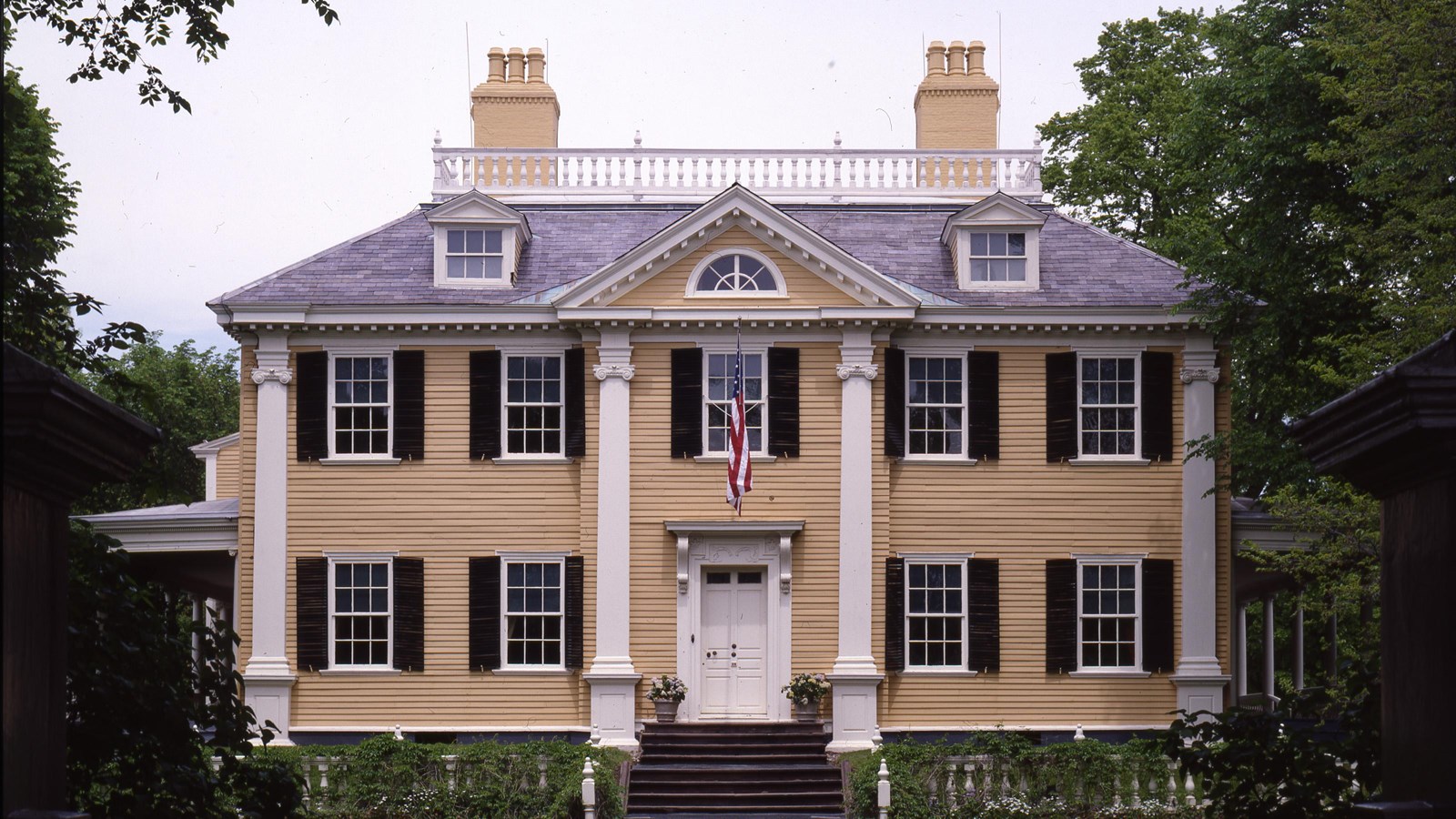
National Park Service photo

That’s all nice, but when I hear “Longfellow House”, I am reminded of my goofy college days.

My family was never particularly well-off. I was a sharp student, but we didn’t have the means to send me to college. So I took what I earned from part-time jobs and went to community college.

Springfield Tech was a good school with a solid electronics program. I already knew Ohm’s Law, Coulomb’s Law, and a variety of formulas and principles, so I had a bit of a head start. I loved those classes, the labs, mathematics, even physics (although it was taught by a professor I’m certain died three years prior).

Then came the dreaded mandatories. First day of first semester, when I had barely any understanding of what to expect, began English 101. I have long forgotten the name of the professor, but I’ll never forget his entrance. Tweed jacket and vest. Dignified salt & pepper beard. And a beret. Yes, a goddamned beret.

I don’t remember all of Professor Beret’s lessons, the one that sticks in my mind is our foray into Robert Frost. I’m talking about that old standby, which most kids learn in high school, “Stopping by Woods on a Snowy Evening”. The discussion came down to the old, self-wankery standby: “what does this poem mean to you?”

Me, being a bit overeager to discuss such heady topics in the presence of adults, instead of with a class full of hormonal teenagers, piped up with “well, a guy is evaluating his life choices. Shall he return to the life he knows, in comfort, or should he take another path, to see if he can become something special.”

“Um, no,” said Prof. Beret. “It’s about suicide.”

What? Well, apparently, if you decide to take that lesser-traveled path, you want to die by freezing to death …

Holy leaping Christ, what the fuck?

Anyway, that lesson tarnished me on poetry forever. I realized that not only do I not easily pick up on symbolism, but people who put poetry up on philosophical pedestals are fucking crazy.
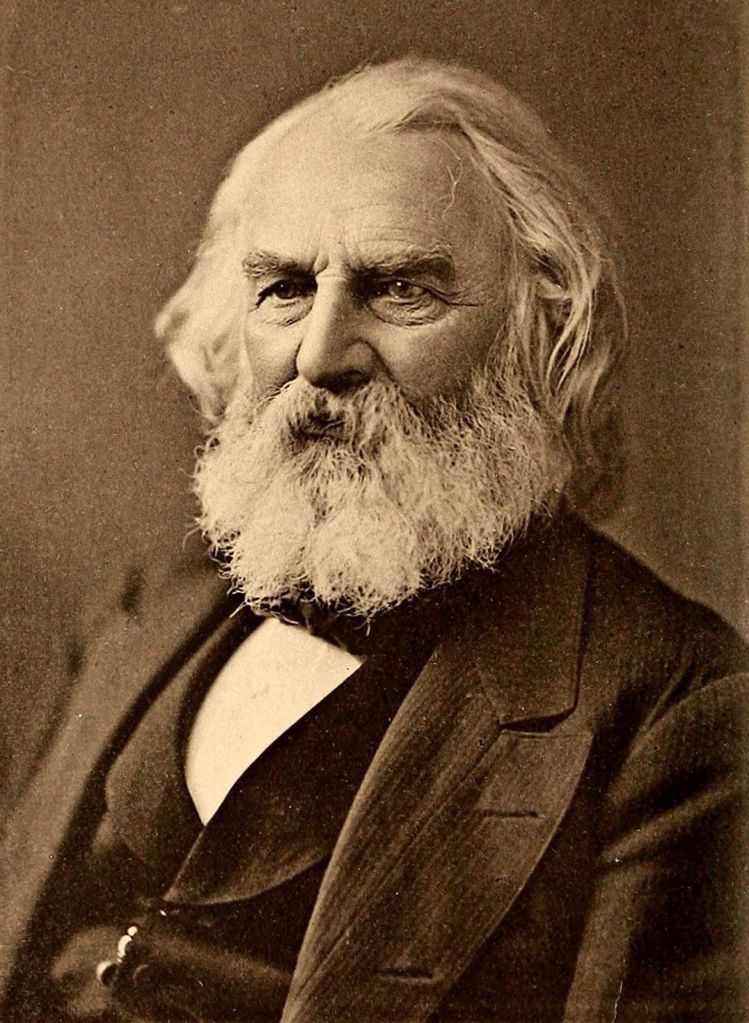
Brittanica.com

In preparation for this essay, I read many poems from Longfellow: The Complete Poetical Works. Most of his works are direct homages to nature and the art of living. There’s not a lot of deep symbolism, just well-structured odes, definitely tame by today’s standards. There’s no doubt he was big for his time, but now it’s all quaint recollections of seeing a shooting star and such.

I’ll leave you with one of my favorites:

The Burial of the Minnisink

On sunny slope and beechen swell,
The shadowed light of evening fell;
And, where the maple’s leaf was brown,
With soft and silent lapse came down,
The glory, that the wood receives,
At sunset, in its golden leaves. 

Far upward in the mellow light
Rose the blue hills.  One cloud of white,
Around a far uplifted cone,
In the warm blush of evening shone;
An image of the silver lakes,
By which the Indian’s soul awakes. 

But soon a funeral hymn was heard
Where the soft breath of evening stirred
The tall, gray forest; and a band
Of stern in heart, and strong in hand,
Came winding down beside the wave,
To lay the red chief in his grave. 

They sang, that by his native bowers
He stood, in the last moon of flowers,
And thirty snows had not yet shed
Their glory on the warrior’s head;
But, as the summer fruit decays,
So died he in those naked days. 

A dark cloak of the roebuck’s skin
Covered the warrior, and within
Its heavy folds the weapons, made
For the hard toils of war, were laid;
The cuirass, woven of plaited reeds,
And the broad belt of shells and beads. 

Before, a dark-haired virgin train
Chanted the death dirge of the slain;
Behind, the long procession came
Of hoary men and chiefs of fame,
With heavy hearts, and eyes of grief,
Leading the war-horse of their chief. 

Stripped of his proud and martial dress,
Uncurbed, unreined, and riderless,
With darting eye, and nostril spread,
And heavy and impatient tread,
He came; and oft that eye so proud
Asked for his rider in the crowd. 

They buried the dark chief; they freed
Beside the grave his battle steed;
And swift an arrow cleaved its way
To his stern heart!  One piercing neigh
Arose, and, on the dead man’s plain,
The rider grasps his steed again. 

=======================

Despite my difficulties with a certain English 101 professor, I did get a great education at that school.

Links:

Longfellow House National Historic Site

George Washington’s Revolutionary War Itinerary

Searchable database of Longfellow poems

Map to the Longfellow house

Read Full Post »

World War 0.1

I hate ignorance. I especially hate it in myself.

It’s one thing to not have all the facts, or to misinterpret the ones you have, or to not grasp the subtlety of a particularly complex situation. But to miss something important in its entirety, that’s ignorance. And to miss something important in your own chosen endeavor, that’s just negligence!

I went to Fort Necessity completely unaware of it’s significance. It was just a spot on a National Park Service map. I thought it had something to do with the Revolution or something. I was so undeniably, completely wrong, so utterly ignorant, it’s shameful. Fort Necessity, as it turns out, is probably the singular site in all the NPS that has truly global significance. This is a site that marks a minor event in American history, but a huge event in world history.

The events unfolded in this manner:

In the time before the American Revolution, England and France vied for the continent. England, of course, had the 13 original colonies along the Atlantic Ocean. France had her own territory, in the north along the Saint Lawrence Seaway and lakes Erie and Ontario, and a spot of land at the foot of the great Mississippi River known as Louisiana. England wanted to move into the interior, and France wanted to use the Ohio and Mississippi Rivers to connect Quebec and New Orleans. For years, the two great powers, with centuries of enmity between them, would dance around each other in the New World.

In 1753, the governor of Virginia heard the French built forts on the south shores of the two big lakes, on land England thought was hers. The governor sent a small squad, led by a young lieutenant, George Washington, to warn the French of their trespass. Washington found himself rudely rebuffed by the French.

In 1754, newly promoted Lt. Col. Washington led a small regiment to help defend a small English fort near the Ohio River, only to find the French had taken over and built their own. Washington’s regiment made camp, and the young colonel thought to engage local Seneca chief Half-King and convince the French to depart. It was meant to be a parlay, backed by a subtle threat of superior numbers and a home-field advantage.

To this day, it is unsure who fired the first shot. It is often debated, but in reality, it doesn’t matter. What matters is a shot was fired. A skirmish erupted, and the young colonel was victorious. Thirteen Frenchmen lay dead, 21 were captured and led back to Williamsburg.

Here is where the tales diverge. In America, we are told that Washington, realizing a counterattack was imminent, led his regiment back into the wild and built a small palisade called Fort Necessity. Unable to solidify alliances with the local Seneca and other Indian tribes, Washington’s 300+ men fought and were defeated by 700 French and Indian troops. Washington had no choice but to surrender and take his men back to Virginia. It would be Washington’s only surrender of his entire career. The French and Indian War, as Americans would come to know it, would be fought, and the French would be pushed out of North America.

In Europe, however, a totally different story is told. There, that ill-fated shot would be used as propaganda by both France and England to ratchet up tensions between the two European powers. The resultant battle between relatively small forces in North America would ignite a massive conflict on the European continent known as the Seven Years War. It was truly the first actual World War, involving many countries across Europe. On the one side, England and her allies (Prussia, Portugal, and some German states) would fight Austria, Sweden, Saxony and France. Russia, in typical fashion, would switch sides in the middle of the thing. Even the Dutch were involved when one of their own colonies was attacked in modern-day India.

This is the tale that Americans aren’t told. Hell, we’re barely taught anything about the French & Indian War! But the Seven Years War cost almost one and a half million lives. It redrew the map, not only in Europe and North America but even in Africa, the Carribbean, and the Indian subcontinent. It severely weakened France, factored in their decision to assist America in their battle for independence, and set the stage for the French Revolution. It ended the Holy Roman Empire entirely, and rose Great Britain to the role of the dominant maritime and colonial power in the world. They would rule large tracts of land from the southern tip of Africa through the Middle East to India, Australia, and Canada for two hundred years until a later World War would undo the effects of this first one or, as I call it, World War 0.1.

Fort Necessity taught me a lot about this period of world history, more than high school or college taught me. Americans aren’t taught this at all, except those who study third-year world history. It’s forgotten, lost, or simply uninteresting. I wonder if it’s ignorance or arrogance. Our own involvement in the Seven Years War was small, and when it did happen, we weren’t really America at that point, so in our eyes, it didn’t even matter. But there are events that happen outside of our cloistered continent that are important, even without us. We need to pay heed, observe and learn of those things outside of our borders (both borders of space and of time).

We are not the center of the universe. We are not even the center of the world. We cannot afford to pay attention to only those things that revolve around us.

[Pics on this post are mine and thusly copyrighted. More are here.]

===============================================

Links:

Fort Necessity National Battlefield

Seven Years War on Military History Online <– such an interesting site I added it to the blogroll

The British Empire Online

Google map to Fort Necessity

Read Full Post »