Premonitions
Ford’s Theater is one of those few true “shrines” in our country. It marks a spot of such profound tragedy in our nation’s history, it stands in an august group with Gettysburg, Pearl Harbor, and Ground Zero.
When I think of Ford’s Theater, what comes to my mind isn’t the figurative or literal theatrics of Lincoln’s assassination, but of the premonitions Lincoln himself had of his own death. Now I don’t believe in supernatural precognition (folks like Nostradamus, Edgar Cayce, Jeanne Dixon, and that freakish Jamaican hag from late-night TV make me want to vomit with force and intent), but I do believe folks who are trying to make a significant impact on the world know full well that someone, somewhere, is out to kill them for it.
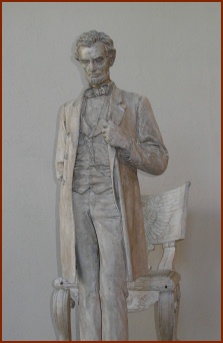 “About ten days ago, I retired very late. I had been up waiting for important dispatches from the front. I could not have been long in bed when I fell into a slumber, for I was weary. I soon began to dream. There seemed to be a death-like stillness about me. Then I heard subdued sobs, as if a number of people were weeping. I thought I left my bed and wandered downstairs. There the silence was broken by the same pitiful sobbing, but the mourners were invisible. I went from room to room; no living person was in sight, but the same mournful sounds of distress met me as I passed along. I saw light in all the rooms; every object was familiar to me; but where were all the people who were grieving as if their hearts would break? I was puzzled and alarmed. What could be the meaning of all this? Determined to find the cause of a state of things so mysterious and so shocking, I kept on until I arrived at the East Room, which I entered. There I met with a sickening surprise. Before me was a catafalque, on which rested a corpse wrapped in funeral vestments. Around it were stationed soldiers who were acting as guards; and there was a throng of people, gazing mournfully upon the corpse, whose face was covered, others weeping pitifully. ‘Who is dead in the White House?’ I demanded of one of the soldiers, ‘The President,’ was his answer; ‘he was killed by an assassin.’ Then came a loud burst of grief from the crowd, which woke me from my dream. I slept no more that night; and although it was only a dream, I have been strangely annoyed by it ever since.” — A. Lincoln
Now this is, indeed, creepy, but it’s not evidence of the paranormal. Lincoln knew full well that he was waging a war against fellow Americans, a war that not everyone in what remained of the Union supported. He knew that he was violating folks’ rights, that Sherman was burning great swaths of farmland in Georgia and the Carolinas, that hundreds of thousands of draftees were laying dead on the fields from Monocacy to Vicksburg. And he knew that someone, or many someones, wanted him dead. Even though he was doing the right thing, he was stomping on somebody, and that somebody would kill him. How sadly accurate his premonition turned out to be.

A while ago, I listened to an interview of comedian Chris Rock, of Saturday Night Live fame. He’s a brilliant comic. Rough-edged and provocative, to be sure, but brilliant nonetheless (or, perhaps, because of). He clearly rattles cages, but he also makes people think about race, and class, and stupidity, and of other topics equally truthful but irritating. He told the interviewer (and I’ll paraphrase): “when I became famous, I figured I’d be dead.” Not because of drug overdose like other SNL alums like John Belushi or Chris Farley, but because someone would shoot him.
Isn’t that terrible? And I’m sure he’s not the only famous entertainer or politican who thinks that. How many duly-elected Representatives or Senators actually wondered “will I get shot today” when they went to all those raucous “health care town hall” meetings? I would question the sanity of any of them who didn’t think that. And why would they be shot? For trying to give more people health insurance? For being the target of an astro-turf uprising orchestrated by talk radio and billionaire media moguls with their own, selfish, ratings-raising axe to grind?
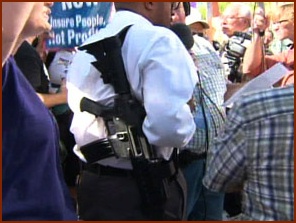
It’s a sad state of affairs in this country that folks of vision (whether philosophical or political or economic or medical or scientific) can be intimidated into submission or silence not by the power of persuasion or debate or fact-driven decision making, but through threats — real or imagined — of force from the very populace they’re trying to reach. Is this what we have become? Is this what the great democratic experiment has wrought? A society where thoughts and efforts to improve the lot of the nation is met with violence? Are the recent events simply a blip, a blemish on the soul of the country, or are we heading down a steep slope to Somalian anarchy?
Lincoln, of course, didn’t back down. He continued on a path he knew was right. He paid the ultimate price for it. But although the aftermath was rocky, the nation reunited, got on its feet, and became the most powerful nation the world has ever seen.
But now, I wonder. Was it really worth it?

[I don’t have many good pics of Ford’s Theater, so I didn’t post any. All of these are from public domain sources.]
===================================================
Links:





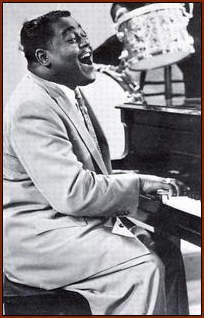
 I love the place, absolutely love it, loved it from the beginning. I was there during the opening, 8-hour concert on Labor Day weekend in 1995, where I saw everyone from Chuck Berry to Johnny Cash to Dr. John to Aretha Franklin to Iggy Pop. That was a fantastic experience. The next day I saw James Brown sauntering through the crowd, surrounded by some of the biggest, scariest bodyguards imaginable, on his way into the Rock Hall. I’ve been back several times since, and love it more and more every time I go. For me, it goes beyond being a fan of rock music. My love of rock & roll dovetails nicely into my love of American history.
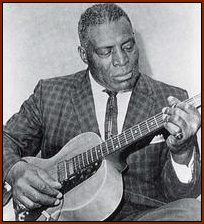
 Rock & roll is uniquely American because of it’s “origin story”. Rock’s primary grandfather was The Blues. Political correctness aside, The Blues was the black man’s music. It’s basically a lament about hard times and suffering set to a quick-paced but rough tempo. The Blues was fostered in a segregated South and derives directly from music sung by plantation slaves. This is Part I of why Rock is uniquely American, it’s the only positive thing to ever come out of our slaveholding past. Without the caustic cauldron of atrocity known as antebellum slavery, and the emotional agony of Jim Crow, the genetic material of The Blues would not have been created. No Blues, no Rock.
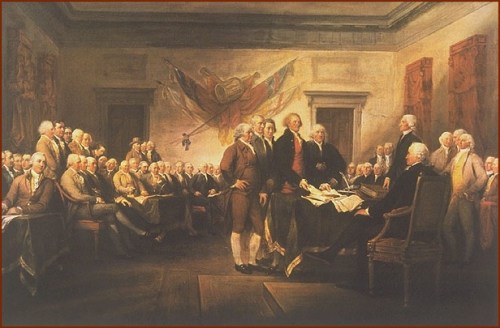
 Then there’s Jazz. Jazz, in my view, represents the independent American mentality applied to music. People wanted to play what they wanted to play, and wanted to hear what they wanted to hear. It’s improv, blending, mixing things up, and doing what you want. It’s throwing away musical convention, just like we threw away monarchial convention. We tossed out the King and made our own government, then we tossed out musical conformity and made our own Jazz. It’s the Declaration of Indepence set to music.
 Rock has then been changed and modified and altered by so much more since then: the injustice of the Vietnam War draft, the poverty of inner cities, the rebellion of angsty white suburbanite teens, plus America’s penchant to abuse mind-altering substances …. All of these things are, again, uniquely attributable to the U.S. and the unique mix (or train wreck, if you prefer) of our culture.


