An Independence Day Essay
This is going to come as no surprise to anyone who knows me, or to anyone who has read a few pages of this blog, but I love American history. Care needs to be taken, however. I am not a rabid “rah rah” American, parading myself around swathed in red, white & blue, attacking all critics and keeping myself oblivious to the dark side. I love American history because American history makes a great story.
Let’s take a look at what makes a great narrative. In my view, a great story revolves around a flawed main character. Typically, this is a person who constantly wrestles with any number of personal weaknesses. The story is the struggle, the struggle by a troubled soul to accomplish something meaningful in a troubled world. Sometimes the story ends happily, sometimes the story ends badly. The thrill is in the story. Can Joe Malfunction make it to his goal without destroying himself in the process?

America is the perfect Joe Malfunction. It was founded on great principles: that absolute power is bad; that the people deserve a say in their government; that people, all people, have a fundamental right to life, liberty, and the pursuit of happiness. This was a wholly novel concept, especially applied on a scale as large as the original thirteen colonies. Never before have just principles such as these been applied across an area as wide and a population as large.

But this character, the United States of America, is a flawed character. Right off the bat, America, our hero, had a slave problem to deal with. How does one proclaim one’s liberty whilst enslaving an entire race of man? With hypocrisy, that’s how. Slavery was the drunken, abusive father of Our Hero. Slavery would keep the country down, keep it weak, keep it from coming into its own greatness. The pressures of this chronic abuse would fester, and fester, until, like a teen-ager finally fighting back, America would explode during the great Civil War, leaving disastrous carnage in its wake. The old America would go through a painful puberty, beat the abusive father into submission, and become an honorable man.

But that was not the end of the story. Our hero struggled to get on his feet. America faced the difficult task of Reconstruction which, although horribly flawed and poorly implemented, would end with America facing the historic 1890s. This was adulthood, this was America finally trying to live up to the ideals on which it was founded. It made a lot of mistakes, including native American genocide and Jim Crowe, but blacks would vote, women would vote, economic prosperity would be wide-spread, and America would venture into the Great Unknown: the Industrial Age and the era of global influence.

Soon, our hero would face two great challenges. Like Scylla and Charybdis from The Odyssey, twin wars, one spawned from the other, would test the nation in ways not seen before. The horror of war, and inner reflections known as isolationism, proved to be a tremendous strain on the nation and the people within. But, like Odysseus, our hero would emerge from these trials almost unrecognized. America would emerge as a great superpower, a juggernaut both military and economic. Some would try to break America’s dominance, but none would succeed. In fact, most would, in the end, try to emulate Our Hero in any way they could.

But, like some great Shakespearean play, superiority begets arrogance, arrogance begets stagnation, stagnation begets weakness, and weakness begets defeat. Unchallenged, our hero turns slothful. He forgets there are still challenges out there, some of them even created by his own misdeeds. His actions (both just and unjust, for he is undoubtedly imperfect), come back to haunt him. New enemies are determined to bleed him in any way possible. He also has forgotten his own roots. He is slowly becoming the bullying father he shrugged off all those years ago, but his conscience, the voice of the people, still gnaws at him.

Today, that Great American Narrative continues. We know the story so far, but there are so many great unknowns. What will happen to Our Hero in the next chapter? Will America remember those principles on which it was founded, and reclaim its honor? Or will it become paranoid, trusting no one, damaging its friends and citizens until it falls at the hands of its enemies? Will it struggle through energy and economic hazards and emerge stronger than ever? Or will it succumb to its own unwillingness to change, and die a cruel death?

Putting all metaphors aside, I think America has its problems. Some of its past is horribly dark and disturbing, and would make children weep if they knew the truth. But the United States was founded with the best of intentions, and its core, being the U.S. Constitution and its attendant Bill of Rights, is sound and noble and has set an example for democracies worldwide (even ones now better than our own). For that fundamental reason, even with its flaws, I love this country and am proud to be an American. I want the story to end well, I want our hero to succeed and live happily ever after.
So wave your flags and light your fireworks this weekend. Come Monday, help write the next chapter, guide Our Hero back on the right path, and maybe the story will have a happy ending.
Happy Independence Day, America!!

 People tend to forget that old battles, battles before mechanized cavalry, helicopters, spy satellites, and unmanned drones, were all about terrain. Old strategies involved taking the high ground, controlling mountain passes, utilizing waterways for transportation and defense, and sneaking to the enemy’s position in the gloom of the morning fog. Entire wars from ancient Thermopylae to Pacific Ocean island hopping in World War II involved strategic uses of terrain to overwhelm and defeat an enemy.
 I’m not going to recount the entirety of the battles surrounding Chickamauga and Chattanooga, there are resources out there that would do a far better job than I ever could. I will say these battles definitely revolved around the lay of the land, and actually being there brings that “eureka” moment. You can read in a book that Union soldiers raced up the slope of Lookout Mountain to chase out the Confederates, but actually going there, and seeing that side of Lookout Mountain is more of a cliff than a slope, really drives the point home that these soldiers were strong, and tough, and committed, and quite amazing. The feats these men (on both sides of the conflict) are truly mind boggling.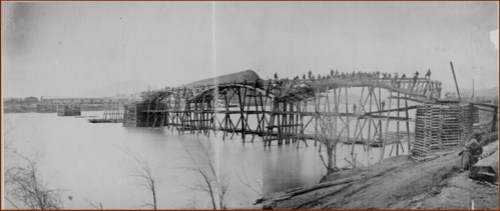
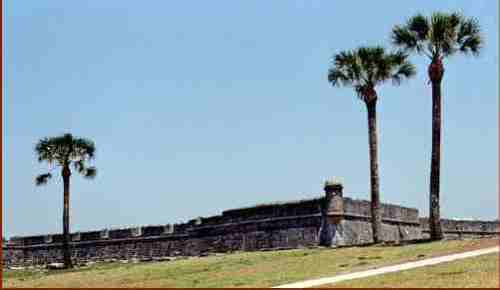
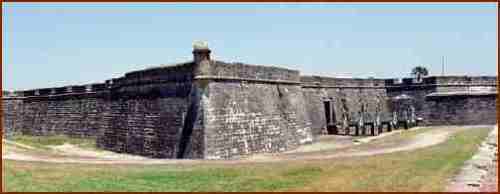
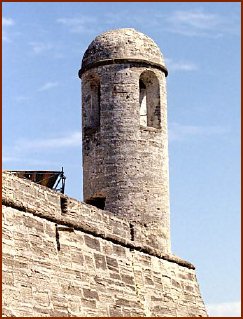 Castillo de San Marcos is right on the waterfront in beautiful St. Augustine, Florida. St. Augustine is a great little city: clean, green, properly developed (meaning neither a dead city nor a frenzy of strip malls). The day I visited was a beautiful, clear day, and I was in a terrific mood. I was on my long, one-way drive from Palm Beach County, Florida, back to New England, beloved land of my birth. I had lived in Florida for over two years, and I just never fit in.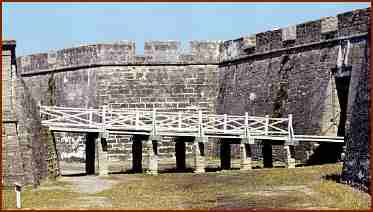
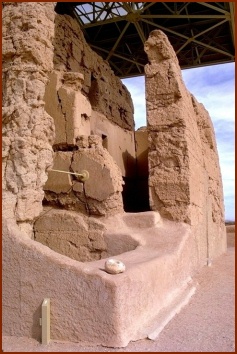
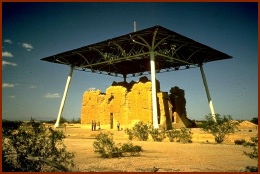 When I was a boy, I remember seeing pictures of the Casa Grande Ruins in my school textbooks. It would be in the American pre-history section, the “time before the Pilgrims” when the native tribes ran the place. Back then, I found it bizarre that a modern pavilion had been built over the ruins. The textbooks would talk about the great adobe homes of the early tribes, but they’d never, ever mention this canopy. The pictures were a bizarre mix of old and new that made no sense.
 There was a story on NPR this week about German castles. See, most of the great castles in Germany were destroyed in World War II. Now that Germany is back from the brink of destruction, they find they miss their castles. So they are in the process of re-building their old castles from scratch to house … shopping malls. Oh yes, there’s historical context for you. “And here, the Earl of Salzburg would enjoy an Orange Julius while his daughters leered at the 12-foot, half-naked himboes plastered on the windows of Abercrombie & Fitch.”


 America In Context
