Feeds:
Posts
Comments

Posts Tagged ‘history’

Book Review

There was only one topic I wanted to discuss in a blog post on Jimmy Carter, and that was how a Presidency could fail. It is as important, if not more so, to study failure as it is to study success. I scoured Amazon & Google for books on the Carter presidency, hoping to find a treatise on how it went so wrong.

Unfortunately, I found myself knee-deep in the right-wing hate machine. Boy, how conservatives use the failings of Jimmy Carter’s presidency as as a way to prop up their own agendas. Book after book after book is set up to just drag the 39th president through vitriol-laden mud, leaping to grandiose conclusions about “character” and “socialism”. Here’s a man, a guy who truly cares about people, whose character is almost above reproach (especially compared to most politicians), treated so harshly by such an abundance of writers, all to “prove” how right-wing ideals are just so great for this country …

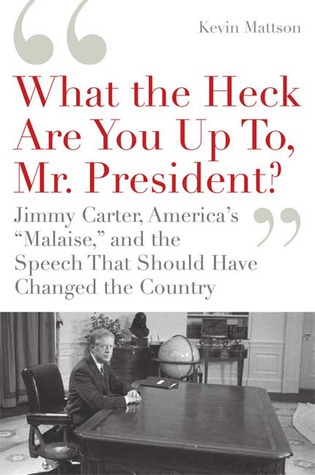
Mattson Book

Anyway, before I get too high on my political soapbox, I eventually came across “What The Heck Are You Up To, Mr. President?” by Kevin Mattson. His book isn’t an analysis of the entire Carter presidency, but it is an insightful piece on the infamous “malaise speech” of 1979. Through interviews and research, he assembles not just a narrative on the crafting of the speech, but a collage of the various bad decisions leading up to it. It’s not hateful, or condescending, or serving some personal agenda. It is a fair analysis, a decent read, and, in my opinion, helpful for anyone studying not just the Carter presidency, but leadership in general.

Unbiased, analytical approaches to contemporary political events are rare. They do exist, though. You just have to dig a little deeper to find them.

——————–

Kevin Mattson at Ohio University

Read Full Post »

Failures in Leadership

When it comes to posting about Jimmy Carter — Nobel Peace Prize winner, home builder, human rights advocate, international statesman — I could have gone in many directions. In light of his recent cancer diagnoses, I could have focused on his positive, post-1980 accomplishments, and may have gotten a lot of positive comments and referrals. Instead, I feel compelled to talk about his greatest failure: his leadership during his tenure as the 39th President of the United States.

Before I go on, I have to say it’s really unfair for me to criticize others for poor leadership. I have practically no leadership abilities at all. I’ve proven time and time again that this is a skill or talent that I simply do not possess, and almost every attempt I’ve made to take leadership of anything has been a fairly abysmal failure. However, I think I can recognize good leadership when I see it. I’ve known a lot of good, and even great, leaders personally, and through careful observation of their methods, I think I have a fair bead on what makes a good leader. I’ve also known a lot of horrible leaders, and am fairly certain I know what poor leaders lack.

Any post criticizing Jimmy Carter would also be unfair if it did not include a disclaimer statement about “level of difficulty”. Carter was elected President in 1976, a period of great internal strife in the U.S. President Nixon resigned in disgrace in 1973. America’s most divisive and most embarrassing confrontation — the Vietnam War — ended in 1975 with the Fall of Saigon. The Cold War’s nuclear arms race was well into its fearful Mutually Assured Destruction phase. Inflation was at a troubling 12%, and the nation was in a depressing funk barely masked by the revelries celebrating our nation’s 200th birthday. Carter was entering into a losing proposition, it would take immense skill to turn the ship of state around.

A_SENIOR_CITIZENS'_MARCH_TO_PROTEST_INFLATION,_UNEMPLOYMENT_AND_HIGH_TAXES_STOPPED_ALONG_LAKE_SHORE_DRIVE_IN_CHICAGO..._-_NARA_-_556256

Yeah, times were GREAT!

Unfortunately, Jimmy Carter, during his tenure as President, was a pretty poor leader.

Of course, that’s not particularly insightful. Folks have been saying this for 35 years, Jimmy Carter has taken quite a bashing from all sides since 1980. If he hadn’t been so successful in his post-Presidential career, he’d be nothing but an entry on a list between Martin Van Buren and Calvin Coolidge: barely remembered unless you went to Carter High School or your commute took you over the Carter Bridge. I’m glad he went on to do great things after his presidency, he’s probably one of the most ethical men to ever hold the office, and he deserves better than a minor footnote in a history textbook. So how did an otherwise good man fail to be an effective leader?

In my opinion, one event, more than any other, illustrates exactly why Carter was such a bad leader as President. That event was his infamous Malaise Speech, delivered to the nation via broadcast television on July 15, 1979. This was a speech that, although initially receiving a favorable reception by the American people, would go down in infamy as the worst speech ever given to the nation by a seated President. This was a speech that would become so reviled, it not only resulted in the loss of the White House to the Republicans in 1980, it most certainly caused the death of American progressive politics.

But wait, something here doesn’t quite compute, does it? How could a simple speech ruin a Presidency and kill a political movement? Speeches are nothing, really, just air exiting through a larynx, magnified by microphones and amplifiers. Most people, even then, rarely listen to political speeches, and of those who do, few even remember anything about them. Throughout American history — over 400 years if you include the colonial period — only half a dozen or so political speeches (“The only thing we have to fear is fear itself”, etc.) have entered into the national consciousness. It’s certain that dozens upon dozens of Presidential speeches quite literally sucked, full of triteness and pandering and even lunacy. Did any of them derail a presidency?

No, and this speech, itself, did not derail Carter’s. What killed his presidency, and what marked Jimmy Carter as a terrible leader during that phase, was he felt that the nation actually needed a speech to solve its problems. That was the fundamental mistake, the fundamental error, the fundamental misunderstanding of leadership that Carter had during that period. What he did was deliver a speech as the solution, rather than delivering a speech to communicate the solution. 

Not a great idea.

Not a great idea.

So many people in positions of authority try this tactic. These folks think that they can inspire people by words. They’ve heard the lore of those half-dozen cool American speeches, or have seen Patton, Braveheart, Henry V, or even Independence Day, and think “ooh, that’s what I need to inspire my troops, a good speech!” Well, no, nothing can be farther from the truth.

My first encounter with a real leader was my Boy Scout scoutmaster. He was a quiet, soft-spoken guy. I can’t remember his speaking voice, honestly. But all the kids loved him because he did stuff. We always had stuff to do, every meeting was full of activities, and our camping trips were chock-full of things to do. His job moved him to second shift, and we got a new scoutmaster. That one was a chatty guy, and the absolute worst scoutmaster. Activities dropped, camping trips dropped, and I dropped Scouts entirely.

Later, I worked at an apple orchard. The owner was not necessarily soft spoken, but he was a great guy. He motivated us to work hard, not through his words, but because he was a hard working guy. If you were employed by him, you would be ashamed to be a slacker because he worked so hard.

I would see other good leaders who displayed good leadership because they loved what they did, or they took the time to teach those under them, or they took bold moves, or they were simply good at their job. They were leaders because they did stuff, not because they talked about stuff. It’s not even about caring for your people — there is no doubt that Jimmy Carter cared about the American people — it’s about recognizing that doing is a prerequisite to leading. 

If Carter had focused more on getting things done as President, he could have made all the crappy speeches in the world and no one would have cared. But he felt the people needed a speech, and history has proven that was a bad choice. Fortunately, Mr. Carter would go on to do plenty of good things in his post-Presidential career, and now he is well respected by many. But for one, brief time, when it was needed the most, he had the wrong idea of what true leadership actually is.

Well, maybe I stand corrected.

Well, maybe I stand corrected.

==============

I didn’t bring my camera when I visited the Jimmy Carter National Historic Site. All photos used in this post are public domain and hosted on Wikipedia Commons.

Jimmy Carter National Historic Site

Character Above All Essay on Jimmy Carter

Jimmy & Roslyn Carter Work Project at Habitat for Humanity

Google Map to JCNHS

Read Full Post »

Concepts of Time

When Lewis and Clark left St. Louis to explore the Great Frontier:

It’s only been 210 years since they set off. In the grand scheme of things, that’s pretty tiny. But look at everything that’s happened.

  • The country: Nearing 320 million
  • The population center is now actually west of Missouri, showing the great expansion of the country and the migration of her people.
  • New York City: 7 million
  • St. Louis: 300,000, and the city has existed so long it’s actually decaying (like all the other great industrial cities)
  • About three hours from Boston to New York if you’re a stodgy driver.
  • A couple more to fly to London
  • You can drive across the entire country in just a few days, or fly over it in about six hours or so.
  • But really, who cares? With Skype, you can talk to someone across country instantaneously. No reason to go anywhere.

It’s hard to fathom sometimes how quickly things have changed, and how much has happened in a measly 200 years.

Courtesy National Park Service

Courtesy National Park Service

Go to St. Louis. See the Gateway Arch. It’s way cool.

===============================

Jefferson National Expansion Memorial

Visionaries with Courage (Video)

Some Gateway Arch photos taken by the masses

Google map to the Gateway Arch

Read Full Post »

Book Review: DARK HORSE: The Surprise Election and Political Murder of President James A. Garfield

The last few years have been a bit rough. Between home improvement projects, a near-career meltdown, and some (albeit minor) health problems, I’ve not only been away from blogging, but I’ve been away from my favorite hobbies. I allowed other, less interesting facets of my life to distract me from the things I love doing: traveling the National Parks and reading books on American history.

Various physical and financial barriers are easing up, and I hope to resume traveling in earnest when spring comes. In the interim, I knew I needed something to rejuvenate my reading. Unfortunately, the next subject for my blog — the home of James Garfield, 20th President of the United States — didn’t seem too promising. I knew very little about the man, and few people discuss his life or presidency. He’s all but forgotten, like a pointless tchotchke in America’s attic. I feared I would be in for another dull read. I still haven’t finished my densely boring pick for the French & Indian War. I wasn’t looking forward to a repeat of that.

I surfed around the Amazon store, and found Ken Ackerman’s Dark Horse. It had decent reviews, but I still wasn’t too confident in my selection, simply because of the subject matter.

I aDark Horsem immensely thankful I was proven wrong. Dark Horse was an excellent selection.

What Ackerman did with Dark Horse is something I really enjoy. Instead of focusing on every trivial tidbit about Garfield’s days in some ramshackle schoolhouse, Ackerman tells the important story: the sequence of events that set Mr. Garfield, tragically, on a path to his own assassination. Ackerman tells the story of Garfield’s surprising nomination and eventual election to the highest office of the land, including all the backroom dealings of allies and foes, and how a delusional slob would use factional loyalty as an excuse to commit murder. Ackerman takes all the items important to the narrative, and to the development of the characters involved, and weaves the story as a story, not as a lecture. This makes a topic as seemingly banal as Garfield’s assassination and makes it actually riveting.

Sure, this is no John Grisham novel. This is history, and history rarely lives up to Hollywood panache. But Ackerman did a great job telling the tale as it truly occurred. I am very grateful I picked this book to rejuvenate my hobby, it was exactly what the doctor ordered. I already have my next selection for my next historically-themed post on my Kindle.

So thanks, Mr. Ackerman. You’ve helped a hobbyist regain his motivation.

Read Full Post »

« Newer Posts - Older Posts »