Feeds:
Posts
Comments

Posts Tagged ‘National Parks’

Coolest Name in the National Park Service

My quest to visit all the National Park sites was inspired partly by grade school science textbooks. I remember all those iconic pictures of Old Faithful, Mount McKinley, the Smoky Mountains, and, of course, Craters of the Moon. The very name evokes fascination in 11-year-old science geeks everywhere: what sort of environment exists in that part of Idaho that earned it the coolest name in the entire National Park Service: Craters of the Moon? It’s not only mentioned in a geologic context, it’s also a place where NASA trained Apollo astronauts and moon rovers for decades. We’re talking a major attraction for science and history geeks here!

Lava Piles © 2008 America in ContextCraters of the Moon is a huge expanse of ancient volcanic lava flows and cinder cones. This type of stuff is pure gold for East Coasters like myself. Here, east of the Mississippi River, is the “old continent”. The weathered Appalachians are some of the oldest mountains in the world, and don’t change too much anymore. No earthquakes, no volcanoes, no change in millions & millions of years, other than the slow erosion of wind and water. Great place for coal mines, lousy place for geologic excitement.

The western part of the country, on the other hand, is terrific. The Pacific plate is still grinding alongside the North American plate, the Rocky Mountains are still pushing skyward, the Great Basin uplift continues, and the Yellowstone hotspot drifts ever so slowly towards the east coast. Craters of the Moon is evidence of this activity. It was the Yellowstone hot spot 8-15 million years ago, and within the park itself are lava flows from volcanic eruptions between 15,000 and 2,000 years ago, well preserved due to the low rainfall in Idaho’s high desert region.

Ghost Tree © 2008 America in ContextDriving & hiking around craters is groups of coolness. You can walk across miles and miles of lava flows, explore numerous vents and tunnels underground, and scramble around rocky cinder cones, mini-volcanoes spurting up like blackhead acne on a 14-year-old. It’s truly a rugged, alien landscape, reminiscent of countless sci-fi movies where Our Heroes are abandoned on some godforsaken hunk of rock to fend for themselves. There is little doubt why NASA tested Apollo mission gear here: few terrains are as uninviting in the United States as Craters of the Moon National Monument. Throw in the heat and lack of precious water, and you’re talking one of the most dangerous tracts of land in the Lower 48. Well, it would be if it weren’t for the well-paved park roads and the close access to State Highway 20, no more than 30 minutes away from the closest Denny’s and their Heart Attack on a Plate Steak-n-Eggs Scrambler….

In my travels, there are moments of great satisfaction when I finally visit a site from those old grade school textbooks. Craters of the Moon was one such moment. It was, indeed, groups of cool.

Cinder Cones © 2008 America in Context

[Pics on this post were taken by the blog owner and are copyrighted thusly. Do not reuse without permission. See my other Craters pics here].

====================================================================

Links:

Barky's Lava Buddy © 2008 America in ContextCraters of the Moon National Monument (check out this cool animation)

Idaho’s Great Rift Zone

University of California Berkely’s Plate Tectonics page

Google map to Craters of the Moon

Read Full Post »

A Welcome Respite

Sure, there’s some historical significance to the Coronado National Memorial. Famed Spanish explorer & would-be conqueror, Francisco Vázquez de Coronado, entered the present-day United States nearby in 1540. But the great thing about Coronado is its role as an oasis.

Now before I go any further, let me say that I really liked Arizona. It was my first big state tour west of the Mississippi, and I really loved that trip. There’s an awful lot to see and do, it’s really a beautiful state. But it is freakin’ hot.

Bob Thompson MountainComing from the cool Northeast, I had a really hard time adjusting to the blast furnace of southern Arizona (see my post on Chiricahua). Saguaro is a desert, Organ Pipe is the hottest spot in America, and Tucson and Phoenix are scorching blacktop heat islands. But Coronado was great. It’s situated on the northern side of the Sierra Madre, meaning it doesn’t get the full blast of the sun. The ground is also moister than the rest of the state, probably because of the mountains and the geological implications of the water table. The place is quite cool and surprisingly lush. A stop at Coronado is a welcome respite for those circling through Arizona’s national park sites.

The park’s HQ has some antique chain mail on display, the rainfall has created a wet cave up the slope (reminiscent of Gollum’s lair in The Hobbit), and there are some enjoyable, windy roads through the nearby mountains (I advise a sunset drive, really beautiful views abound). Just don’t pick up any hitchhikers….

I know, it doesn’t sound particularly exciting. But it is a nice change of pace.

[I didn’t own a digital camera when I visited Coronado. Pic courtesy of the National Park Service.]

Links:

Coronado National Memorial

Coronado’s Exploration into the American Southwest

Coronado Trail Scenic Byway

Google map of Coronado

Read Full Post »

9/11, Patriotism, and the Spirit of America

The events of Sept. 11, 2001, were horrible. I don’t know about the rest of you, but 9/11 threw me into a state of grief I had never encountered before. Honestly, at one point that very afternoon, I stepped out of the building, sat at a nearby picnic table, put my head in my hands, and cried. Tears of pure grief. I had never felt real grief before. Yeah, I had lost family members, including my grandfather, a man I deeply admired. But those were expected deaths, deaths resulting from a life long lived. 9/11 was a complete shock, a true tragedy, and different from anything I had ever seen before.

Firefighter & Flag

The terrorists attacks upon the World Trade Center and the Pentagon, and the foiled Flight 93 attack, killed 3000 people. It was the greatest loss of life in a single day on American soil due to conflict since Antietam. But I was not in grief solely because of the horrible loss of life, or of the families torn apart, or of the resulting economic turmoil. I was in grief because I felt I was witnessing the beginning of the end. Nations and civilizations can fall because of great tragedies. Would 9/11 be the catalyst for the collapse of the Great American Experiment? This is what I felt I was witnessing: the defeat and collapse of the country I loved.

For the first time in my lifetime, America had been directly attacked. Not one of our outposts, not some ship in a foreign port, but one of our own cities. And not just one of our cities, but our greatest city. And not just attacked, but brutally and savagely with devastating effect. Just what the hell was happening? Have our decades of choices since WWII been so misguided that a huge segment of the world – namely 900 million Muslims – wants to destroy us? How did we go so wrong? Would our decadent and irresponsible society recover? Could our incompetent leadership handle this tragedy properly and put us back on the right path? This was my state of mind in the aftermath of 9/11: doubt, discouragement, grief.

Washington QuoteI had already made my plans to visit park sites in Virginia and North Carolina in the fall of ’01 when 9/11 happened. Of course, I had to go through with my trip. Even though my faith in the country was shattered, hiding in the basement was clearly not the answer. I had dear friends flying to Hawaii for their honeymoon, I couldn’t be a coward and stay home. So, grief-stricken and all, I packed up and headed south.
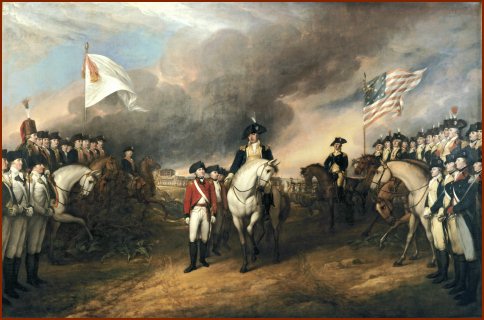
Colonial National Historical Park was one of my first stops on that swing through the South. It’s the home of the famous Yorktown Battlefield, where the Revolutionary War was settled in 1781. I was twitchy during the entire drive from Connecticut. By then the planes were flying again, and I found myself startled every time I heard a jet engine. Was it crashing into a building?? I found myself alarmed whenever the radio cut out. Did terrorists take out a radio tower (many New York-area radio stations went off the air during the WTC attacks)?? The worst moment was when I saw a group of Muslims sitting & talking in a pavilion near the Colonial visitor’s center. They made me nervous & suspicious, clearly a prejudicial reaction of which I am not proud.

Surrender of Lord Cornwallis

Now normally, I revel in the history of our national park sites. I’ll go through all the displays, do as many trails as I can, investigate the terrain and surroundings, try to internalize the significance of the events at hand. At Yorktown, I clearly went through the motions, lost in a fog of my post-9/11 funk. It was a beautiful fall day, the peak of autumn colors, bright blue skies, but I was just wandering around, avoiding the public, just roaming the grounds. But I did manage to notice a few people in a field, clearly interested in something in the skies up ahead.

There, above a field, near the very site where Cornwallis surrendered to Washington, giving Americans their freedom, circled two bald eagles.

There’s a lot to be said about symbolism. Psychologists, archaeologists, writers, artists, Madison Avenue marketing experts and politicians study and leverage the power of symbols on a daily basis. Symbols can sway opinions, change moods and can even affect the course of a nation. Powerful symbols can affect the most intelligent, pragmatic folks, and even impact the cynical and the jaded (although they are loathe to admit it). Never underestimate the power of a well-placed and well-timed symbol.

Bald EagleBald eagles were not common in Virginia. Their numbers are improving (in fact there’s been a great resurgence of the species) but they were still fairly rare in the southern Eastern Seaboard. Yet there they were, just circling around above the field, clear as day in the bright, blue sky.

I don’t know if it was the symbolism of the bald eagle circling a site of such great historical significance, or if the coolness of seeing such beautiful birds in an area where they are rare, or if it was just something different to snap me out of my funk, but whatever it was, I felt better after that point. Later I realized that we managed to keep this country together for more than 200 years, through some really tough times, and although 9/11 was terrible, it really didn’t crush the country. We’d recover.

In the years since 9/11, we’ve had a tough time of it. We had some bad governance, went down some really dark paths, but I’m convinced (perhaps especially in light of the recent election) that we’ll get out of this. I still have faith in the Great American Experiment, even though we’ve been sidetracked by events external and internal. The great, extinct nations of the past died because of stagnation, but here we have a chance to change our direction every election cycle. The eagles of Yorktown mirror that belief: once on the brink of extinction, the great birds have rebounded because we changed our direction. Our decisions to ban DDT and provide bald eagle habitat saved the species. If we can do that, we can also make the choice to change our direction and save the country. That gives me great optimism.

Not to say I’m not still jaded and cynical, I guess I’m just optimistically jaded and cynical. 😛

Banner

[I didn’t own a digital camera when I visited Colonial NHP in 2001. All pictures are, I believe, in the public domain.]
Links:

Colonial National Historical Park

A Collection of Post-9/11 Essays (not all of which are endorsed by AiC)

Recovery of the Bald Eagle

Google map to Colonial NHP

Read Full Post »

I have returned!

Just got back from a two-week jaunt to New Mexico (with a few side trips to Arizona & Texas). Another 18 National Park Service sites down!

I hit NM at a great time: temperatures were mild but still pre-snowfall, and the aspens and alders were ablaze with golden color. Haven’t been through my pictures yet, but I’m expecting some fantastic shots.

If there is an overriding theme of New Mexico parks, it’s ‘historic tribal life in the shadow of extinct volcanoes’. Cliff dwellings are carved into the ash piles of ancient volcanoes. Petroglyphs are carved into well-patinaed volcanic rocks. Trading roads criss-cross waterless lava fields. Natural flint mounds, formed from the pressures of hot ash, form the basis of Indian economies.

From a wide view, New Mexico represents what this blog is all about: forces of nature directly lead to forces of society. One cannot separate the natural world from humanity, and, when you throw in the effects of Spanish exploration and conquest, one cannot separate one segment of humanity from another. Events a million years ago lead to events 2000 years ago lead to events happening yesterday. Only when you put all these elements together, in context with one another, do you truly understand America.

This trip also re-energized my interest in America’s National Parks, and I hope to be posting regularly again soon. 🙂

Read Full Post »

« Newer Posts - Older Posts »