Feeds:
Posts
Comments

Posts Tagged ‘Native Americans’

Peace, Quiet and Thought

I’ve said this before, but I love visiting the Great Plains. There’s something about the vast open spaces, the capacity to see for miles and miles, that frees my mind from the cluttered inanity of the world. Having a broad field of vision in the physical world leads to having a broad field of vision in the metaphysical world. OK, fine, that last sentence was a bit over the top. I’m just fishing for fancy ways of saying “open spaces make me feel better”.
New England, much as I love it, tends to be a bit claustrophobic. The hills, mountains and forests restricts field of vision; the constant clamor of a high population density clutters the mind with noise. There ends up being so much noise, so much distraction, it’s hard to stay focused on a task, think through life’s bigger challenges, or simply sit and listen and appreciate a moment in time. Clarity and depth of thought requires personal space and lots of it; the lack of such space clutters the mind like the spare room of a chronic hoarder.

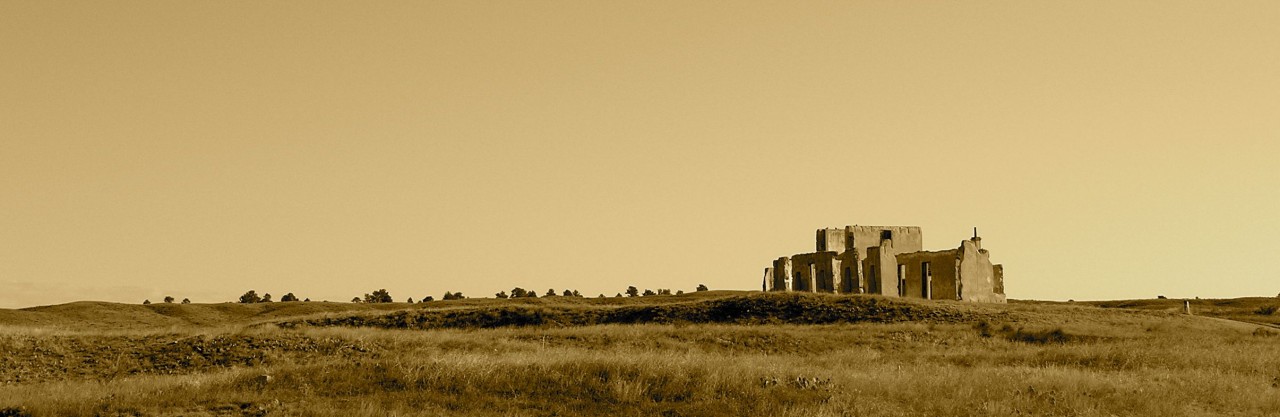
Eastern Wyoming (where Fort Laramie sits) is vast, open, and sparsely populated. It’s so easy to find peace and quiet, to be alone with one’s thoughts. This lends itself to observation, contemplation, and (yes, I’ll say it) spiritual reflection. Even the chronic prevailing winds of the western plains assist. A good, stiff wind in your face cleanses the soul like a sand-blaster cleans painted brick. Wide open spaces and weather: these are a few of my favorite things.

Add in historic Fort Laramie, with its crumbling brick facades, you find yourself reflecting on the past. Like most historic sites west of the Mississippi, Fort Laramie is part and parcel of Native American history, in this case the history of Indian suppression. A visit there makes one specifically reflect on that part of America’s past.

I feel like I could type forever, spewing forth my thoughts about the tragic conflict between the tribes of the Americas and the white settlers. I’d make a blog post so massive and unreadable it’d go down in the annals of bad web content forever. Instead, let me just give a short list of some observations I made at Fort Laramie and similar sites across the country:

  • Did you ever notice that great swaths of the Plains cleared of Indians by the U.S. Army are still pretty empty?
  • Did you notice that people are actually moving out of rural areas in the midwest? Depopulation of the plains has been going on for some time now.
  • Did you know that much of the land taken from tribes was given to cattle ranching? Did you notice that overconsumption of beef is now deemed a health hazard, and current factory-style, corn-fed beef production is considered bad for the environment?
  • Did you notice that family farms, another beneficiary of U.S. Indian relocation policies, are dying out and being replaced by corporate farming concerns that no one seems to like?
  • Have you noticed that California, the “promised land” for wagon trains and railroads, is, well, kind of a mess right now?
It’s been well over a hundred years since the government’s longstanding programs effectively nullified the Indians as a resistance movement and nearly eradicated tribal culture completely. But now, after all this time, I think the question needs to be asked: was it really worth the price?
Playing “what if” games is rarely productive. Nothing can undo what was done, and Monday-morning quarterbacking has as much value as Monopoly money. But maybe, hopefully, we can take the lessons we learned and teach them to others who sit along a similar precipice we sat upon in our expansionist phase. You don’t need to extinguish a competing culture or civilization to succeed and grow. In fact, it’s quite likely it leads to an opposite result.

[The pictures on this blog entry are mine and copyrighted thusly. More are here.]

============================================================

Links:

Fort Laramie National Historic Site

Change of Heartland: The Great Plains

Holy Cow: The Wide Impact of Eating Red Meat

Google map to Fort Laramie

Just for the heck of it, I added a picture of a bunny….

Read Full Post »

A Touch of Imagination

The traveler scrambled down the banks of Siphon Canyon. It wasn’t much of a canyon, really, more like a gully. It was the end of the dry season, but the creek still meandered between its banks. The traveler headed into that gully for a reason: it was far cooler in the shade of the ash, willow & mesquite trees fed by the perpetual, life-giving waters of the spring at the head of the creek.

It was that famed spring the traveler sought. Once he reached that spot, he would head east towards his destination. But a shadow in the trees moved in the wrong direction. There was something up ahead, blocking the path. Small eyes stared past a broad snout, straight at the traveler. The two, the wild boar who belonged, and the unarmed man who did not, locked gazes. One would react with instinct, the other needed to react with thought or risk being gored. This far from civilization, that would not be a good outcome.
——————————————————–

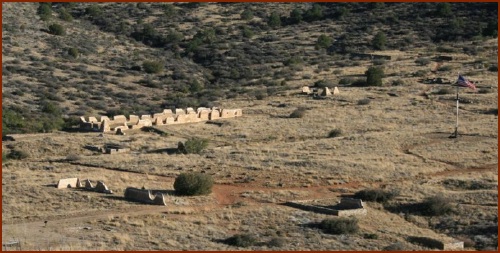
It was dry up on the knoll, far to the east of the creek and spring. That’s where they built these forts back in the day: the inevitable filth from dusty soldiers couldn’t pollute the only reliable water supply. Despite the dry, hot air, there seemed to be a mist, a spectral haze, hovering over the ruins. The entire place was eerie. The air was still, not a leaf was blowing. There was no sound beyond the traveler’s own breathing. No squirrels were shuffling leaves in the woods, no birds were twittering in the trees. Even the ground was heavy, the traveler barely kicked up any dust as he wandered through the ruins.

The ruins themselves were downright ghostly. The remnants of adobe walls, white and rounded from decades of wind and monsoons, dotted the area like mournful apparitions. Nothing of substance grew on the pathways. Life, it seemed, wanted nothing to do with this place. This was a place of evil, a staging area for mayhem, conflict, abuse, and genocide. This was a place used by one people for the subjugation of another, used by the powerful to forcibly take the land and lifestyle from another. Now, the very place murmurs out a mournful “why?”, but of course, there’s no one to listen. No one but a lone traveler who briefly bows his head and continues on to his next destination.

——————————————————–

I’m a firm believer in imagination, and in my view, there’s no better place to exercise one’s imagination than in the varied sites of the National Park System. Let’s face it, some of the sites are pretty lame: a four-room loft in a Philadelphia townhouse, an old steel foundry in a sleepy Massachusetts suburb, a forgotten fort in an unspectacular chunk of Arizona. A little imagination goes a long way in such places.

One can imagine the past and try to reconstruct how people lived and thought in days gone by. One can imagine the future by applying old lessons to today’s situations. Fort Bowie’s remoteness and appearance encourages imagination, perhaps the plot for some third-rate fantasy novel or Peter Jackson film project. Because of this, Fort Bowie is one of my favorite National Historic Sites.

Imagination is good. Exercise it from time to time. And take a trip out to remote Fort Bowie.

[Sadly, I didn’t own a digital camera when I visited Fort Bowie. Pics are public domain from the University of Arizona and a neat site I stumbled upon: Fort Wiki.]

==================================================

Links:

Fort Bowie National Historic Site

Fort Wiki

The Capture of Geronimo

Google map to Fort Bowie

Read Full Post »

G, A, F, (octave lower) F, C? B flat, C, A flat, (octave lower) A flat, E flat!!

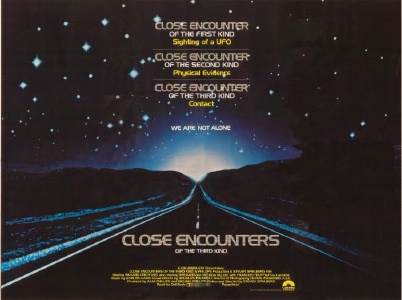
In 1977, I was twelve years old, smack-dab right in the middle of the target audience for a blockbuster movie. A movie about two people whose mundane lives are interrupted by visitations from extraterrestrial beings and the government conspiracy to cover it up. Close Encounters of the Third Kind was a huge experience for me back then. Mega-huge!!! I was all over those ads with the bright light at the end of the deserted highway. “Close encounters of the first kind: visual sighting. Close encounters of the second kind: physical evidence. Close encounters of the third kind: CONTACT!”.

Close Encounters Poster © 1977 Columbia Pictures

Oof, cue the chills down the spine! The posters, the collectible cards, all that sweet, sweet geeky goodness. Ambrosia! It’s almost as if Steven Spielberg woke up one morning and said “Hmmm, I think I’ll write a movie that’ll appeal to that scrawny kid with the Coke-bottle glasses from Western Massachusetts.”  I was all over that film like stink on roadkill. A couple of years later, we were one of the first houses in town to get cable TV, and my dad bought all the pay channels. I watched Close Encounters 18 times in one month, and was damned proud of myself for it!

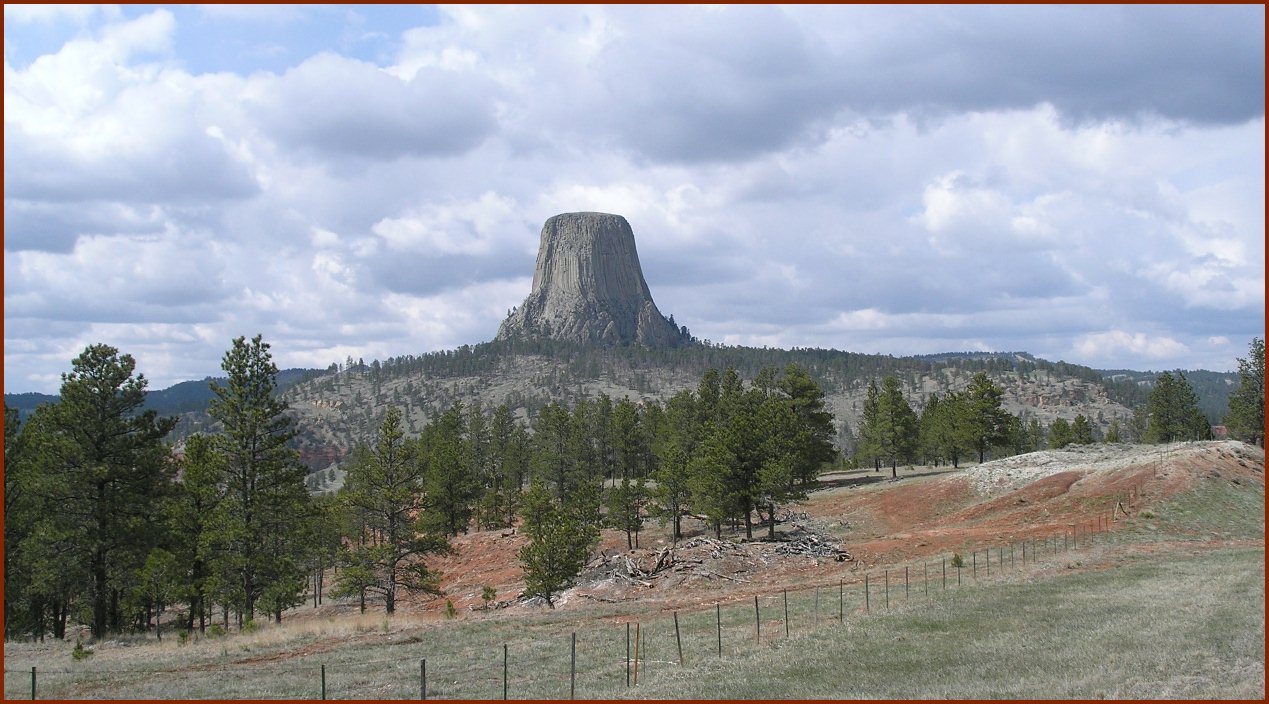
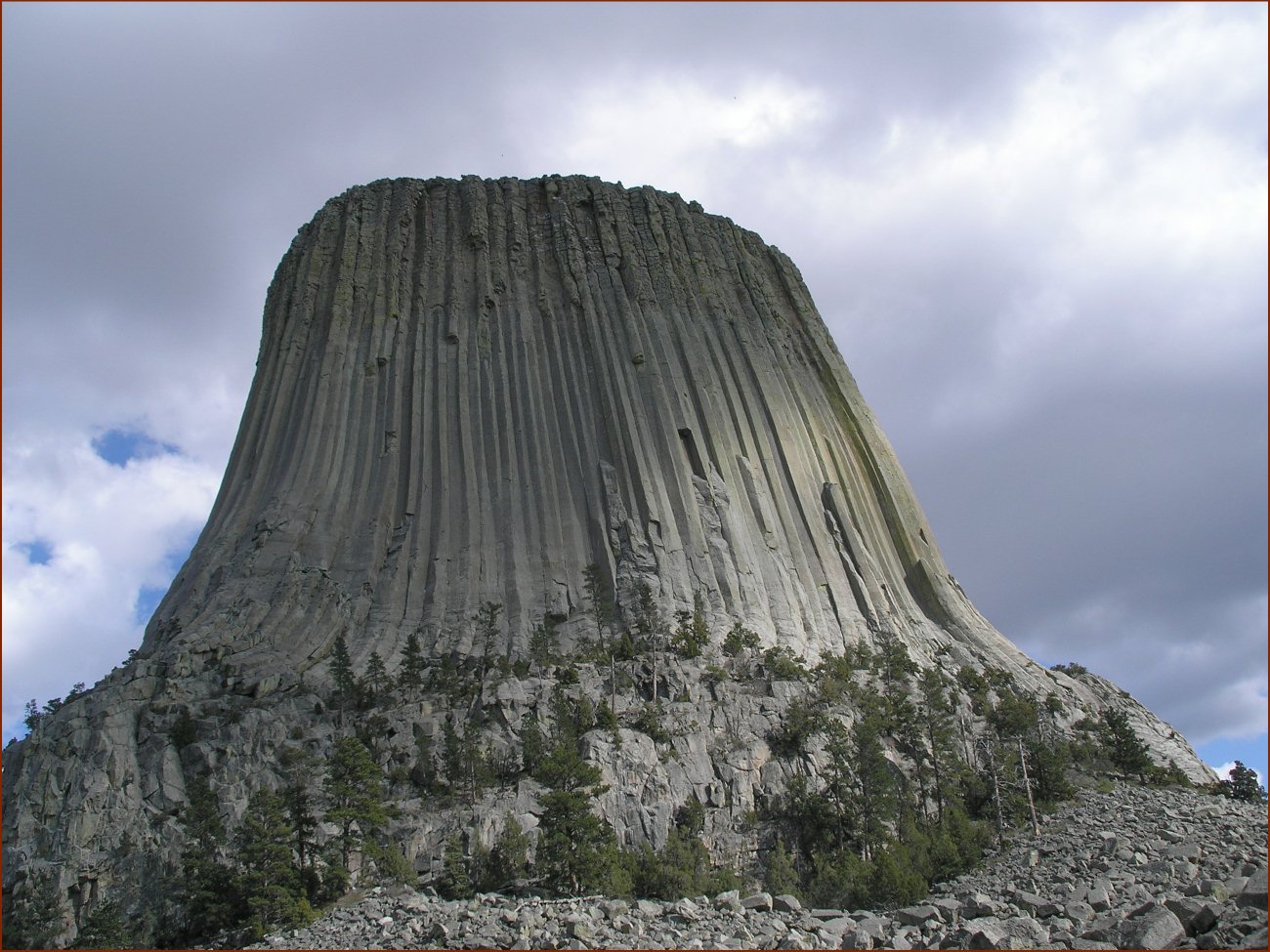
You can be damned sure that visiting Devils Tower (no apostrophe, contrary to popular belief) was high on my list of must-see sites in the National Park Service. And when I rounded that corner of State Highway 14 and saw that great monolith sticking out of the low eastern Wyoming hills, I was as giddy as a 12-year-old boy in a movie line the night of the big premier (after months of soaking in shameless & targetted Hollywood promotion). I’m actually glad I was alone, I could just revel in the giddiness without apologizing to anyone. Yes, ladies and gentlemen, it was a pure geek fantasy come to life, and I was enjoying every rapturous moment of it!!

Tower and Clouds © 2009 America In Context

Devils Tower is truly a wonder to behold, even if you’re not into movies. It’s an enourmous volcanic extrusion that not only towers above the surrounding countryside but seems so alien to that landscape. It looks like it doesn’t belong, it’s like those Sesame Street clips: “one of these things is not like the other ones…” It’s almost as if those extraterrestrials placed it here millions of years ago as a signpost: “Gateway to the Stars — Free Anal Probes to the First 10,000 customers.”

A Shadow Passes © 2009 America In ContextIt’s easy to see how mankind has marvelled at it since the Bering Land Bridge first allowed humans to cross into North America. It’s held special significance to Native Americans for hundreds of years. The Cheyenne, the Arapaho, the Lakota Sioux, the Eastern Shoshone, and many other plains tribes revered the spot, and gave it names such as “Bear’s Lodge”, “Tree Rock”, and “Mythic Owl Mountain”. To this day, their descendants return to Bear Lodge for ceremonies and to tie prayer offerings to the trees.

Later, when European settlers and their descendents crisscrossed the west looking for furs, or gold, or a path to the Pacific, they gave it the dramatic name “Devils Tower”, and eventually the greatest environmental president, Teddy Roosevelt, signed the law protecting it as America’s first National Monument. How could you not?? To this day, I have yet to see a natural wonder of such singular, unique stature in the United States.

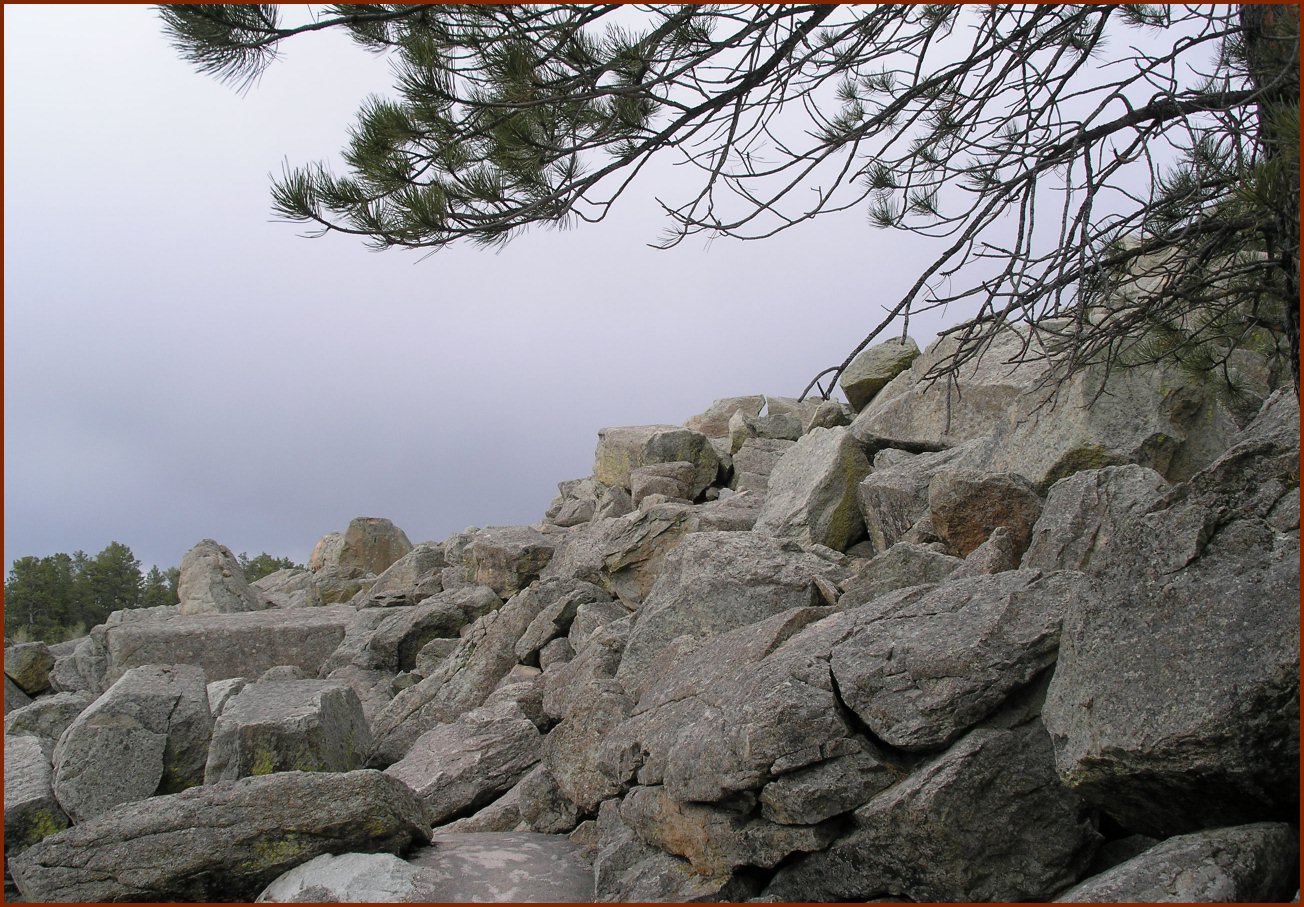
rock-scrambleNowadays, people think of Devils Tower and think of Spielberg’s film, and I guess that’s OK too. A nation’s culture is defined by its arts, and in America’s case, our arts is really defined by our films. So I’m cool with the fact that this great wonder of nature has been immortalized by a blockbuster movie and not by the simple fact that it’s so fascinating.

Of course, some people can’t separate film from reality: when I came back to tell folks of my visit, a lot of people asked “did you see any aliens when you were there?” Um, well, no, that was a movie. But I did dream up a sequel to Close Encounters called Close Encounters: The Return, wherein the extraterrestrials come back to Earth and return Richard Dreyfuss. “Please, take him back. His liberal politics and sappy, pedantic movies are ruining our culture!”

I don’t see that appealing to any 12-year-old kids.

Departure © 2009 America In Context

[All photos, except the Close Encouters poster, are mine and thusly copyrighted. Please do not use without my permission. More of my Devils Tower pics are here.]

=======================================================

Links:

Devils Tower National Monument

Close Encounters of the Third Kind on IMDB

Lakota Archives: Bear Mountain

Google map to Devils Tower

Read Full Post »

Mother Nature Gives a Sign

Imagine you’re part of a wagon train during the great westward migration. For days on end you’ve seen nothing but flat grassland prairie. You’re only marker on the trail is the rising and setting sun, and the North Star. You wonder if you’re even making any progress, of if you’ll even manage to keep your sanity amongst the boredom.

Suddenly, it looms before you. Chimney Rock, sticking straight up into the sky, visible for miles around. The first sign that the plains are ending, the first sign that the next phase of the journey – the crossing of the great Rocky Mountains – is coming. At least it represents change.

Chimney Rock © 2008 America In Context

The story of Chimney Rock is the story of westward migration, but (like most of the nation’s natural landmarks), it was also of sacred importance to the native people of the land. Then again, like almost everything else, that meant little to the newcomers, the white man. Just like the land and the environment, Chimney Rock was a cast-off on the way to prosperity, something to be used and then discarded. The sacred pillar was even used for target practice by army gunners during the Indian Wars, how’s that for a slap in the face?

When I see Chimney Rock, I don’t see the spire as a pointer to riches in California. I see the Great Nature Spirit giving us all the finger.

The Finger © 2008 America In Context

[A short post for a small site. Pics are mine & copyrighted thusly.]

Links:

Chimney Rock National Historic Site

Google map to Chimney Rock

Read Full Post »

« Newer Posts - Older Posts »