Feeds:
Posts
Comments

Posts Tagged ‘Pennsylvania’

World War 0.1

I hate ignorance. I especially hate it in myself.

It’s one thing to not have all the facts, or to misinterpret the ones you have, or to not grasp the subtlety of a particularly complex situation. But to miss something important in its entirety, that’s ignorance. And to miss something important in your own chosen endeavor, that’s just negligence!

I went to Fort Necessity completely unaware of it’s significance. It was just a spot on a National Park Service map. I thought it had something to do with the Revolution or something. I was so undeniably, completely wrong, so utterly ignorant, it’s shameful. Fort Necessity, as it turns out, is probably the singular site in all the NPS that has truly global significance. This is a site that marks a minor event in American history, but a huge event in world history.

The events unfolded in this manner:

In the time before the American Revolution, England and France vied for the continent. England, of course, had the 13 original colonies along the Atlantic Ocean. France had her own territory, in the north along the Saint Lawrence Seaway and lakes Erie and Ontario, and a spot of land at the foot of the great Mississippi River known as Louisiana. England wanted to move into the interior, and France wanted to use the Ohio and Mississippi Rivers to connect Quebec and New Orleans. For years, the two great powers, with centuries of enmity between them, would dance around each other in the New World.

In 1753, the governor of Virginia heard the French built forts on the south shores of the two big lakes, on land England thought was hers. The governor sent a small squad, led by a young lieutenant, George Washington, to warn the French of their trespass. Washington found himself rudely rebuffed by the French.

In 1754, newly promoted Lt. Col. Washington led a small regiment to help defend a small English fort near the Ohio River, only to find the French had taken over and built their own. Washington’s regiment made camp, and the young colonel thought to engage local Seneca chief Half-King and convince the French to depart. It was meant to be a parlay, backed by a subtle threat of superior numbers and a home-field advantage.

To this day, it is unsure who fired the first shot. It is often debated, but in reality, it doesn’t matter. What matters is a shot was fired. A skirmish erupted, and the young colonel was victorious. Thirteen Frenchmen lay dead, 21 were captured and led back to Williamsburg.

Here is where the tales diverge. In America, we are told that Washington, realizing a counterattack was imminent, led his regiment back into the wild and built a small palisade called Fort Necessity. Unable to solidify alliances with the local Seneca and other Indian tribes, Washington’s 300+ men fought and were defeated by 700 French and Indian troops. Washington had no choice but to surrender and take his men back to Virginia. It would be Washington’s only surrender of his entire career. The French and Indian War, as Americans would come to know it, would be fought, and the French would be pushed out of North America.

In Europe, however, a totally different story is told. There, that ill-fated shot would be used as propaganda by both France and England to ratchet up tensions between the two European powers. The resultant battle between relatively small forces in North America would ignite a massive conflict on the European continent known as the Seven Years War. It was truly the first actual World War, involving many countries across Europe. On the one side, England and her allies (Prussia, Portugal, and some German states) would fight Austria, Sweden, Saxony and France. Russia, in typical fashion, would switch sides in the middle of the thing. Even the Dutch were involved when one of their own colonies was attacked in modern-day India.

This is the tale that Americans aren’t told. Hell, we’re barely taught anything about the French & Indian War! But the Seven Years War cost almost one and a half million lives. It redrew the map, not only in Europe and North America but even in Africa, the Carribbean, and the Indian subcontinent. It severely weakened France, factored in their decision to assist America in their battle for independence, and set the stage for the French Revolution. It ended the Holy Roman Empire entirely, and rose Great Britain to the role of the dominant maritime and colonial power in the world. They would rule large tracts of land from the southern tip of Africa through the Middle East to India, Australia, and Canada for two hundred years until a later World War would undo the effects of this first one or, as I call it, World War 0.1.

Fort Necessity taught me a lot about this period of world history, more than high school or college taught me. Americans aren’t taught this at all, except those who study third-year world history. It’s forgotten, lost, or simply uninteresting. I wonder if it’s ignorance or arrogance. Our own involvement in the Seven Years War was small, and when it did happen, we weren’t really America at that point, so in our eyes, it didn’t even matter. But there are events that happen outside of our cloistered continent that are important, even without us. We need to pay heed, observe and learn of those things outside of our borders (both borders of space and of time).

We are not the center of the universe. We are not even the center of the world. We cannot afford to pay attention to only those things that revolve around us.
[Pics on this post are mine and thusly copyrighted. More are here.]

===============================================

Links:

Fort Necessity National Battlefield

Seven Years War on Military History Online <– such an interesting site I added it to the blogroll
The British Empire Online

Google map to Fort Necessity

Read Full Post »

Is It Time?

How long does it take for an event to move from the present into history?

I’ve listened to a lot of talks by a lot of historians. It never fails, someone will inevitably ask “how will history look back on the the events of today?” And historians almost always give the same reply: “well, we won’t know until enough time has past. Future historians will have to judge.” Yadda yadda yadda.

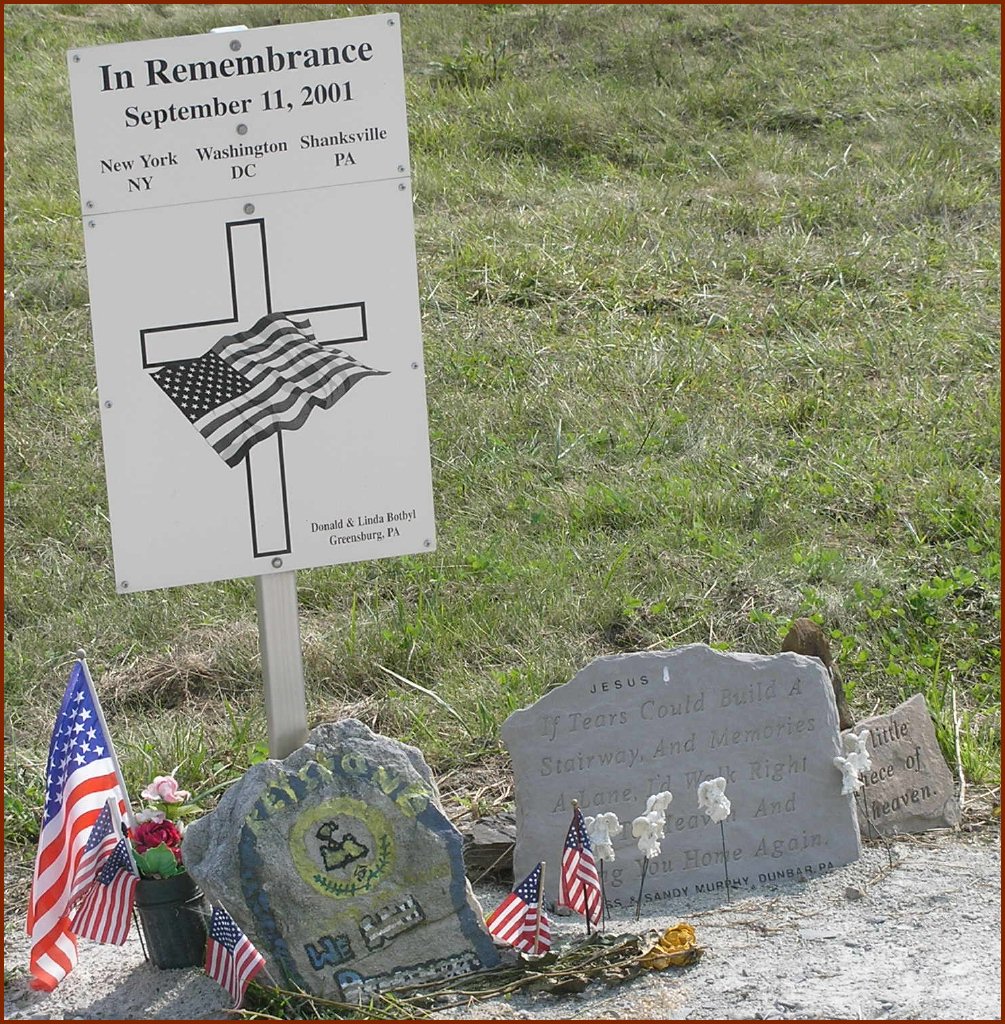
In Remembrance © 2009 America In ContextI’m wondering: has enough time passed to honestly and objectively look back on 9/11? There hasn’t been another terrorist attack on U.S. soil, but al Qaeda still makes is presence felt elsewhere.  The administration of President George W. “9/11” Bush is over, but the resulting wars in Afghanistan and Iraq are still going on. And bin Laden is still out there, somewhere. We don’t know if he’s dying of cancer or plotting the next attack. So I’m not quite sure enough time has past to put 9/11 in its proper context, it seems like we are still living it today. If we are still living it, has it past into history? Hmmm….

Because I’m not sure it has past into history, I’m also not quite sure we can properly memorialize it. Time has to pass before one can honestly reflect on an event. There’s too much emotion otherwise, and you end up acting completely on impulse and make bad judgements that you then have to live with. So has enough time passed to build memorials, things that will stand for generations and generations? Will such a memorial teach the right lesson to those who weren’t here in 2001?

Jacket and Stuff © 2009 America In ContextThe Vietnam Veteran’s Memorial was built in 1982, seven years after the fall of Saigon. Here we are, eight years after 9/11, so maybe it is time after all. The only difference, of course, is the Vietnam War actually ended. The conflict itself was closed, the troops were brought home. The scars and carnage remained, but at least the nation had those seven years to reflect, and think, and figure out how those lost lives should be remembered. We now have one of the most moving memorials ever created on the west end of the National Mall.  I want the same thing for 9/11, a symbol that evokes the right emotion and conveys the right message to those who might visit it 20, 50, or 100 years later. I don’t want some rushed hunk of granite garbage that evokes a response of “WTF?”

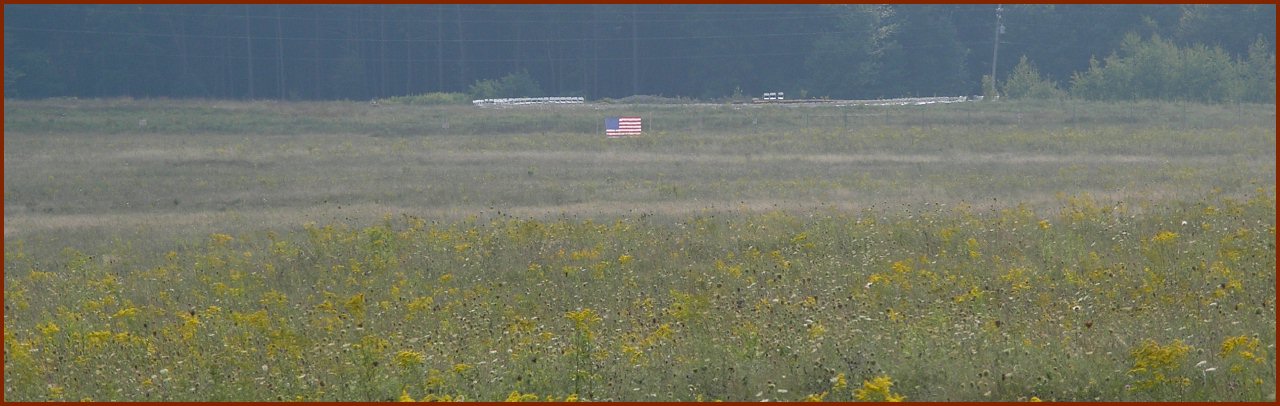
Regardless of the answer to this heavy question, I do like the design for the memorial to Flight 93. I’ve reviewed it, and I’ve visited the site, and I have to give my own, “mouse that roared” thumbs-up to the proposed memorial in Shanksville, PA. I think it’s subdued enough, thoughtful enough, and emotive enough to qualify as a true, honorable monument to those 40 folks who gave their lives in a senseless, pointless act of violence. I especially like the groves of trees and the low, graceful lines of the design. It fits in with the landscape and the dignity we’d all like to see.

I don’t ask this often, but I hope you’ll take the time to visit the Flight 93 Memorial Project and make a  contribution to the creation of this monument. After wrestling with the issue during the crafting of this post, I think its time has come.

Sacred Ground © 2009 America In Context

[Pics are mine and appropriately copyrighted. More are here.]

=============================================================

Links:

Flight 93 National Memorial

Flight 93 Memorial Project

Google map to the Flight 93 memorial

Read Full Post »

For Your Consideration: The Greatest American

Some time ago, on a long-forgotten internet message board, someone posed a question: who was the greatest American in history?

Of course, the internet being the internet, the argument soon disolved into a flame war (I’m sure someone mentioned “abortion” somewhere and it just devolved from there). Somewhere in the fray, however, I made a case for Dwight D. Eisenhower as the Greatest American. Now you can’t answer a question without understanding a question so, as I did on that tiny little  message board, I’ll start off explaining my interpretation of that particular question.

Ike Earrings

Most folks, upon hearing that question, will instinctively think only in terms of America itself, as in “which American did the most for America”. A logical answer here would be Abraham Lincoln, a man who not only kept the Union from dissolving, but also had the guts and fortitude to fight the greatest evil America has ever wrought: the continuation of slavery nearly 9 decades into its existence. Slavery was an unholy abomination that should have been extinguished when Thomas Jefferson put the last period on the Declaration of Independence, but it was allowed to exist through the sheer audacity (and utter cowardice) of founders and legislators and presidents alike. No President stood up to slavery until Lincoln, and his actions saved our country. We were not only saved literally (by stopping secession), but also morally. We had no moral fiber as a nation until slavery was abolished. It is as simple as that.

Ike and 101st AirborneThe only problem I have with proclaiming Lincoln as the “greatest American” is his actions really only saved the country. When I hear “greatest American”, I think globally: which American did the most for the world? Now that is an entirely different question. Sure, some could extrapolate “well, America is the greatest country, and Lincoln saved America, so Lincoln is the greatest”. That not only shows a grotesque level of hubris, it’s not really accurate. America wasn’t a world player for nearly a century after Lincoln’s time. We were an isolationist nation. We were protected on two fronts by mighty oceans, and only had two neighbors. No threats = no conflict = no interest in the world. Plus we were a nation of immigrants, collectively giving Europe the big middle finger as we went on our way, making our own prosperity (and driving the native population into their graves, but that’s the subject for yet another post). Saying Lincoln was a great world figure is simply disingenuous.

So, if we honestly answer “which American did the most good for the world”, well, you can come up with a lot of answers. Many (and perhaps rightly) say medical pioneers like Jonas Salk or inventors like Thomas Edison or scientists like Robert Oppenheimer deserve the title.  I appreciate these picks, but I have to ask: is science purely an American endeavor? Isn’t science simply the discovery and application of facts, principles and theorems? What makes it uniquely American? Doesn’t science transcend nationality? Jonas Salk could just have easily have been German, or Spanish, or Japanese. I’m not at all denigrating the work of these individuals in making my pick, I’m actually elevating them beyond simply being Americans.  Well, I suppose Edison was truly American: he was an incredibly shrewd businessman and power broker who set out to destroy his competitors, but, again, that’s a subject for another post …

5 StarsThis leads me to my own approach to the “Greatest American” question. First, did the individual have a postive, global impact; and second, did the individual act with the best of our core American principles (life, liberty, pursuit of happiness, etc.)? I say Ike deserves serious consideration as the Greatest American under that context, and I say it for one big reason: World War II.
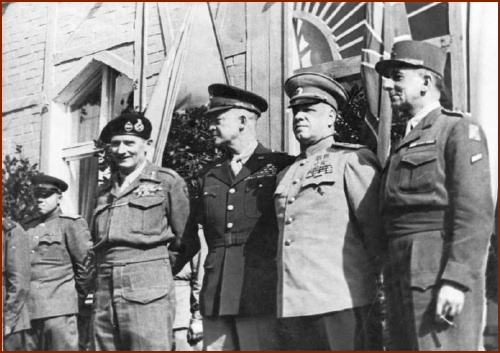
World War II was the greatest conflagration the world has ever known. Never before, and thankfully never since, has the globe ever been covered in carnage and evil as horrid as during the period between 1939 and 1945. I don’t even know if people can comprehend that evil. I’m fairly convinced Americans can’t, we simply haven’t experienced war firsthand on our own soil since 1865. Let me tell you, it was nasty-horrid. And the Nazis, the Nazis were the worst. They epitomize evil to this very day. Every tyrant since 1945 is judged against Hitler, every evil movement has been compared to Nazism. These people were cold, heartless butchers; utterly disinterested in freedom and liberty; technocrats and bullies of the worst kind; the filthiest type of genetic bigots and medical torturers this world has ever seen. America saw this evil and (after much prodding by FDR) finally decided to confront it. But we brought more than men and equipment to Europe, we brought a secret weapon. We brought Ike.

Montgomery Eisenhower Zhukov de Tassigny

I don’t know if I’ll make many friends with this paragraph, and I don’t mean any disrespect to any man or woman who ever served in our Armed Forces, but an army isn’t worth a damn unless it has good, strong leadership. Throughout history, there are lots of stories of brave armies led to their defeat and slaughter by lousy generals; and plenty of other stories of underpowered armies led to victory by great generals. Anyone who’s read about our Civil War knows stories like these, and they occur in European history as well. Victory and defeat don’t rest on the shoulders of the soldier, they reside in the brains of the generals.

Ike was one of the better ones. I don’t think he’s rated as the greatest American general ever (I think that title tends to fall on Lee or Patton or even George Washington), but there can be no doubt he had the greatest challenge of any of them. He had to face a highly skilled, highly entrenched opponent, who had (in some cases) superior weaponry and better planning (at least in the early parts of the war). Not only that, he had to rescue no less than an entire continent from the greatest scourge mankind has ever seen. This was an enemy unlike any faced by Americans in our entire history. This was an enemy who actually sat down, in offices, using businesslike precision, and plotted the extermination of, by some counts, 11 million people! [See link below for more on this]. This was much, much more than simple warfare. The stakes were much higher.

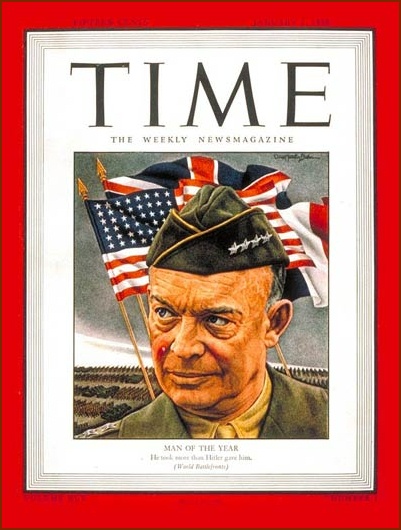
Man of the Year

I’m hoping that, by now, you see why I’m nominating Dwight D. Eisenhower, Supreme Allied Commander Europe, as the Greatest American. Yeah, he didn’t beat the Nazis all by himself (no one achieves anything by themselves). Yeah, he made a lot of blunders and mistakes and some (like the continued delay of the invasion of Europe) probably led to further deaths in the Soviet Union.  I still think his achievement earns him the title of Greatest American. He was a fine president, the 50’s were a good time in this country. He sponsored the interstate highway system, connecting us in a way we never were connected before. He started the battle against Communism (although he didn’t act to combat McCarthyism). He tried to integrate our racially divided nation (with admittedly limited success). He even tried to warn us about the growing power of the military-industrial complex, you don’t hear too many politicians doing that these days.

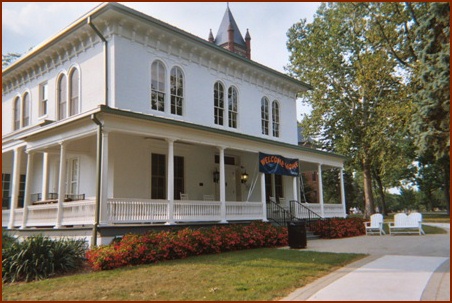
Most impressive, in my view at least, he was a humble man. His retirement home, now the Eisenhower National Historic Site near Gettysburg, Pennsylvania, is probably the humblest house ever inhabited by any former President. Hell, it’s not much different than the farmhouse next door to my own boyhood home. Personally, I think humility is one of the best characteristics a human being can ever have. Arrogance is for assholes, humility is for great people. Personally, I think Eisenhower was more of the latter and less of the former.

Eisenhower Home

[I normally don’t ask for direct feedback on a post, but I’d love to hear your thoughts on the “Greatest American” question. Also, I didn’t have a camera when I visited Ike’s house, all pictures on this post are public domain photos taken from the NPS or Wikipedia or other sources.]

===========================================

Links:

Eisenhower National Historic Site

PowerKills, R. J. Rummel’s works on democide

Atlantic Monthly’s Top 100 Americans and a contrary list

Google map to Ike NHS

Read Full Post »

American Classics

Edgar Allen Poe is a true American classic. I suspect that Poe is the second most recognized 19th Century American author (behind perennial favorite Mark Twain). Most everyone has heard of Poe through his well-known works like “The Raven”, “The Pit and the Pendulum”, “The Masque of the Red Death”, and that grade-school reader staple, “The Tell-tale Heart”. Some folks may have read one book by Herman Melville or Louisa May Alcott, and only college-level literature students have read anything by Emerson, Longfellow, or Thoreau, but most of us are familiar with Poe’s work and his influence on mystery and the macabre. I suppose it’s sad that he’s better known than his contemporaries (critically speaking Poe’s works pale in comparison to Emerson, Longfellow and Thoreau), but his visceral take on humanity made a huge impact on popular culture. You can trace so many mystery-thrillers directly back to Poe. It’s hard to imagine Hitchcock or Stephen King or even CSI would be here today without his influence.

But a visit to Poe’s old homestead in Philadelphia evokes a different sort of American classic.

The Window © 2009 America In ContextPhiladelphia wasn’t the only city Edgar Allan Poe called “home”.  Never a wealthy man, Poe and his family led a fairly hardscrabble life. They travelled a lot, always trying to find a new opportunity in another city. Consequently, they lived in many places, from Boston to Richmond to New York. The only Poe home that has been preserved is an old, faltering row house north of Independence Park, on the bad side of I-676. Yes, that’s right: the former home of Edgar Allan Poe, one of the premier poets and authors of his time, is a shitty house in a shitty part of town. And I find that terrific.

I visited Poe NHS on a crappy, drizzly day. I spent the prior gorgeous, sunny day strolling Independence NHS, the well-manicured core of touristy Philadelphia, with its horse-drawn carriages and Ben Franklin impersonators. But the day I visited Poe’s House was sodden and sopping. Rain doesn’t bother me, I threw on a raincoat and headed out. Of course, I didn’t realize I’d be walking about a mile into the slums of Philadelphia. Honestly, that part of town isn’t that bad, but I clearly stood out like a sore thumb. I have to admit I was pretty nervous, but I didn’t run into any trouble. In hindsight, I think it was a very appropriate walk. Too many of us, myself included, stick to the “good” parts of America, and daren’t venture into the rougher sections. A brilliant thing about my National Park Site collection is you see virtually all of America, including some slums. You get a pretty complete picture that way, in my opinion.

The Cupboard © 2009 America In ContextBy the time I got to the Poe house I was pretty soaked. I entered and took off my coat, leaving puddles in my wake. A retired couple were there, their Lincoln parked in the lot, water beaded from a fresh waxing. We were just in time for a tour. Our guide (a really sharp and well-versed lady, a credit to the NPS) took us through the outwardly rickety building, and told us of Poe. A troubled man, a restless man, a man who struggled with success (both commercial and in life). A man who always tried to find his way, a man who seemingly lost his mind and eventually died a very mysterious death, yet a man who left us with some of the most beloved works in American literary history.

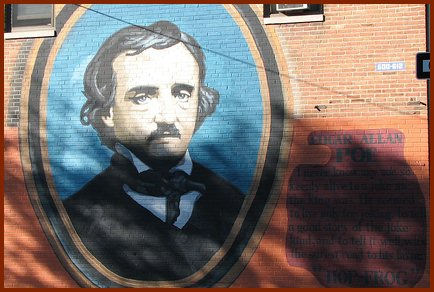
Poe’s story was intriguing, but what I found more intriguing was the relationship the Poe site and the NPS has with the local residents. Obviously that part of Philadelphia has a typical, urban, African-American population: undereducated, underemployed, living their own hardscrabble lives built on single-parent households, gang warfare, drug abuse, and a collage of government entities that don’t give a crap about them. But the folks at Poe NHS have worked really hard to get in touch with the community. They are constantly hosting children from local schools for tours and storytelling and events, and that ranger clearly loved to do it. There was no pretension or hypocrisy in her voice when she told those stories, even when she was talking to three Whiteys from the ‘Burbs. Her love of her job and the locals was pretty evident, and appreciated. She also pointed out the brilliant mural of Poe on a nearby building, and the fact that it has never been defaced by graffiti in all the years it’s existed. That is a telling factoid and really shows that either Poe’s works unites us on a fundamental level, or that if you respect people, they will respect you back.

The Raven © 2009 America In Context

Poe NHS doesn’t just tell the story of a famous American author, it tells the story of a rough life, a life led by many millions of Americans before and many more millions who came after. Rough living in a rough house in a rough neighborhood, a life lived by more of us than we care to think about. I doubt my tour companions really got the point of Poe NHS. The retired gentleman, who was supposedly making a coffee table book about “homes of great Americans”, clearly missed it when he said “I doubt this house will make my book.” We all didn’t grow up in marble mansions, doofus.

If you want to experience America, you need to experience all of it, including tilting houses in seedy neighborhoods. That is an idea worthy of a coffee table book.

The Mural

[Pics on this post are mine and copyrighted thusly, except for the mural. I didn’t get a good picture of it (crappy photog that I am), so I had to pirate one.]

========================================================

Links:

Edgar Allan Poe National Historic Site

Poe Museum (Richmond, Virginia)

Tabula Rasa’s History of Horror

Google map to Poe NHS

Read Full Post »

« Newer Posts - Older Posts »