Somewhere Down That Lazy River
The Delaware Water Gap is a protected stretch of river and shoreline between Port Jarvis and East Stroudsburg, Pennsylvania. Like Catoctin, Chickasaw, and Cuyahoga, it’s mundane and uninteresting. But that’s OK, because like those other national park sites, it serves a purpose: protecting our natural resources, providing habitat for wildlife, and simply giving city folks a place to see what a tree looks like. I go on and on about this point so often in this blog, I don’t really feel like retreading that all over again here.
What I do want to talk about is good, old-fashioned laziness.
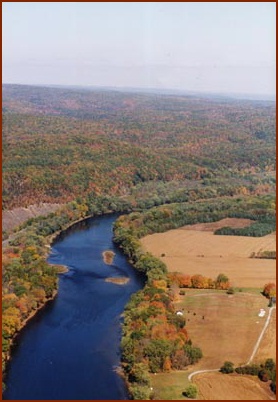 I had no grandiose plans for my Water Gap visit. I had an exciting, inspiring trip the prior autumn when I visited Alaska for the first time (a subject for my next post), but for my trip through Pennsylvania the following spring, I wanted to tone it down (although some might say you have no alternative but to ‘tone it down’ when you visit Pennsylvania, but, well, moving on …).
For my visit to the Delaware Water Gap, I went uber-simple. I just rented a kayak from the fine, Bohemian folks at Chamberlain Canoes, and paddled (well, floated really) downstream for a couple of hours. Yes, it was lame and unexciting. A couple of deer playing on an island, a few ducks paddling around, a couple of Class 1 (actually Class 0.5) rapids, that’s about it. There wasn’t a drop of adrenaline for miles around (unless you count the headbanging hillbilly houseparty happening on the eastern shore). I didn’t even take my camera, didn’t feel like fussing with it. I just wanted to enjoy a calm, early summer afternoon, futzing around on the Delaware River.
As I live my life and travel around the country, observing the society around me (and often looking inward, as I am wont to do), I feel that one ability sadly missing in most Americans is an ability I am calling “soulful laziness”. Our society is high-strung, jittery, overly busy, and tremendously uptight. Everywhere you turn, you see it: the chronic impatience, the busy little rush-rush for even the most mundane of tasks, that hum of self-created stress for decidely unimportant minutiae, that decidedly un-subtle “me first and right now” attitude that sends psychic ripples of anxiety up and down the corridors of business and the tiled expanses of mall food courts nationwide. I feel this constant buzz-buzz of motion and thought and stress is so damaging to folks that our society would be so much better if we could simply learn to be soulfully lazy.
 Now I have to be careful here: I am calling it “soulful laziness” for a very specific reason. It’s the ability to just stop, for a few minutes or a few hours or a few days, and relax. Find a quiet spot, at the beach or in a field or on your own back patio, and take a breather. Get away from the noise. Stop and smell the roses. Free your mind and the rest will follow. Let not only your body and your mind but the very fiber of your being, your soul (in both the theological and non-theological meanings of the word) take a rest.
Let me also be clear, lest there be no confusion. Laziness (or sloth if you will), is the Fourth Deadly Sin, and for good reason. Physical laziness is clearly bad, and is a chronic problem in America. Our obesity epidemic is one part bad nutrition and one part physical laziness. Our environmental problems are partly attributable to physical laziness. How many folks are simply too lazy to walk up one flight of stairs and burn unknown amounts of kilo-watt hours using the elevator instead? I even think our economic collapse has elements of physical laziness. So many folks are too lazy to earn an honest living or provide real value to customers or society or business, instead they try to take the short road through lying on home mortgage applications, cheating people via pyramid schemes, or making horribly risky get-rich-quick investments. That’s laziness right there.
 Part and parcel with physical laziness is intellectual laziness, as evidenced by excessive TV watching, vapid internet surfing, pointless shopping sprees or chronic videogaming. Many people are too intellectually lazy to even ask questions of our leaders or their bosses or even their spouses. Fewer and fewer people read or write effectively, or even try to think their way out of problems, instead depending on others to bail them out or praying to God for salvation while having another box of Ring-Dings and watching Monday Night Football. How many people can’t even count change? Lots and lots.
The odd thing is, even lazy folks injure themselves through pointless, self-inflicted stress. The chronic TV watcher bombards himself with cacophonies of action-packed movies, bitch-slap reality TV bickerfests, or pointless arguments on Fox News. The shop-a-holic exposes herself to a crush of traffic, a swarm of humanity in the checkout line, and that ludicrous self-inflicted drama of “does this look good on me” that serves no purpose. The chronic internet surfer or videogamer literally absorbs himself into a narrow, two-dimensional world where one must constantly point-and-click-and-point-and-click all for the next split-second fix of Flash-animated inanity in order to remain interested. So even the physically and intellectually lazy segments of society clutter themselves up with so much stress and noise, they too can benefit from a self-inflicted heavy dose of soulful laziness.
 What we need to do as individuals is occasionally enter that state that allows one to set aside all the petty, self-created stresses, and just sit there in a quiet, low-key space and watch the world go by for a few hours on the weekend, or a few days while on vacation. This type of laziness is a wonder and a marvel. It shuts off all the noise and all the crap that we either willingly enter or (far worse) create for ourselves. Now this brand of laziness must be earned and can’t be abused (you can’t live your life staring out into space or gazing into your own navel, that’s what puts you into “the home”), but, in moderation, this is what we need, what we all need, the entire country, for our own sanity and our own survival.
I think if there’s one hope, one bright & shining potential outcome from our current economic crisis, it’s the notion that maybe people will start to shut out the noise and self-propagated stress in our lives and learn to be soulfully lazy once in a while. I spent $40 for that kayak rental down the Delaware River, and I loved it, but soulful laziness can have the best price tag possible in tough economic times: it’s free.
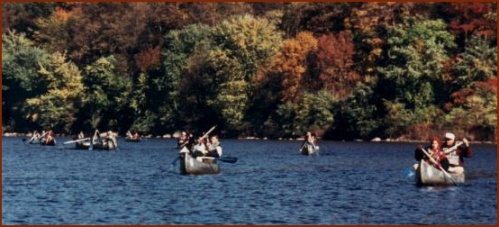
[The above picture is from Chamberlain Canoes’ website. I hope they don’t begrudge me using it here, they’re nice folks & deserve some props. All the other pics on this post are public domain from the National Park Service website. I also took a hike up to Dingman’s Falls, a few pics from that hike are here.]
=================================================================================
Links:
Delaware Water Gap National Recreation Area
Google map to Delaware Water Gap
I normally have four links per post but I was just too durn lazy
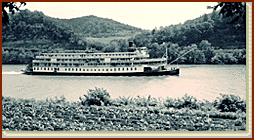 In the early 1800’s, westward expansion was really gearing up. The frontier represented opportunity. For settlers, it was the opportunity to find a new life. To the merchants in the eastern states, the frontier represented money. Settlers needed tools, and supplies, and seed. Settlers needed to sell their own products (timber, crops, cattle) to buy those tools, supplies, and seed. The merchants were ready to handle both sides of the equation. The nation, as today, ran on commerce. There were riches to be had on the frontier, that much was certain. But how do you transport all these people and goods back and forth? The answer was water.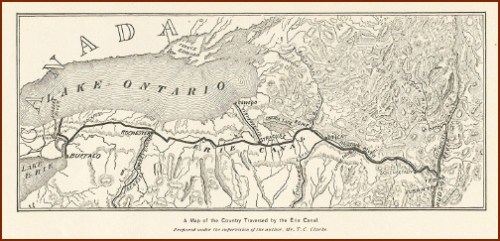


 America In Context