Feeds:
Posts
Comments

Posts Tagged ‘poetry’

Community College English 101

The Longfellow House in Cambridge is a beautiful, historic house. Built in 1759 in the Georgian style, it was originally occupied by Jamaican plantation owner John Vassall. A staunch loyalist, Vassall saw the writing on the wall and fled to England, just in time for George Washington to use it as headquarters during the early years of the Revolution. After the war, the house was purchased by Washington’s apothecary general, Andrew Craigie. His financial acumen was less than stellar, forcing his widow Elizabeth to take in boarders in 1819, including the soon-to-be-renowned poet Henry Wadsworth Longfellow. Later, Longfellow received the home as a wedding gift, and it stayed in the family or their trust until the entire building, its furnishings, and the grounds were donated to the National Park Service.
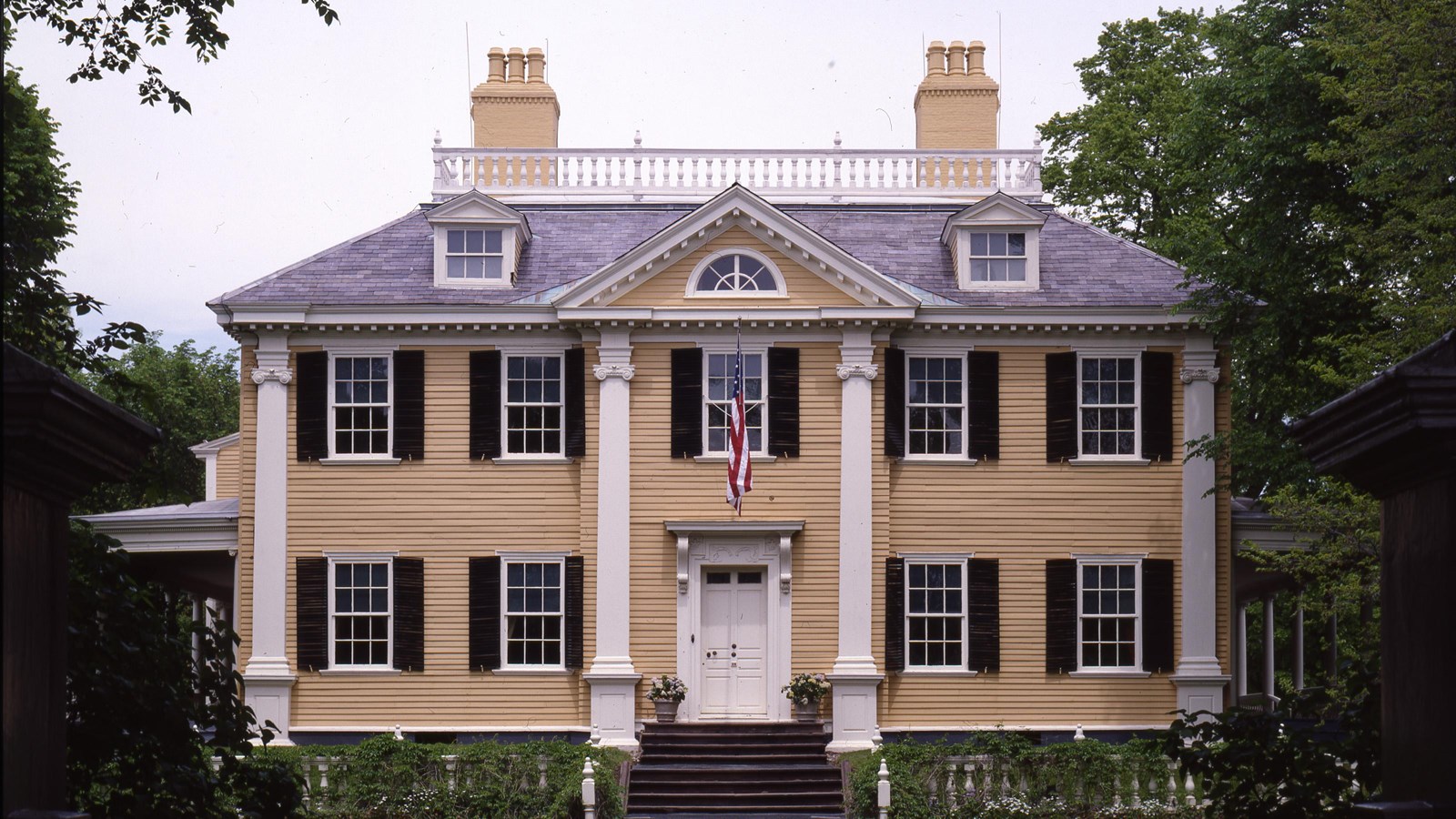
National Park Service photo

That’s all nice, but when I hear “Longfellow House”, I am reminded of my goofy college days.

My family was never particularly well-off. I was a sharp student, but we didn’t have the means to send me to college. So I took what I earned from part-time jobs and went to community college.

Springfield Tech was a good school with a solid electronics program. I already knew Ohm’s Law, Coulomb’s Law, and a variety of formulas and principles, so I had a bit of a head start. I loved those classes, the labs, mathematics, even physics (although it was taught by a professor I’m certain died three years prior).

Then came the dreaded mandatories. First day of first semester, when I had barely any understanding of what to expect, began English 101. I have long forgotten the name of the professor, but I’ll never forget his entrance. Tweed jacket and vest. Dignified salt & pepper beard. And a beret. Yes, a goddamned beret.

I don’t remember all of Professor Beret’s lessons, the one that sticks in my mind is our foray into Robert Frost. I’m talking about that old standby, which most kids learn in high school, “Stopping by Woods on a Snowy Evening”. The discussion came down to the old, self-wankery standby: “what does this poem mean to you?”

Me, being a bit overeager to discuss such heady topics in the presence of adults, instead of with a class full of hormonal teenagers, piped up with “well, a guy is evaluating his life choices. Shall he return to the life he knows, in comfort, or should he take another path, to see if he can become something special.”

“Um, no,” said Prof. Beret. “It’s about suicide.”

What? Well, apparently, if you decide to take that lesser-traveled path, you want to die by freezing to death …

Holy leaping Christ, what the fuck?

Anyway, that lesson tarnished me on poetry forever. I realized that not only do I not easily pick up on symbolism, but people who put poetry up on philosophical pedestals are fucking crazy.
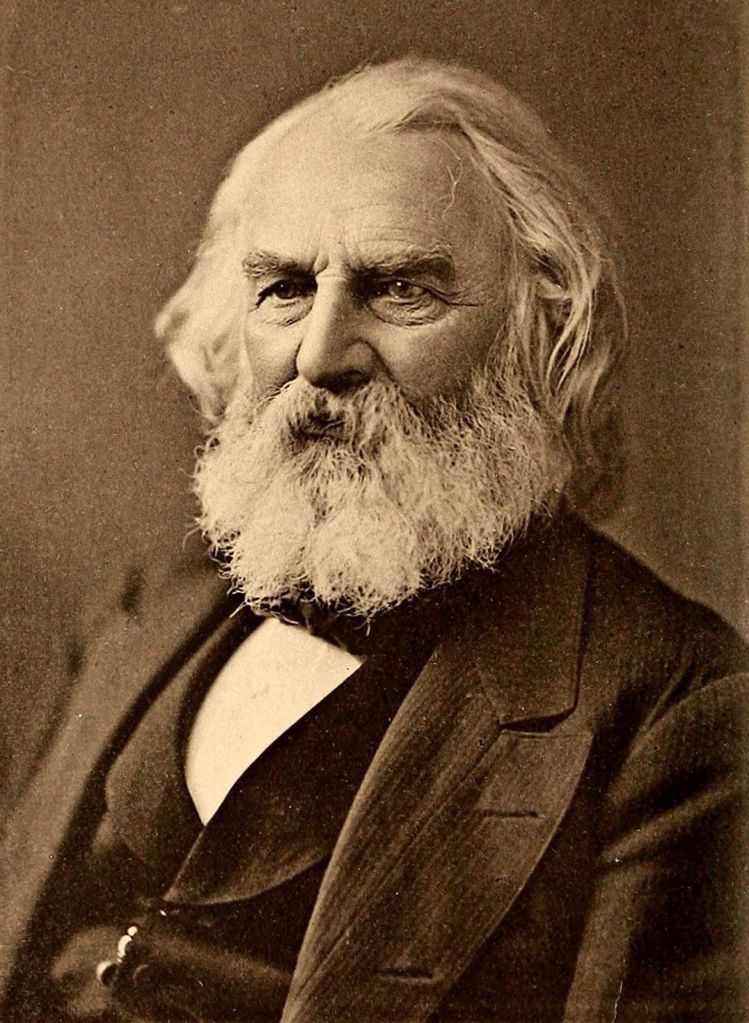
Brittanica.com

In preparation for this essay, I read many poems from Longfellow: The Complete Poetical Works. Most of his works are direct homages to nature and the art of living. There’s not a lot of deep symbolism, just well-structured odes, definitely tame by today’s standards. There’s no doubt he was big for his time, but now it’s all quaint recollections of seeing a shooting star and such.

I’ll leave you with one of my favorites:

The Burial of the Minnisink

On sunny slope and beechen swell,
The shadowed light of evening fell;
And, where the maple’s leaf was brown,
With soft and silent lapse came down,
The glory, that the wood receives,
At sunset, in its golden leaves. 

Far upward in the mellow light
Rose the blue hills.  One cloud of white,
Around a far uplifted cone,
In the warm blush of evening shone;
An image of the silver lakes,
By which the Indian’s soul awakes. 

But soon a funeral hymn was heard
Where the soft breath of evening stirred
The tall, gray forest; and a band
Of stern in heart, and strong in hand,
Came winding down beside the wave,
To lay the red chief in his grave. 

They sang, that by his native bowers
He stood, in the last moon of flowers,
And thirty snows had not yet shed
Their glory on the warrior’s head;
But, as the summer fruit decays,
So died he in those naked days. 

A dark cloak of the roebuck’s skin
Covered the warrior, and within
Its heavy folds the weapons, made
For the hard toils of war, were laid;
The cuirass, woven of plaited reeds,
And the broad belt of shells and beads. 

Before, a dark-haired virgin train
Chanted the death dirge of the slain;
Behind, the long procession came
Of hoary men and chiefs of fame,
With heavy hearts, and eyes of grief,
Leading the war-horse of their chief. 

Stripped of his proud and martial dress,
Uncurbed, unreined, and riderless,
With darting eye, and nostril spread,
And heavy and impatient tread,
He came; and oft that eye so proud
Asked for his rider in the crowd. 

They buried the dark chief; they freed
Beside the grave his battle steed;
And swift an arrow cleaved its way
To his stern heart!  One piercing neigh
Arose, and, on the dead man’s plain,
The rider grasps his steed again. 

=======================

Despite my difficulties with a certain English 101 professor, I did get a great education at that school.

Links:

Longfellow House National Historic Site

George Washington’s Revolutionary War Itinerary

Searchable database of Longfellow poems

Map to the Longfellow house

Read Full Post »

American Classics

Edgar Allen Poe is a true American classic. I suspect that Poe is the second most recognized 19th Century American author (behind perennial favorite Mark Twain). Most everyone has heard of Poe through his well-known works like “The Raven”, “The Pit and the Pendulum”, “The Masque of the Red Death”, and that grade-school reader staple, “The Tell-tale Heart”. Some folks may have read one book by Herman Melville or Louisa May Alcott, and only college-level literature students have read anything by Emerson, Longfellow, or Thoreau, but most of us are familiar with Poe’s work and his influence on mystery and the macabre. I suppose it’s sad that he’s better known than his contemporaries (critically speaking Poe’s works pale in comparison to Emerson, Longfellow and Thoreau), but his visceral take on humanity made a huge impact on popular culture. You can trace so many mystery-thrillers directly back to Poe. It’s hard to imagine Hitchcock or Stephen King or even CSI would be here today without his influence.

But a visit to Poe’s old homestead in Philadelphia evokes a different sort of American classic.

The Window © 2009 America In ContextPhiladelphia wasn’t the only city Edgar Allan Poe called “home”.  Never a wealthy man, Poe and his family led a fairly hardscrabble life. They travelled a lot, always trying to find a new opportunity in another city. Consequently, they lived in many places, from Boston to Richmond to New York. The only Poe home that has been preserved is an old, faltering row house north of Independence Park, on the bad side of I-676. Yes, that’s right: the former home of Edgar Allan Poe, one of the premier poets and authors of his time, is a shitty house in a shitty part of town. And I find that terrific.

I visited Poe NHS on a crappy, drizzly day. I spent the prior gorgeous, sunny day strolling Independence NHS, the well-manicured core of touristy Philadelphia, with its horse-drawn carriages and Ben Franklin impersonators. But the day I visited Poe’s House was sodden and sopping. Rain doesn’t bother me, I threw on a raincoat and headed out. Of course, I didn’t realize I’d be walking about a mile into the slums of Philadelphia. Honestly, that part of town isn’t that bad, but I clearly stood out like a sore thumb. I have to admit I was pretty nervous, but I didn’t run into any trouble. In hindsight, I think it was a very appropriate walk. Too many of us, myself included, stick to the “good” parts of America, and daren’t venture into the rougher sections. A brilliant thing about my National Park Site collection is you see virtually all of America, including some slums. You get a pretty complete picture that way, in my opinion.

The Cupboard © 2009 America In ContextBy the time I got to the Poe house I was pretty soaked. I entered and took off my coat, leaving puddles in my wake. A retired couple were there, their Lincoln parked in the lot, water beaded from a fresh waxing. We were just in time for a tour. Our guide (a really sharp and well-versed lady, a credit to the NPS) took us through the outwardly rickety building, and told us of Poe. A troubled man, a restless man, a man who struggled with success (both commercial and in life). A man who always tried to find his way, a man who seemingly lost his mind and eventually died a very mysterious death, yet a man who left us with some of the most beloved works in American literary history.

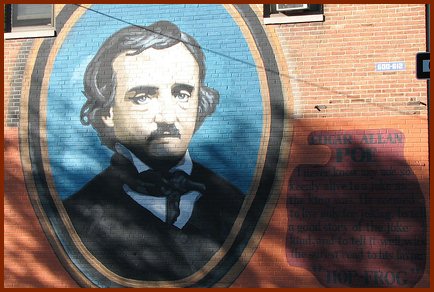
Poe’s story was intriguing, but what I found more intriguing was the relationship the Poe site and the NPS has with the local residents. Obviously that part of Philadelphia has a typical, urban, African-American population: undereducated, underemployed, living their own hardscrabble lives built on single-parent households, gang warfare, drug abuse, and a collage of government entities that don’t give a crap about them. But the folks at Poe NHS have worked really hard to get in touch with the community. They are constantly hosting children from local schools for tours and storytelling and events, and that ranger clearly loved to do it. There was no pretension or hypocrisy in her voice when she told those stories, even when she was talking to three Whiteys from the ‘Burbs. Her love of her job and the locals was pretty evident, and appreciated. She also pointed out the brilliant mural of Poe on a nearby building, and the fact that it has never been defaced by graffiti in all the years it’s existed. That is a telling factoid and really shows that either Poe’s works unites us on a fundamental level, or that if you respect people, they will respect you back.

The Raven © 2009 America In Context

Poe NHS doesn’t just tell the story of a famous American author, it tells the story of a rough life, a life led by many millions of Americans before and many more millions who came after. Rough living in a rough house in a rough neighborhood, a life lived by more of us than we care to think about. I doubt my tour companions really got the point of Poe NHS. The retired gentleman, who was supposedly making a coffee table book about “homes of great Americans”, clearly missed it when he said “I doubt this house will make my book.” We all didn’t grow up in marble mansions, doofus.

If you want to experience America, you need to experience all of it, including tilting houses in seedy neighborhoods. That is an idea worthy of a coffee table book.

The Mural

[Pics on this post are mine and copyrighted thusly, except for the mural. I didn’t get a good picture of it (crappy photog that I am), so I had to pirate one.]

========================================================

Links:

Edgar Allan Poe National Historic Site

Poe Museum (Richmond, Virginia)

Tabula Rasa’s History of Horror

Google map to Poe NHS

Read Full Post »