Feeds:
Posts
Comments

Posts Tagged ‘travel’

Mammoth Cave National Park, Kentucky

I was a freshman in high school when I was introduced to Dungeons & Dragons. I was smack in the middle of the target demographic for Gary Gygax’s brainstorm. I read a lot of Greek myth as a boy (I was more fascinated by Odysseus and Bellerophon than I was by dinosaurs). Rankin-Bass’ 𝘛𝘩𝘦 𝘏𝘰𝘣𝘣𝘪𝘵 introduced me to Tolkien’s 𝘓𝘰𝘳𝘥 𝘰𝘧 𝘵𝘩𝘦 𝘙𝘪𝘯𝘨𝘴, which I read voraciously and repeatedly. The 𝘚𝘪𝘯𝘣𝘢𝘥 movies came out in the prior decade and hit rerun television so often I almost knew them by heart. Then, of course, there was 𝘔𝘰𝘯𝘵𝘺 𝘗𝘺𝘵𝘩𝘰𝘯 𝘢𝘯𝘥 𝘵𝘩𝘦 𝘏𝘰𝘭𝘺 𝘎𝘳𝘢𝘪𝘭 (Ni!). Between a deep understanding of these pop-culture references, my coke-bottle glasses, and a total lack of athleticism, it was inevitable I’d play D&D. It was the perfect fit: a social activity that required imagination, a propensity for dick jokes, and math. Lots of math.

Lots of other things, too.

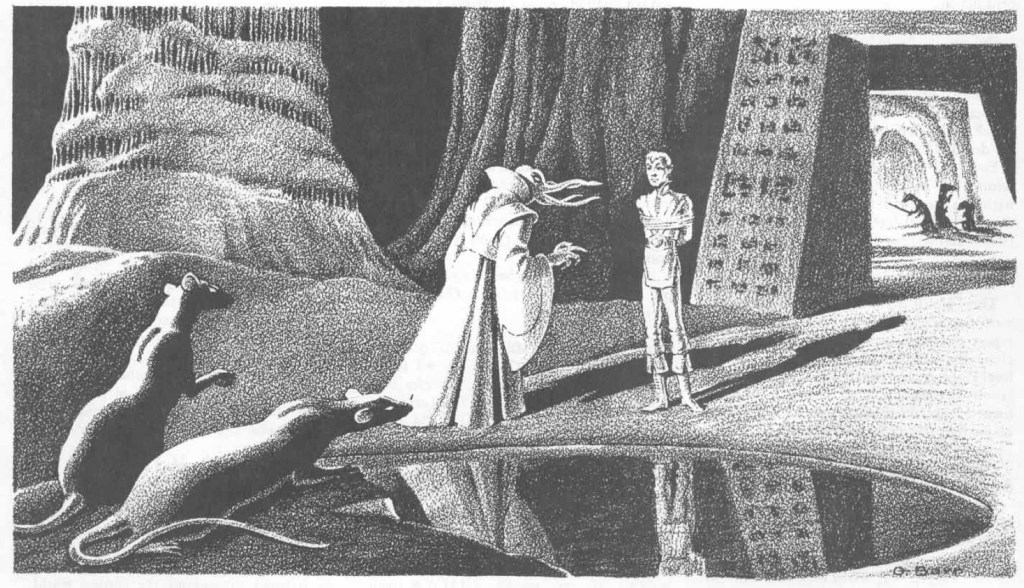
One of D&D’s milieus is the underground. “Dungeons” is in the name, after all. Not just creepy basements under spooky castles, but vast networks of deep tunnels; expansive caverns housing fantastic cities; underground rivers filling huge underground lakes; all filled with horrific monsters and evil civilizations. One of my favorite adventures was Descent Into the Depths of the Earth. You play a band of heroes (of course), hot on the trail of evil underground-dwelling elves called “drow”. Traversing miles of tunnels, wide enough for trade caravans, you search for clues in warrens of troglodytes, and negotiate with schools of walking, cannibalistic fish-men called “kuo-toa”. Danger lurks around every dark corner. Adventurers succeed or die gruesome, horrible deaths. Great fun.
:slrrgrrlph: Have you read “The Watchtower”? :slrrgrrlph:

Of course, it’s all fantasy. All these fictional worlds, whether Dungeons & Dragons, or Riftworld, or Middle Earth, or Pandora, or whatever, are fantastic places that can’t possibly exist. Physics, gravity, geology, hydrology: they simply don’t work that way. You can’t have flat planets, you can’t have floating islands, you can’t fly a dragon to the moon, and you can’t have huge underground cities connected by caravan-wide tunnels.

Or can you?

Websites around the world proclaim this or that to be the “world’s biggest” or “world’s best”, but you rarely believe such exaggerations. There’s always disappointment, always overselling, always that feeling of being let down, just around the corner. But when I went to the original natural entrance of Mammoth Cave, a gaping maw at least 30’ wide, I knew this was, indeed, something special.
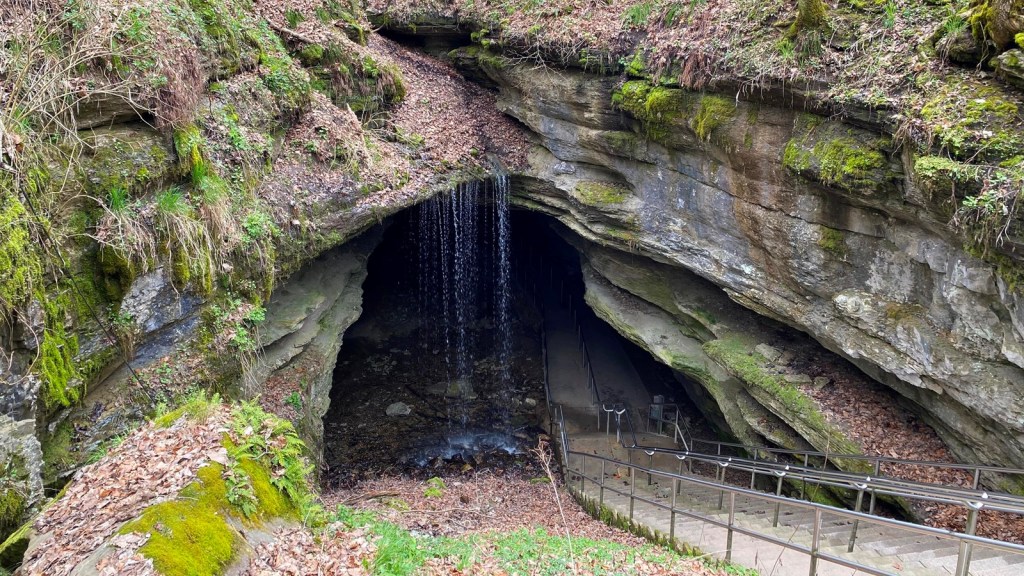
Natural Entrance

The cave system contains over 400 miles of passages, with more being discovered every year. Some of these passageways are 30’ wide, and tall enough for a school bus. Many of them are easy walking (constructed walkways mostly for accessibility and protecting fragile formations). Deeper down are the windy, spelunk-worthy crawl-ways, but there’s also an underground river where they used to offer boat tours! It’s hard to explain how large and fantastic these caves are without seeing them, and unfortunately I didn’t have a digital camera all those years ago when I toured. I’ll throw links at the bottom of this post, you can see for yourself the scale of the thing.
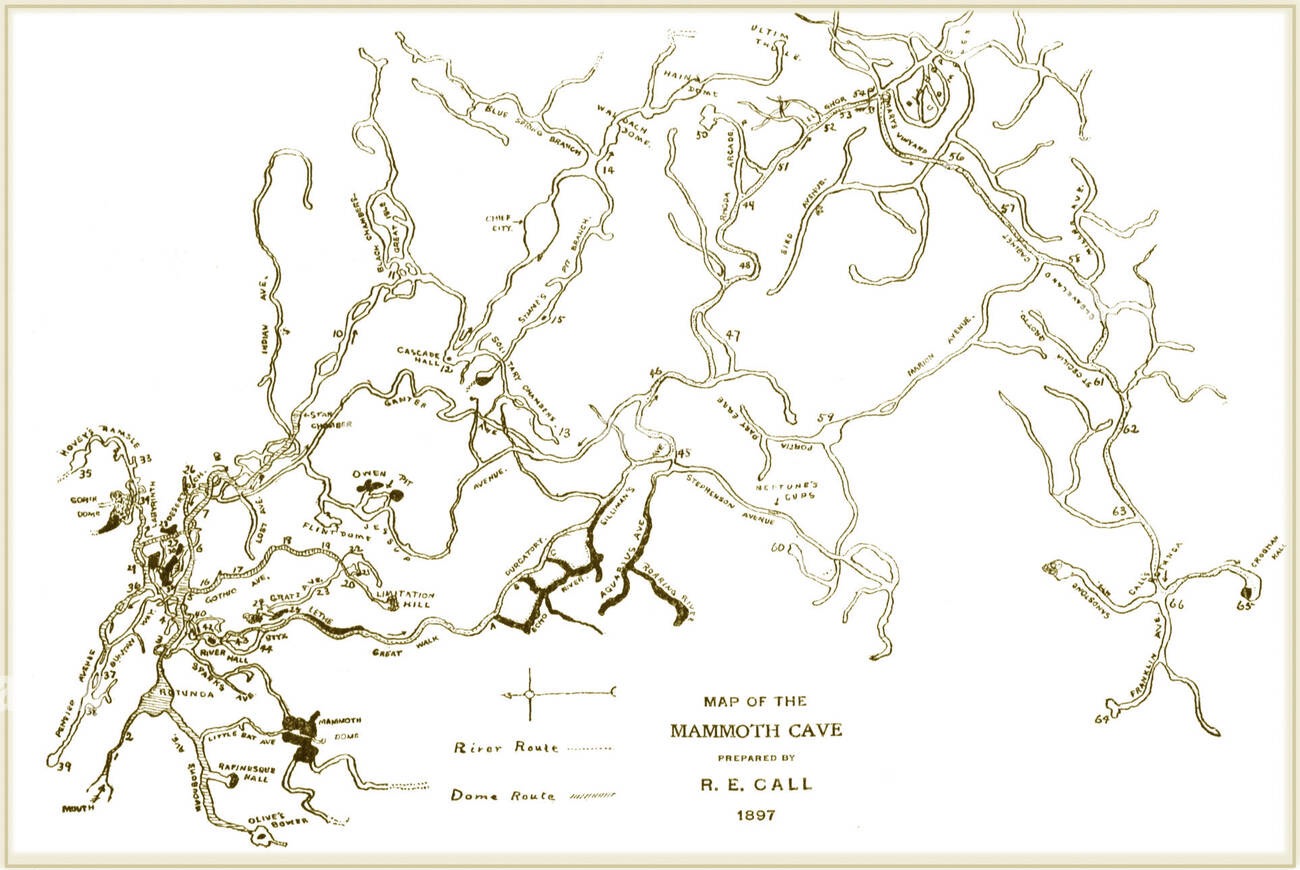
You Are Here

I love letting my imagination run wild when I go to these places. How can you not envision pre-Columbian Lakota buffalo hunting when you visit Big Sky Country? How can you not imagine great whaling ships when you visit New Bedford, or the struggles of Martin Luther King when you walk the streets of Birmingham, or immense alien spaceships while standing in the shadow of Devil’s Tower? Or drow and kuo-toa whilst inside Mammoth Cave?

I still play D&D from time to time. It hits differently than it used to, of course, but it’s still fun to get together with a bunch of like-minded nerds to roll dice and tell dick jokes and swing vorpal swords at green dragons. It’s cheaper than playing poker, beats sitting around a bar ruining your liver, and there’s nothing but crap on all these streaming services anyway. If you can’t be in the woods, on a mountain overlook, or deep in a cave system, grab some dice and roll up a gnome illusionist.

================

Links:
Mammoth Cave National Park

MCNP: Natural World Heritage Site

Google Maps: MCNP

Nerds Only

Read Full Post »

Community College English 101

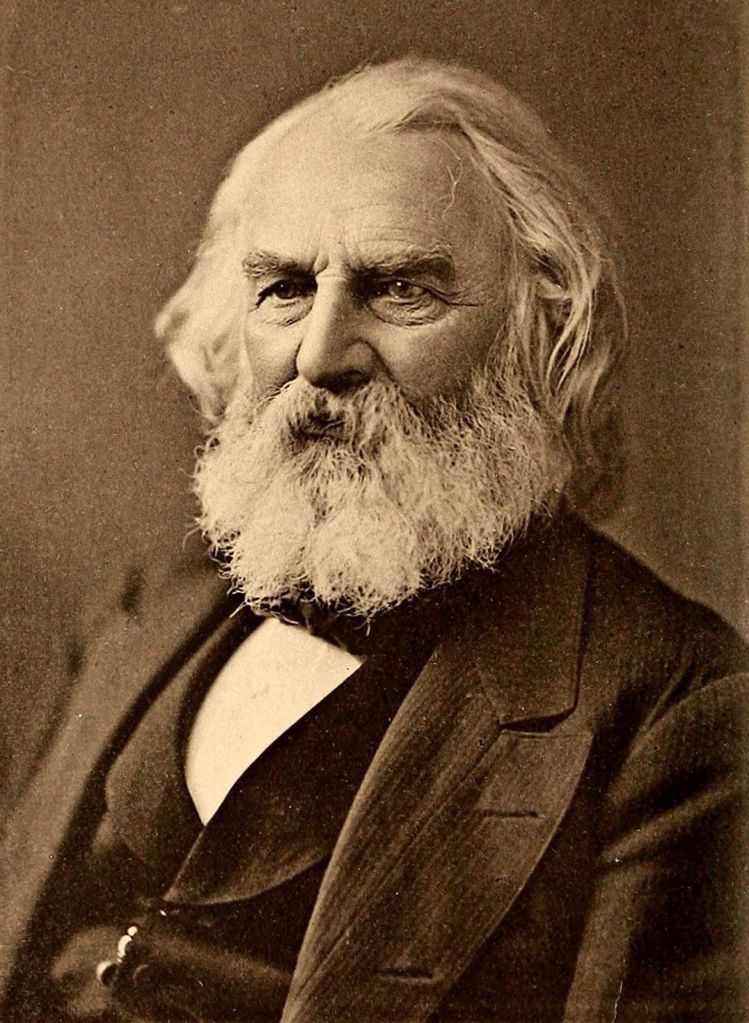
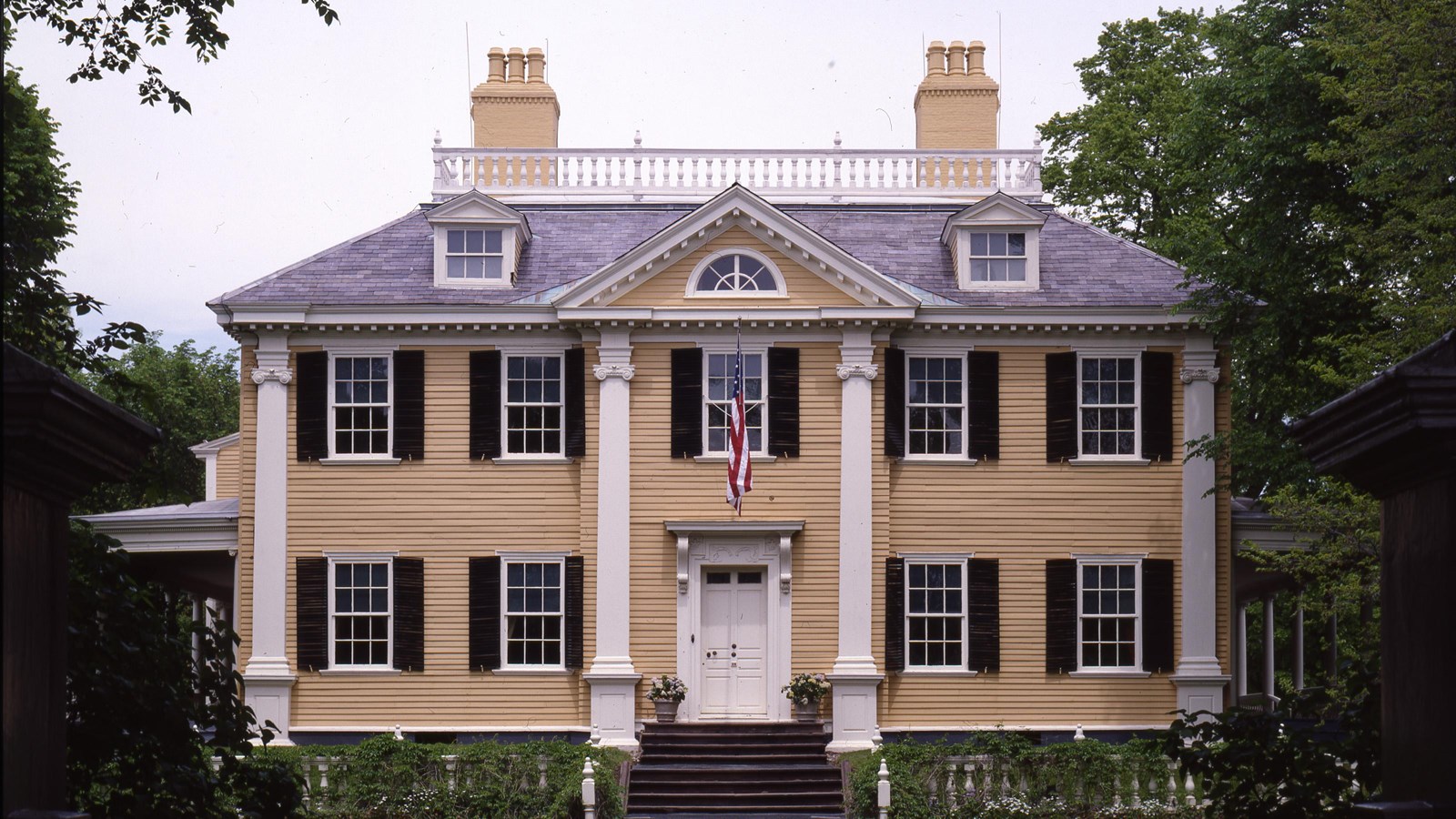
The Longfellow House in Cambridge is a beautiful, historic house. Built in 1759 in the Georgian style, it was originally occupied by Jamaican plantation owner John Vassall. A staunch loyalist, Vassall saw the writing on the wall and fled to England, just in time for George Washington to use it as headquarters during the early years of the Revolution. After the war, the house was purchased by Washington’s apothecary general, Andrew Craigie. His financial acumen was less than stellar, forcing his widow Elizabeth to take in boarders in 1819, including the soon-to-be-renowned poet Henry Wadsworth Longfellow. Later, Longfellow received the home as a wedding gift, and it stayed in the family or their trust until the entire building, its furnishings, and the grounds were donated to the National Park Service.

National Park Service photo

That’s all nice, but when I hear “Longfellow House”, I am reminded of my goofy college days.

My family was never particularly well-off. I was a sharp student, but we didn’t have the means to send me to college. So I took what I earned from part-time jobs and went to community college.

Springfield Tech was a good school with a solid electronics program. I already knew Ohm’s Law, Coulomb’s Law, and a variety of formulas and principles, so I had a bit of a head start. I loved those classes, the labs, mathematics, even physics (although it was taught by a professor I’m certain died three years prior).

Then came the dreaded mandatories. First day of first semester, when I had barely any understanding of what to expect, began English 101. I have long forgotten the name of the professor, but I’ll never forget his entrance. Tweed jacket and vest. Dignified salt & pepper beard. And a beret. Yes, a goddamned beret.

I don’t remember all of Professor Beret’s lessons, the one that sticks in my mind is our foray into Robert Frost. I’m talking about that old standby, which most kids learn in high school, “Stopping by Woods on a Snowy Evening”. The discussion came down to the old, self-wankery standby: “what does this poem mean to you?”

Me, being a bit overeager to discuss such heady topics in the presence of adults, instead of with a class full of hormonal teenagers, piped up with “well, a guy is evaluating his life choices. Shall he return to the life he knows, in comfort, or should he take another path, to see if he can become something special.”

“Um, no,” said Prof. Beret. “It’s about suicide.”

What? Well, apparently, if you decide to take that lesser-traveled path, you want to die by freezing to death …

Holy leaping Christ, what the fuck?

Anyway, that lesson tarnished me on poetry forever. I realized that not only do I not easily pick up on symbolism, but people who put poetry up on philosophical pedestals are fucking crazy.

Brittanica.com

In preparation for this essay, I read many poems from Longfellow: The Complete Poetical Works. Most of his works are direct homages to nature and the art of living. There’s not a lot of deep symbolism, just well-structured odes, definitely tame by today’s standards. There’s no doubt he was big for his time, but now it’s all quaint recollections of seeing a shooting star and such.

I’ll leave you with one of my favorites:

The Burial of the Minnisink

On sunny slope and beechen swell,
The shadowed light of evening fell;
And, where the maple’s leaf was brown,
With soft and silent lapse came down,
The glory, that the wood receives,
At sunset, in its golden leaves. 

Far upward in the mellow light
Rose the blue hills.  One cloud of white,
Around a far uplifted cone,
In the warm blush of evening shone;
An image of the silver lakes,
By which the Indian’s soul awakes. 

But soon a funeral hymn was heard
Where the soft breath of evening stirred
The tall, gray forest; and a band
Of stern in heart, and strong in hand,
Came winding down beside the wave,
To lay the red chief in his grave. 

They sang, that by his native bowers
He stood, in the last moon of flowers,
And thirty snows had not yet shed
Their glory on the warrior’s head;
But, as the summer fruit decays,
So died he in those naked days. 

A dark cloak of the roebuck’s skin
Covered the warrior, and within
Its heavy folds the weapons, made
For the hard toils of war, were laid;
The cuirass, woven of plaited reeds,
And the broad belt of shells and beads. 

Before, a dark-haired virgin train
Chanted the death dirge of the slain;
Behind, the long procession came
Of hoary men and chiefs of fame,
With heavy hearts, and eyes of grief,
Leading the war-horse of their chief. 

Stripped of his proud and martial dress,
Uncurbed, unreined, and riderless,
With darting eye, and nostril spread,
And heavy and impatient tread,
He came; and oft that eye so proud
Asked for his rider in the crowd. 

They buried the dark chief; they freed
Beside the grave his battle steed;
And swift an arrow cleaved its way
To his stern heart!  One piercing neigh
Arose, and, on the dead man’s plain,
The rider grasps his steed again. 

=======================

Despite my difficulties with a certain English 101 professor, I did get a great education at that school.

Links:

Longfellow House National Historic Site

George Washington’s Revolutionary War Itinerary

Searchable database of Longfellow poems

Map to the Longfellow house

Read Full Post »

Terror on the Backroads!

It was late spring in the mid-90’s. The world had not yet discovered the convenience of smartphones, nor had the general public made avail of navigation by GPS. There I was, in the woodlands of east-central Alabama, in a shoddy minivan (thanks Avis), Rand-McNally road atlas open on the passenger seat.

Totally lost.

I planned out the rest of that trip very well. I was going to Horseshoe Bend, I was going to Tuskegee, I was going to Chattanooga and Chickamauga and Plains, Georgia and Andersonville and the Ebeneezer Baptist Church. All were wonderful, informative, educational, and even moving. But for some, dumb reason, I phoned in the plan for Little River Canyon, and fell flat on my face.

Well, I didn’t literally fall on my face. What I literally did was drive around various backroads, trying to find the canyon. There was nary a sign to be seen, I just keep flitting around various windy roads, taking random left turns like a blithering jackass. Then, the storms rolled in.

First there were flashes of light, followed by the rumble of distant thunder. Then the sky turned black as night. The wind picked up, the rain fell, then went sideways, and then the flash of the lightning and the crash of the thunder occurred nearly simultaneously. I was in the eye of the maelstrom, in a shitty rented minivan, surrounded by 100’ tall loblolly pines. I was waiting for that one tree to give up its ghost, forcing me to give up mine.

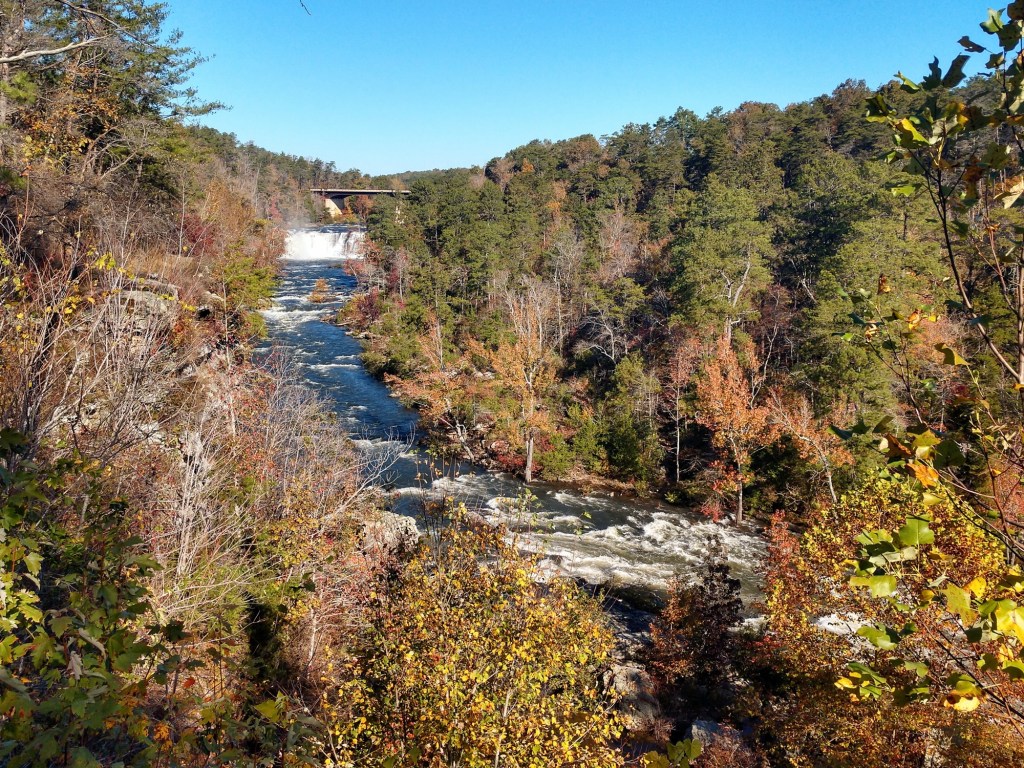
In about 15 minutes, the storm passed and the sky cleared. Heart pounding, I pressed on, and there, on my right, revealed by the sunlight, was the Little River Canyon. It was cool and all, and incredibly photogenic in that moment, but all I wanted to do was go back to my hotel and have a drink.

I haven’t made too many boneheaded mistakes in my visits to over 200 National Park sites, but my short visit to Little River Canyon was one of the dumbest.


I didn’t own a digital camera when I visited the canyon. The photo is from the National Park Service website: https://www.nps.gov/liri/index.htm

Read Full Post »

Contemplation

I was very fortunate when I visited Lincoln Home NHS. Due to some unknown confluence of circumstance, I toured the park when there were virtually no other visitors. There were maybe a dozen in all, including the four who accompanied me on a tour of the house.

I am a little sad when important historical sites have no visitors. I worry that Americans are failing their children by ignoring their own history, being otherwise enrapt in their video games or casinos or cruise ships. But I’m also more than a little grateful, for it gives me time to experience the importance of place, ponder the passage of time, and contemplate the importance of it all.

The site covers a scant four blocks, but the houses therein are well-preserved in 1860 style. The effect is quite immersive: sans many other tourists, it is easy to imagine yourself in 1846, walking towards 413 S. 8th St., dressed in your finest frock coat and sporting your best cane, so you can wish the newly-elected Representative Abraham Lincoln a fine good morning and sincere congratulations on his recent victory. Perhaps you truly believe the sentiment, perhaps you are hoping to curry favor, but regardless, you have performed proper pleasantries as is expected of a gentleman, and now must visit the mercantile to see if your package has arrived.

I believe that vacations should include not only excitement, awe, and wonder, but also quiet, and also contemplation. With summer upon us, here’s hoping you find all five during your next vacation.

————————

Pictures are mine and thusly copyrighted.

Read Full Post »

Older Posts »