Angel of Mercy
OK, this is sappy time. I hate sappy time. I like trying to be insightful, I like to try to put the pieces together. I like trying to be observant, I like pointing out things that might not be obvious. And I love being snarky, cynical, humorous, and rebellious. But, due to the subject matter, I can’t be anything else but sappy today.
 Clara Barton National Historic Site is truly unique amongst all of the historic sites in the National Park System. To my knowledge, it is the only site that was originally built with honorable, selfless intentions. I can think of no other site that was built upon as many good intentions as the collection of buildings erected by Clara Barton and her American Red Cross organization on the outskirts of Washington, DC.
This is a site where a visit really drives home the point of the person or organization it honors. It is a fairly sizable estate, but every building was built for a single purpose: helping people in trouble, whether from war or disaster or hardship. It was built 25 years after the Civil War, where Clara Barton aided the wounded at the horrific battles of Manassas, Antietam, Fredericksburg and others. It was built 20 years after her trip to Europe, where she first heard the ideals of the International Red Cross. It was built 10 years after she took those ideals back to the States and founded the American Red Cross. It is a set of buildings that exudes from their very timbers the goodwill, helpfulness, and sympathy that comes from a caring heart.
 Clara Barton’s home doesn’t have a magnificent name, she was beyond such vainglorious honorifics. It’s not lined in comfort or affluence, she was neither born into wealth nor had a desire to accumulate it. It doesn’t even have any remarkable architectural elements, such things are trivialities compared with the sufferings of man. What her home did have were dozens of bedrooms, lots of storage and warehouses, proximity to Washington, DC, and easy access to the main byways of the nation. On her property, she could house those left homeless by disaster, stockpile and ships tons of emergency supplies, and lobby Washington endlessly on behalf of those who needed help.
The remarkable thing about Clara Barton’s home is it was, indeed, her home. So she lived amongst all of these charitable activities day in and day out. She truly committed her entire life to it. She wasn’t some rich philanthropist who gave cash to charity and head out for steak tartare with her socialite friends. She wasn’t some politician who cuts a ribbon at an AIDS clinic and skeedaddles before the sick people show up. She was there, with her operation, day and night, night and day. This was truly a remarkable woman.

Now it has been said that Clara Barton could also be a terrible taskmaster and, frankly, a real bitch. I also know that the Red Cross has not had a sterling reputation throughout its entire history (witness the scandals after 9/11 and Katrina). And, when I was younger, I personally talked to WWII veterans who hated the Red Cross (I think the Red Cross was useless when families fraught with disaster needed to urgently track down soldier sons & husbands). But, in my opinion, no other charitable American had both the kindness of heart, and the spirit and determination, to help as many people as Clara Barton did.
I challenge any reader to think of any other NPS site that is built upon as many good intentions as Clara Barton’s home in Glen Echo, Maryland. If you want to nominate one, please post a comment and we’ll talk about it!

[For some reason, I don’t have any pictures from my visit to Clara Barton NHS. I know I owned a digital camera, but I must have run out of memory on my disk or something. It was the first year I owned one, so I probably screwed up somehow. A wholly reasonable notion, based on the operator 😉 . Pictures on this post are public domain photos courtesy of Wikipedia.]
Links:
Clara Barton National Historic Site
Apharesis (This is an alternative way to donate blood, where you donate the life-saving platelets & plasma but you keep your own red blood cells. This means it doesn’t tire you out like regular blood donation. If you’re an eligible blood donor, try it out. I do it regularly and like it. Frankly, it’s the only way I can relax for an hour or so in this hectic-assed world 😉 )


 After less than a mile on the trail (the downhill leg no doubt), I thought I’d die.
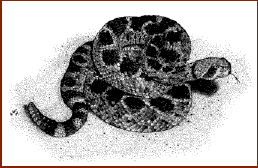
 I think most people would have panicked. For some odd reason, I found this comforting. If my time was up, it would have been the head of that rattlesnake, not the tail, and I would be dead. I was not going to die that day, I was convinced of that. All that was left was getting my head back into the game and focus my attention on getting out of the bad situation.
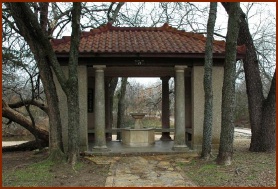 It does have some funky natural springs. There’s something exotic in the geology of the area that causes half a dozen or so natural springs of differing qualities. Some are infused with sulfur (hence the name of the nearby town of Sulphur) and are therefore highly poisonous. Others have similarly nasty high levels of arsenic, or high levels of copper, or are perfectly safe mineral springs. For amateur geologists in the audience, the place is pretty interesting for these features. The Chickasaw Nation Native Americans saw the value of these springs soon after they were relocated from Alabama & Mississippi, and preserved it for decades before deeding it to the National Park Service.
 In my opinion, one of the big problems with this country is its evolution from the United States of America to the United States of Generica. From sea to shining sea, almost without fail, you’ll see the same strip malls, the same chain restaurants, the same big box retailers. Even regional slangs & accents are starting to disappear, thanks to mass media. It’s nice in one way, you can travel across this whole country without getting into serious cultural trouble. But it has also made the country less interesting, blander, more vanilla.