Feeds:
Posts
Comments

Posts Tagged ‘travel’

Feel the Love

I went to Baltimore on business in 1992, early in my National Park quest. That was in that tremendously warm-and-fluffy, “the world is SAVED!!!” time in the years after the fall of the Berlin Wall. It was such a great time for this country: the end of Soviet communism, the liberation of eastern Europe, the first time since WWII that America had actually won! We had just kicked Saddam Hussein out of Kuwait in a great victory. Our economy was in good shape, we were the biggest dogs in the neighborhood, and finally, after all those decades, the fear of nuclear annihilation was gone.

It felt everything was going our way. It was great! Now, of course, our country is well, kind of a mess (when crabbyolbastard and I are out for a couple of beers nowadays, the words “it’s all a bag of ass!” cross our lips quite often). But back then, it was a great time to visit America’s Shrine.

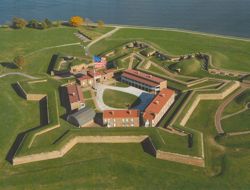
Fort McHenry was the spot of inspiration that enabled Francis Scott Key to pen the poem that would become the Star Spangled Banner, our national anthem. Fort McHenry is the only spot in the NPS called a “shrine”, and rightly so. And I have to say, if you’re as “into” this country as I was at that particular time, then McHenry is the place to go. I was downright gooey with patriotic love (um, ewwww!) when I was there. It was terrific. It’s a beautiful spot, right on the bay, great views, stiff ocean breeze, big Stars & Stripes fluttering from a big mast, absolutely marvelous! I need to stop by again next time I drive down I-95.

I want to give a little shout-out to Baltimore. I don’t know what downtown Baltimore is like today, but I was there at what seemed like a great time for the city. Camden Yards was just finished, there were all these great restaurants and pubs (and, even better, brewpubs!) around the harbor. I don’t have any specific memories of my short time there, but the general ones I have are fond. I’d love to hear from Baltimoreans (Baltimorites??) today. What’s the city like? How’s the downtown and the harbor doing? And just how is good, old Fort McHenry?

[I didn’t own a digital camera when I visited Fort McHenry. Heck, digital cameras weren’t even invented yet! Pics are public domain stuff scraped from the National Park Service website.]

======================================

Links

Fort McHenry National Monument and Historic Shrine

The Fall of Communism in Eastern Europe

Baltimore’s Inner Harbor Neighborhood

Google map to Fort McHenry

Read Full Post »

Peace, Quiet and Thought

I’ve said this before, but I love visiting the Great Plains. There’s something about the vast open spaces, the capacity to see for miles and miles, that frees my mind from the cluttered inanity of the world. Having a broad field of vision in the physical world leads to having a broad field of vision in the metaphysical world. OK, fine, that last sentence was a bit over the top. I’m just fishing for fancy ways of saying “open spaces make me feel better”.

New England, much as I love it, tends to be a bit claustrophobic. The hills, mountains and forests restricts field of vision; the constant clamor of a high population density clutters the mind with noise. There ends up being so much noise, so much distraction, it’s hard to stay focused on a task, think through life’s bigger challenges, or simply sit and listen and appreciate a moment in time. Clarity and depth of thought requires personal space and lots of it; the lack of such space clutters the mind like the spare room of a chronic hoarder.

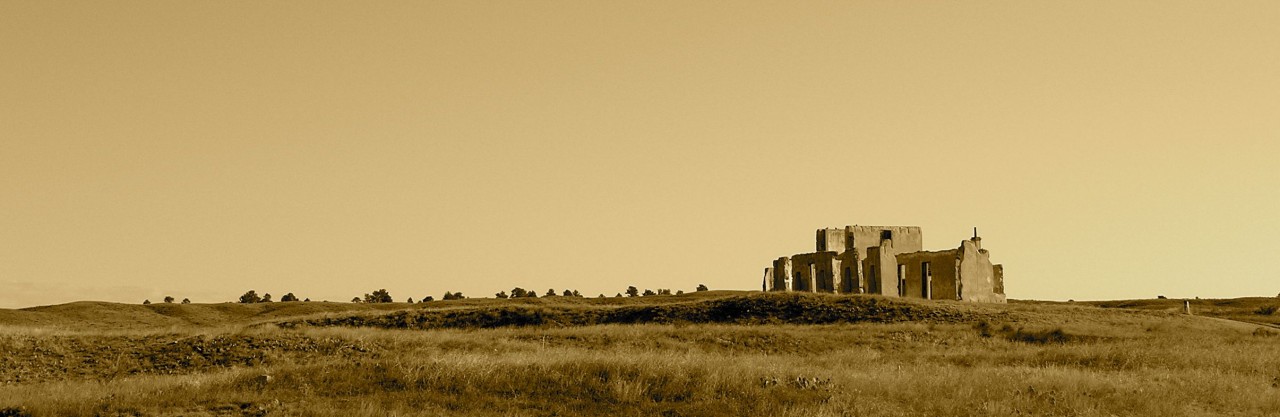
Eastern Wyoming (where Fort Laramie sits) is vast, open, and sparsely populated. It’s so easy to find peace and quiet, to be alone with one’s thoughts. This lends itself to observation, contemplation, and (yes, I’ll say it) spiritual reflection. Even the chronic prevailing winds of the western plains assist. A good, stiff wind in your face cleanses the soul like a sand-blaster cleans painted brick. Wide open spaces and weather: these are a few of my favorite things.

Add in historic Fort Laramie, with its crumbling brick facades, you find yourself reflecting on the past. Like most historic sites west of the Mississippi, Fort Laramie is part and parcel of Native American history, in this case the history of Indian suppression. A visit there makes one specifically reflect on that part of America’s past.

I feel like I could type forever, spewing forth my thoughts about the tragic conflict between the tribes of the Americas and the white settlers. I’d make a blog post so massive and unreadable it’d go down in the annals of bad web content forever. Instead, let me just give a short list of some observations I made at Fort Laramie and similar sites across the country:

  • Did you ever notice that great swaths of the Plains cleared of Indians by the U.S. Army are still pretty empty?
  • Did you notice that people are actually moving out of rural areas in the midwest? Depopulation of the plains has been going on for some time now.
  • Did you know that much of the land taken from tribes was given to cattle ranching? Did you notice that overconsumption of beef is now deemed a health hazard, and current factory-style, corn-fed beef production is considered bad for the environment?
  • Did you notice that family farms, another beneficiary of U.S. Indian relocation policies, are dying out and being replaced by corporate farming concerns that no one seems to like?
  • Have you noticed that California, the “promised land” for wagon trains and railroads, is, well, kind of a mess right now?

It’s been well over a hundred years since the government’s longstanding programs effectively nullified the Indians as a resistance movement and nearly eradicated tribal culture completely. But now, after all this time, I think the question needs to be asked: was it really worth the price?

Playing “what if” games is rarely productive. Nothing can undo what was done, and Monday-morning quarterbacking has as much value as Monopoly money. But maybe, hopefully, we can take the lessons we learned and teach them to others who sit along a similar precipice we sat upon in our expansionist phase. You don’t need to extinguish a competing culture or civilization to succeed and grow. In fact, it’s quite likely it leads to an opposite result.

[The pictures on this blog entry are mine and copyrighted thusly. More are here.]

============================================================

Links:

Fort Laramie National Historic Site

Change of Heartland: The Great Plains

Holy Cow: The Wide Impact of Eating Red Meat

Google map to Fort Laramie

Just for the heck of it, I added a picture of a bunny….

Read Full Post »

Is It Time?

How long does it take for an event to move from the present into history?

I’ve listened to a lot of talks by a lot of historians. It never fails, someone will inevitably ask “how will history look back on the the events of today?” And historians almost always give the same reply: “well, we won’t know until enough time has past. Future historians will have to judge.” Yadda yadda yadda.

In Remembrance © 2009 America In ContextI’m wondering: has enough time passed to honestly and objectively look back on 9/11? There hasn’t been another terrorist attack on U.S. soil, but al Qaeda still makes is presence felt elsewhere.  The administration of President George W. “9/11” Bush is over, but the resulting wars in Afghanistan and Iraq are still going on. And bin Laden is still out there, somewhere. We don’t know if he’s dying of cancer or plotting the next attack. So I’m not quite sure enough time has past to put 9/11 in its proper context, it seems like we are still living it today. If we are still living it, has it past into history? Hmmm….

Because I’m not sure it has past into history, I’m also not quite sure we can properly memorialize it. Time has to pass before one can honestly reflect on an event. There’s too much emotion otherwise, and you end up acting completely on impulse and make bad judgements that you then have to live with. So has enough time passed to build memorials, things that will stand for generations and generations? Will such a memorial teach the right lesson to those who weren’t here in 2001?

Jacket and Stuff © 2009 America In ContextThe Vietnam Veteran’s Memorial was built in 1982, seven years after the fall of Saigon. Here we are, eight years after 9/11, so maybe it is time after all. The only difference, of course, is the Vietnam War actually ended. The conflict itself was closed, the troops were brought home. The scars and carnage remained, but at least the nation had those seven years to reflect, and think, and figure out how those lost lives should be remembered. We now have one of the most moving memorials ever created on the west end of the National Mall.  I want the same thing for 9/11, a symbol that evokes the right emotion and conveys the right message to those who might visit it 20, 50, or 100 years later. I don’t want some rushed hunk of granite garbage that evokes a response of “WTF?”

Regardless of the answer to this heavy question, I do like the design for the memorial to Flight 93. I’ve reviewed it, and I’ve visited the site, and I have to give my own, “mouse that roared” thumbs-up to the proposed memorial in Shanksville, PA. I think it’s subdued enough, thoughtful enough, and emotive enough to qualify as a true, honorable monument to those 40 folks who gave their lives in a senseless, pointless act of violence. I especially like the groves of trees and the low, graceful lines of the design. It fits in with the landscape and the dignity we’d all like to see.

I don’t ask this often, but I hope you’ll take the time to visit the Flight 93 Memorial Project and make a  contribution to the creation of this monument. After wrestling with the issue during the crafting of this post, I think its time has come.

Sacred Ground © 2009 America In Context

[Pics are mine and appropriately copyrighted. More are here.]

=============================================================

Links:

Flight 93 National Memorial

Flight 93 Memorial Project

Google map to the Flight 93 memorial

Read Full Post »

The Good Life

A little while ago, in my post on Edgar Allan Poe, I talked about a creative genius whose life would suffer through poverty and hardship and end in tragedy and mystery.

Today, I’m posting about another great literary figure whose life progressed quite differently: Nobel- and Pulitzer-prize winning playright, Eugene O’Neill.

I am, admittedly, not “well read”. I’ve only read one or two of the classics, and only because certain college courses demanded it. I also don’t attend a lot of theater, although I will attend plays by Shakespeare whenever our local playhouses present one. So I really don’t know that much about O’Neill or his plays, other than a forced reading of “The Hairy Ape” for that three-credit “art domain” course at the state university. But there is no denying the man is one of the giants in American literature, having penned renowned plays such as “Morning Becomes Electra” and “The Iceman Cometh”.

Porch © 2009 America In ContextWhen you visit his home in the hills of Contra Costa County, California, it becomes abundantly clear that he, unlike Poe, enjoyed the fruits of his labors. It’s a beautiful Spanish Colonial house, set on a wonderfully landscaped lot, overlooking the valley below, and backed by the rocky, wooded hills of the Las Trampas Regional Wilderness. It’s a truly elegant setting, fit for a man clearly loved for his dramatic creations. The only tragedy here is his wife, Carlotta, was extremely light-sensitive and kept the windows covered by thick wood blinds and shades. Such tremendous views wasted, although I don’t fault her. I suffer slightly from light sensitivity, I can empathize with her dilemma.

I’m not quite sure what else to say about Eugene O’Neill, except for this: I never begrudge artists, whether authors or playwrights or actors or musicians, from living well off their talents. Artists are special, and art advances us as a species like nothing else can. Art is more influential than technology or governance or business or medicine in that regard. Art is the gateway to the spirit of mankind, and it is that spirit that advances us.

I know this sounds trite and packaged. Aren’t we all supposed to say “art is the gateway to the spirit of mankind” or some such crud? Sounds like it’s right from the mouth of a guest star on Oprah. But I’m convinced it’s true. There’s something personal and unique about an encounter with art. You see it, or read it, or listen to it, or watch it, and your initial reaction is unique to you and you alone. Art tends to cut through all those social filters that muddy up our society and sends a message straight to the individual (instead of the huddled masses).

Friends © 2009 America In ContextNow, that message might be: “Hi. I’m really, really ugly. Please take note.” And that’s fine, because the next guy, totally independently, can receive a message: “Hi. I’m you. You really need to take a hard look at this, and change your life before it’s too late,” and that can be a really powerful message.

Famous and beloved artists tend to touch more people, send out those messages that give them hope, or give them insight, or give them motivation to change. Technology can’t do that, it only provides a vehicle to get things done. Politicians can’t do that, all they can do is further enslave us into dependency on government. Theocrats can’t do that, all they can do is entrap us deeper into the constraints of dogma. Only artists can do that. Or maybe a real, good friend.

Folks like O’Neill, Bob Dylan, George Carlin, Steven Spielberg, Robert Plant, Stephen King, and a host of others, all manage to reach out and touch lots and lots of people, and I have no problem when these folks living well. In fact, I hope they do so.

Now Brittany Spears, well, that’s an entirely different topic …

Front View © 2009 America In Context

On a side note, I do want to mention one key difference between Poe’s and O’Neill’s NPS sites. In my prior post, I remarked how the Poe site’s neighbors seemed to like having Poe in the neighborhood. They do readings for local kids, and no one has ever defaced that wonderful mural of the author, even though it doesn’t seem like a pleasant neighborhood. It’s sad to say so, but it certainly appears that O’Neill’s neighbors aren’t particularly interested in having his site in their neighborhood. It’s a very upscale, expensive neighborhood, and you have to be bused in from a commuter parking lot (no tourist cars are allowed), and there doesn’t seem to be the connection between the neighborhood and the site or the man. In all fairness, the winding roads and limited parking are not conducive to lots of tourists, but you definitely get the feeling folks int he area don’t care too much for having a National Park unit in their vicinity. It’s sad, and in my view, it doesn’t speak well to their character.

I hope someone from the area can post here contradicting me. It was just an observation, drawn from a particular moment in time and seen through my jaded eyes. Hopefully reality is different. If you have direct experience with this site and its neighborhoods, and you think I’m full of crap, please post & tell me (just keep it civil 😉 ).

[Photos on this post are mine and copyrighted thusly. See other photos of Eugene O’Neill’s home on my Photobucket page.]

========================================================

Links:

Eugene O’Neill National Historic Site

Eugene O’Neill Archives

Google map to E.O. NHS

Read Full Post »

« Newer Posts - Older Posts »