Right Place, Right Time, Right Action
In 2002, I decided to stage my escapade through Kentucy and Indiana from Louisville. From there, I would take day trips to Lexington, Abe Lincoln’s birthplace, Mammoth Cave, and George Rogers Clark National Historical Park.Most times when I take my park excursions, I plan at the last minute and don’t do a ton of research. And most times I find myself disappointed by the uninspired mundanity of my accommodations, and the realization I may have missed something grand or at least interesting. However, for once, my lack of foresight had good consequences. I figured Louisville would be a typical, decaying, Middle American city, with typically craptastic restaurants and nothing much to see or do. Well, as occasionally happens during my ill-planned sorties, I was shocked and pleasantly surprised. Louisville actually has a hoppin’ Bohemian district!
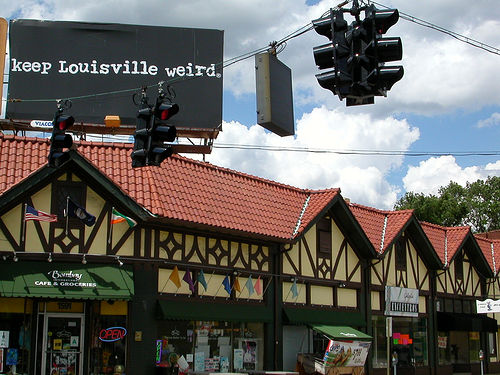
This place was great. Lots of restaurants, high-end shopping (which meant cadres of good looking women), used book & music stores, antique shops, and great clubs & brewpubs. It had head shops, tie-dye stores, acupuncturists, and even a Church of Scientology (located in some sort of run-down, drive-through bank building). I couldn’t believe it. Here — lying in stark contrast to the decidedly Christian backwater that comprises the rest of Kentucky — is this little nook of cultural strangeness. Hard to believe this section of Louisville is in the same state as the Creationism Museum with its displays of man peacefully co-existing with dinosaurs….
Of course, it is only a couple square miles. One can’t expect more in this part of the country. Heading northwest from the city, it doesn’t take long to get back to what one would expect: a traditionally decaying mill town; surrounded by smallish, uninteresting suburbs; dropping into Indiana corn country. It’s not a bad ride to Vincennes, really. Yeah, it’s a bit boring, but the countryside is moderately unspoiled and you do pass through the Hoosier National Forest. There are worse 2-hour drives in the country, I’ve been on some :coughwesttexascough:
—-
Poor, forgotten George Rogers Clark. A Revolutionary War general, he’s sadly missing from the text-book lists of American founders. That’s a big list: Washington, Jefferson, Franklin, Lee, Lafayette, Kosciuszko, Hancock, Adams. Yet Clark’s vision ensured the westward expansion of a post-revolutionary, fledgling United States of America. It’s actually a funny story (in a geeky, history-buff kinda way).
 It all started with the settlement of interior North America. The French got their first and got busy. By the mid-18th century they had settlements from modern-day Quebec down the St. Lawrence River to the Great Lakes and down the Mississippi to New Orleans. They also had spots on the Ohio River and other tributaries. They were in a pretty good position actually, but their settlers were more concerned with fur trapping and trade than continental domination. The Seven Years’ War with England (called the French and Indian War by us Yanks) came along, the French got beat pretty badly and, in the Treaty of Paris, England gained possession of all those forts. Of course, the Brits being the Brits, they figured they could just plop some redcoats in the forts and claim lordship over the lands. The French settlers still worked their farms, collected fur pelts, and paddled up & down the river in trade like they had for a generation, while theoretically under British “control”.
Then along came the American Revolution. The thirteen colonies wanted their independence, and badly. Unfortunately, the colonists also knew the British would be a problem even if they won. The Brits would control almost all the fledgling country’s borders: their territories to the north (modern-day Canada) and all these forts along the lakes and rivers to the west. So even if the colonies gained independence, the new nation would still be bottled in, and likely harassed in perpetuity, by Great Britain. Kinda like living in your mother-in-law’s house after the divorce. Awkward!!
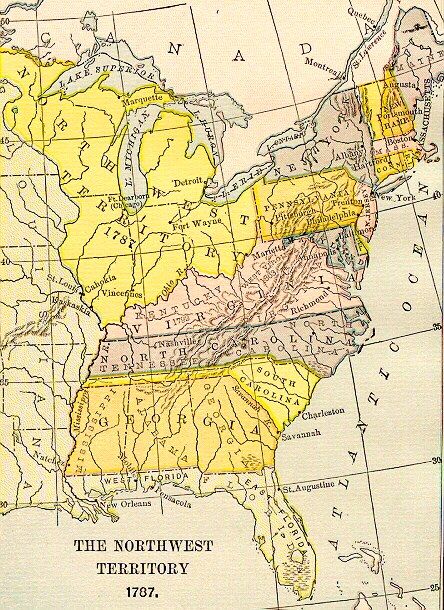
George Rogers Clark saw this problem. He beseeched the Virginia militia commanders, who saw the brilliance of his proposal and lent him a band of raiders to harass these forts. Up they marched to the Ohio River, and then down to the first fort … which they took without much of a fight. Then they marched to the next fort, and … took it, too, without much of a fight. Why? Well, the French settlers kinda didn’t give a crap for the British, and basically told the militia “well, go ahead and take it, we don’t care. We just want to kill some fluffy little animals.” The two or three Redcoats manning those forts, realizing they had no logistical support, high-tailed it out of there or just sat drinking their tea and said “meh”. Result: the colonial powers now owned the Northwest Territories, the Great Lakes, and the Mississippi down to Louisiana. Hardly any casualties (other than long marches in the wilderness would claim).
This was met with great “huzzahs!” by the Continental Congress and Washington’s army, and deservedly so. Now the country had a chance to not only be independent, but have the breathing room it needed to keep it safe and sound for the foreseeable future. Clark was heralded and promoted and eventually fought in actual combat situations. But he’s honored at a humble little shrine in Vincennes, Indiana for basically ensuring the Brits wouldn’t be on our flank for all time.
If there’s a story to take away from Clark, it’s this: it’s not only about being in the right place at the right time, but taking the right action. And it helps if the French don’t give a crap.

[Sadly, I didn’t own a digital camera when I visited GRC NHP. All pics are public domain from Wikipedia or the links referenced below. Some also came from www.earlyamerica.com, a nice, simple site on American history I thought worthy of blogrolling to the right.]
==============================
Links:
George Rogers Clark National Historical Park
The Highlands of Louisville
Creationism Museum
Neat Kentucky history link
Read Full Post »


 America In Context