Feeds:
Posts
Comments

Posts Tagged ‘Black History Month’

Martin Luther King, Jr. National Historical Park, Atlanta, Georgia

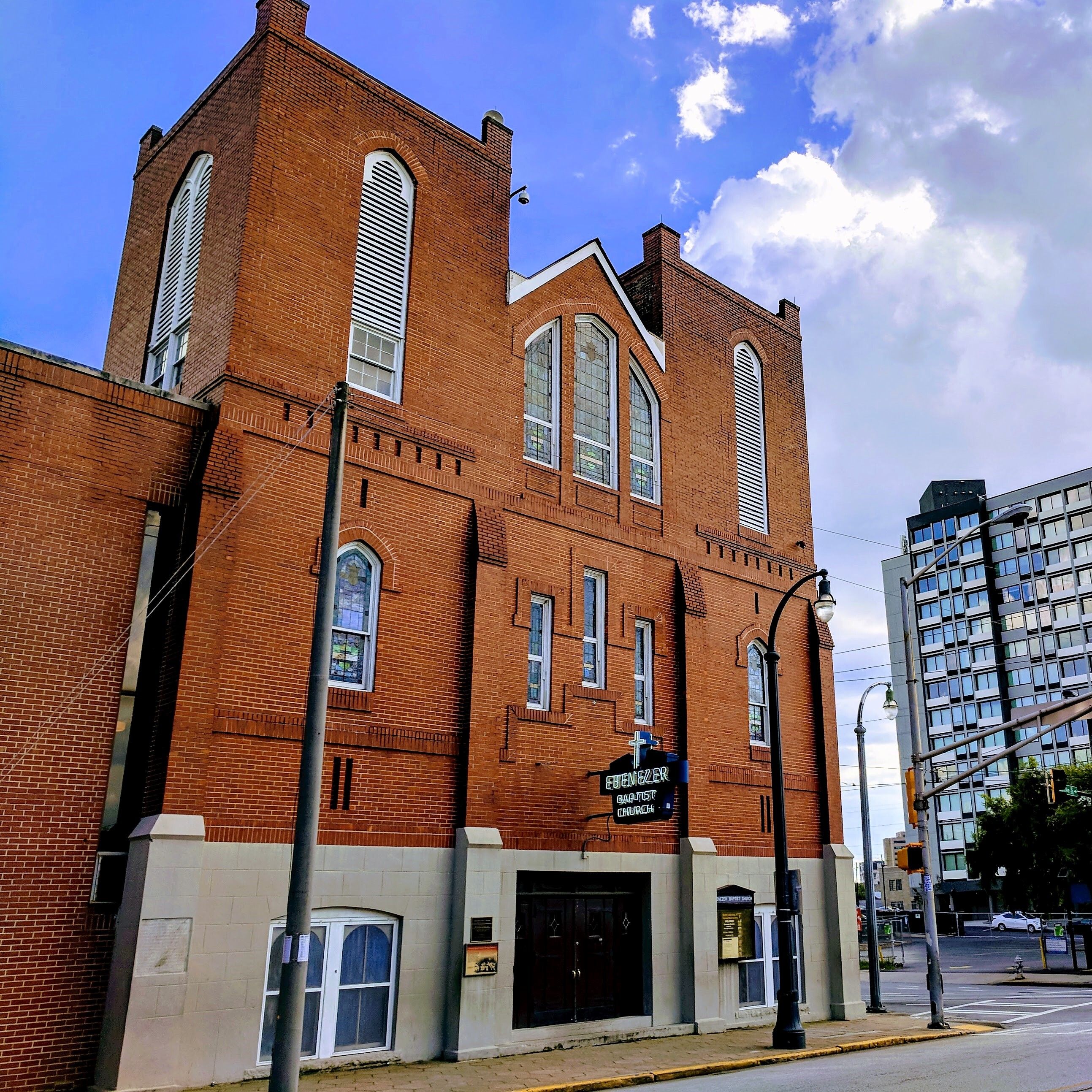
The most immediate thing I noticed when got to the historic Ebeneezer Baptist Church was the dozens of Black kids hopping off numerous school buses for a field trip. I’ve been touring these parks — natural, cultural, historical — for over 30 years, and one thing that’s glaring is the rarity of African-American visitors. It’s not surprising, considering the distinct difference between the white and black experience in these United States, but it’s still a shame. This is their country, after all: they built it, they endured 400 years of slavery and misery because of it, and it’s a damn shame that we haven’t come to terms with that. But, we haven’t, and in light of events of the past decade, I doubt we will in my lifetime.
Ebenezer Baptist Church

I’m currently reading Bearing the Cross: Martin Luther King, Jr., and the Southern Christian Leadership Conference, by David J. Carrow. I’m embarrassed and ashamed I never read a King biography, so I chose this Pulitzer-prize winning 1986 tome. It’s a thorough retelling (perhaps too thorough, it’s taken me an embarrassingly long time get through), but it’s very interesting. Of course, it goes into the major events (the early bus boycotts, the March on Washington, Kennedy’s assassination, and the ultimate demise of Rev. King himself), but also a lot of the smaller behind-the-scenes machinations and foundational decisions of the Civil Rights movement. There’s still a lot to learn from those days, lessons that we can apply today, under this slew of new attacks on fundamental and Constitutional freedoms.

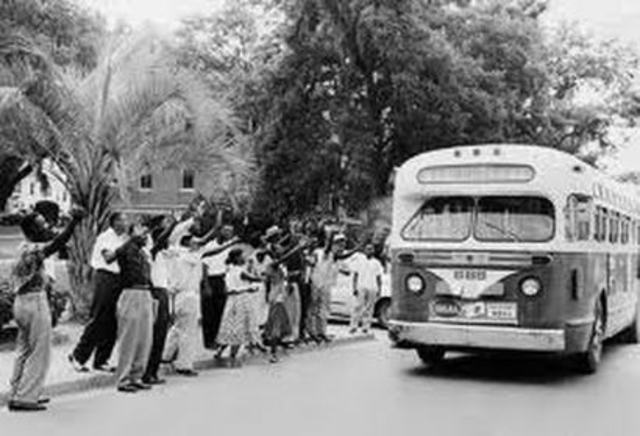
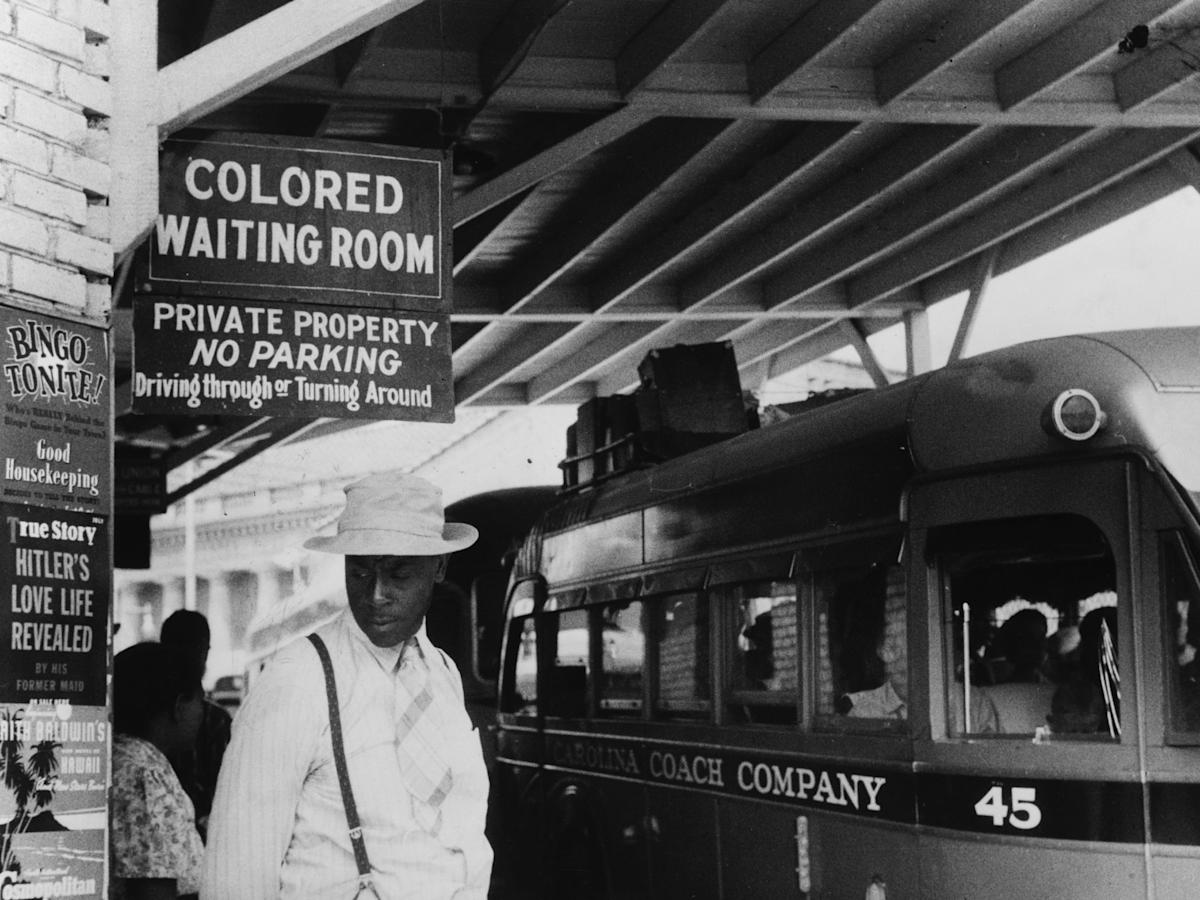
The Montgomery Bus Boycott is a fascinating case study of resistance, one perfectly suited to America’s blend of capitalism and democracy. Montgomery, Alabama was a typical, deep-south city of the time: segregated lunch counters, water fountains, schools. Tacit agreements on hiring, Black people relegated to menial labor, domestic service, or setting up their own commerce on the sly. Today, we know all of this, but what people might have forgotten was the importance of bus transportation in the 50’s. One out of three households did not own a car, higher in the cities (as is today). Buses were used by all races and classes back then, to get to work, go shopping, run errands, etc. They were the backbone of cities everywhere. And, of course, the buses in Montgomery were segregated.
Bus Hecklers

It was a stroke of genius to boycott the buses. It threatened the bankruptcy of the city’s lifeline, hitting business owners right in the wallets. Those business owners demanded pushback, and that pushback came: harsh and violent. Shots were fired, bombs hurled. But the good guys prevailed, the desegregation of the Montgomery buses became an early victory in the battle for civil rights, and the entire movement was off and running. This victory led to a few other incidents — some peaceful, some violent — that got the attention of the White House, eventually leading to the passage of the Civil Rights Act in 1964.

History likes to tell us it was state & local governments that kept the oppression of slavery alive through unjust Jim Crow laws, and that’s true. History also likes to tell us it was the KKK and a slew of police and sheriff’s departments who enforced those laws with indiscriminate brutality, and that, too, is true. But history likes to forget that the engine of oppression, the true power behind the throne, the thumb that the Black man had to live under in order to put food on the table, was American business, small and large. All those diners and music halls; department store soda counters; baseball stadiums; newspapers and radio stations; and transit systems: they’re the ones who truly kept racism alive. They’re the ones who called the cops if Black people were walking by their front door too slowly, or sat on a bench to rest. They’re the ones who funded the reelection campaigns of the city councils and legislatures who passed those laws. They’re the ones who fueled hate with conspiracy theories and false narratives in their newspapers and on their radio programs. And they’re the ones who took advantage of an entire race by paying them lousy wages for hard work by ensuring there were no other opportunities.
Waiting for a Segregated Bus

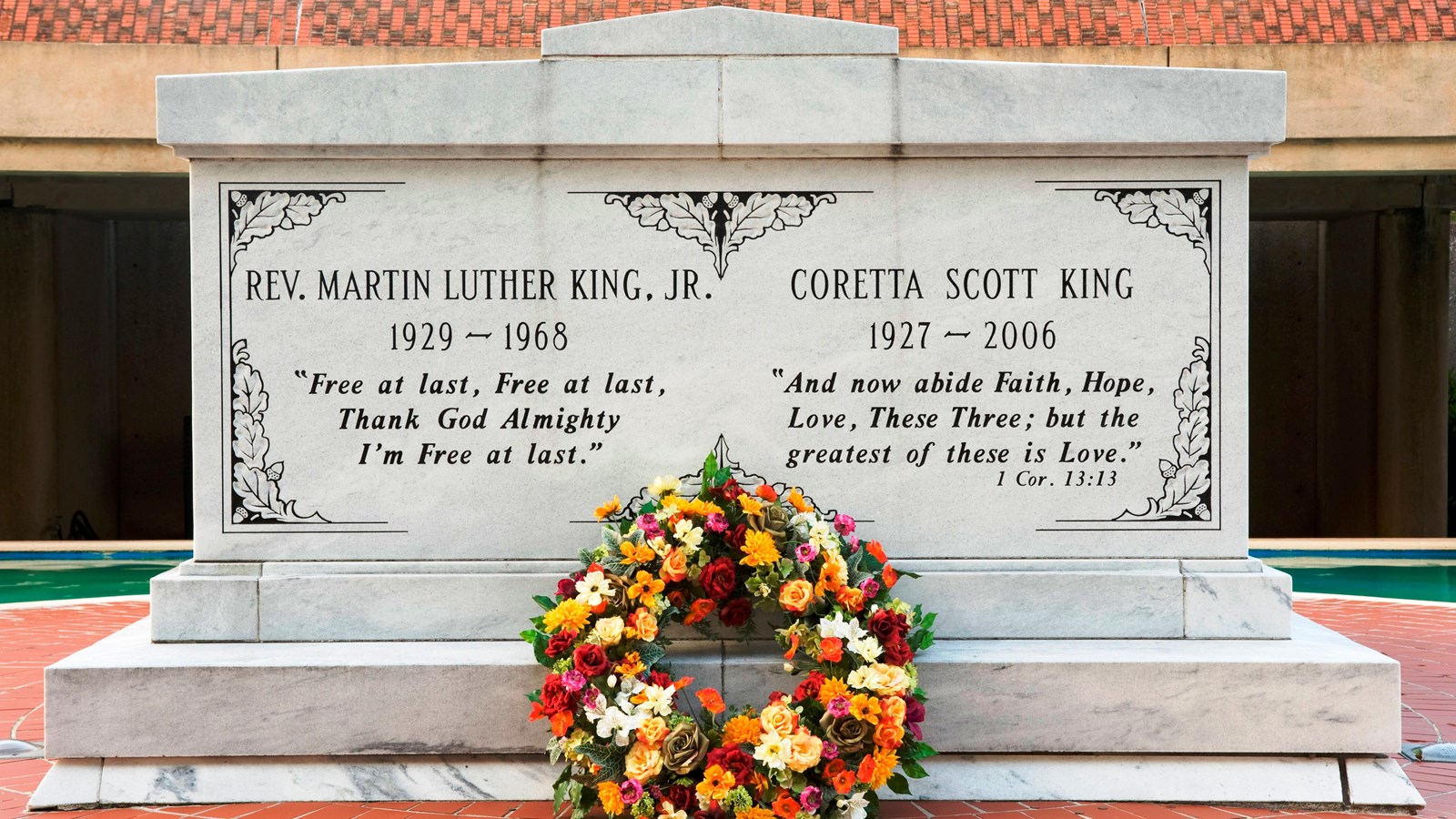
Dr. King and all the others who marched, protested, and caused good trouble in the Civil Rights movement were brave beyond measure. They stood up to centuries of contempt, threats, abuse, legal trickery, violence, and outright murder, and the country came out better for it. It saddens me to no end to see all those hard-won gains be lost today, due to the machinations of a new cadre of oligarchs, the politicians they bankroll, and the brownshirts radicalized by their media empires.

I’ll be retiring soon, and I hope to devote my time in opposition to what is happening in this country. My one, big hope is someone comes along to show us the way, like Dr. King showed us in 1955.

I have a feeling such a person is not coming. We’re going to have to do this on our own.

Links:

Martin Luther King, Jr. National Historical Park

David J. Carrow

Important Historical Protests

The Rise of America’s Broligarchy

Read Full Post »

Freedom and Repatriation

The Lincoln Memorial might be our greatest national symbol. It’s everywhere: our currency, our iconography, our culture. Presidents have spoken in front of it. Martin Luther King gave one of his most moving speeches from its stairs. Numerous musical artists including, famously, opera singer Marian Anderson, performed to massive crowds gathered there. It’s appeared in everything from Mr Smith Goes to Washington to Forrest Gump to Planet of the Apes. There’s not much I can add to the lore of it, other than to say every American should make the pilgrimage at least once.

Instead of posting some weak trivia list about the Lincoln Memorial, I’m going to write about The 1619 Project.

Marian Anderson, 1939 (Library of Congress)

————————

The 1619 Project was a collection of essays published by the New York Times in 2019, and again in book form in 2021. I’ll let historian and journalist Lerone Bennett, Jr. explain:

A year before the arrival of the celebrated Mayflower, 113 years before the birth of George Washington, 244 years before the signing of the Emancipation Proclamation, [a] ship sailed into the harbor at Jamestown, Virginia, and dropped anchor into the muddy waters of history. It was clear to the men who received this “Dutch man of War” that she was no ordinary vessel. What seems unusual today is that no one sensed how extraordinary she really was. For few ships, before or since, have unloaded a more momentous cargo.

Bennett, Lerone Jr, Before the Mayflower, 1962

That ship was the White Lion, the year was 1619, and its cargo was “twenty and odd” captives from west Africa.

The central premise of The 1619 Project is this: the collective history Americans hold dear grossly underrepresents the impact and long-lasting effect of slavery on this country. In a series of long-form essays, a variety of authors, journalists, and historians lay out the case that slavery affected America’s viewpoint on everything from property rights to citizenship to economics to the very definition of democracy. These essays are hard-hitting, blunt, and brutal, and together assemble a very sobering read. Of course, they cover the obvious, like the 3/5th clause of Constitution and the collaboration between the KKK and law enforcement in the Jim Crowe South. But they also make links that might not be so obvious, including throwing some shade on our best president, Abraham Lincoln.

Before I go on, let me state up front that this is not intended to demean or degrade the Great Emancipator. Frederick Douglas called him “Tender of heart, strong of nerve, of boundless patience and broadest sympathies, with no motive apart from his country. […] Take him for all, in all Abraham Lincoln was one of the noblest, wisest and best men I ever knew.” Booker T Washington said “[M]ay I say, you do well to keep the name of Abraham Lincoln permanently linked with the highest interests of the Negro race. He was the hand, the brain, and the conscience that gave us the first opportunity to make the attempt to be men instead of property.“ But W.E.B. Dubois was probably more accurate in his own assessment: “Abraham Lincoln was perhaps the greatest figure of the 19th century. Certainly of the five masters – Napoleon, Bismarck, Victoria, Browning and Lincoln, Lincoln is to me the most human and lovable. And I love him not because he was perfect but because he was not and yet triumphed.”

Laborer with Lincoln Memorial (Library of Congress)

Lincoln, as great as he may have been, had one small problem, a bit of a character flaw, or at least a lapse in judgement. That problem was the American Colonization Society. Founded in 1816, the ACS was an unlikely group of early abolitionists, Southern slaveholders, and politicians of all persuasions. These men felt the chief concern of the time had a solution, and that solution was the repatriation of freed Blacks to Africa.

The abolitionists were afraid freed Blacks would simply never fit in, becoming a permanent underclass throughout the North. Slaveowners felt these freedmen would work tirelessly to free their brethren, perhaps engaging in violence or insurrection or even murder. Politicians were afraid they would taint voter rolls, influence elections, and threaten established power. Honestly, it’s hard to say their fears were unjustified, and Lincoln himself seemed to share those fears. Although he was not a member of the ACS, Lincoln espoused the idea of Black relocation as early as 1851. By 1862, he created the position of Commissioner of Emigration, and convinced Congress to appropriate $600,000 to ship freed Blacks to another country.

Black freedmen were appalled. They wanted to be free, yes, but not like that. By this time, some 240 years had passed since the White Lion docked. Generations of their forebears lived in houses, worked the soil, raised their children, all on these shores. They knew not of other lands, knew not of Africa, nor of any other land but America. Repatriation was a deplorable option. The United States, as flawed as it was, as dangerous and hostile as it was to slaves and freedmen alike, was still their home.

They would prove this in short time. After Lincoln’s official Emancipation Proclamation — which did not include any references to repatriation — some 200,000 Black men served in the Union army. That’s an astounding 78% of military-aged men! They took the Civil War personally, it was their fight, for their freedom, in their country.

Colored Troops, Port Hudson, LA, 1864 (National Archives)

———

Lincoln was an imperfect man. His emigration plan was a terrible idea. But he listened to the criticisms, dropped it, and changed the course of American history. Unfortunately, we still stumble across repatriation now and again. In this country, we debate the disposition of the Dreamers, young people smuggled into this country when they were very small, at no fault of their own, who are often threatened with deportation to countries they’ve never known. And right now, in the Middle East, ancient animosities are used as excuses to forcibly evict people off lands they’ve inhabited for decades if not centuries. In these cases, and many, many others, nobody cares. These “intolerables” would be better off gone, some would think.

But no one should be forced from the only home they’ve ever known. This has to be a fundamental precept of freedom.

———

I highly recommend The 1619 Project. I consider it vital reading for anyone wishing to understand this country, past and present.

———

Links:

Read Full Post »