For Your Consideration: The Greatest American
Some time ago, on a long-forgotten internet message board, someone posed a question: who was the greatest American in history?
Of course, the internet being the internet, the argument soon disolved into a flame war (I’m sure someone mentioned “abortion” somewhere and it just devolved from there). Somewhere in the fray, however, I made a case for Dwight D. Eisenhower as the Greatest American. Now you can’t answer a question without understanding a question so, as I did on that tiny little message board, I’ll start off explaining my interpretation of that particular question.

Most folks, upon hearing that question, will instinctively think only in terms of America itself, as in “which American did the most for America”. A logical answer here would be Abraham Lincoln, a man who not only kept the Union from dissolving, but also had the guts and fortitude to fight the greatest evil America has ever wrought: the continuation of slavery nearly 9 decades into its existence. Slavery was an unholy abomination that should have been extinguished when Thomas Jefferson put the last period on the Declaration of Independence, but it was allowed to exist through the sheer audacity (and utter cowardice) of founders and legislators and presidents alike. No President stood up to slavery until Lincoln, and his actions saved our country. We were not only saved literally (by stopping secession), but also morally. We had no moral fiber as a nation until slavery was abolished. It is as simple as that.
 The only problem I have with proclaiming Lincoln as the “greatest American” is his actions really only saved the country. When I hear “greatest American”, I think globally: which American did the most for the world? Now that is an entirely different question. Sure, some could extrapolate “well, America is the greatest country, and Lincoln saved America, so Lincoln is the greatest”. That not only shows a grotesque level of hubris, it’s not really accurate. America wasn’t a world player for nearly a century after Lincoln’s time. We were an isolationist nation. We were protected on two fronts by mighty oceans, and only had two neighbors. No threats = no conflict = no interest in the world. Plus we were a nation of immigrants, collectively giving Europe the big middle finger as we went on our way, making our own prosperity (and driving the native population into their graves, but that’s the subject for yet another post). Saying Lincoln was a great world figure is simply disingenuous.
So, if we honestly answer “which American did the most good for the world”, well, you can come up with a lot of answers. Many (and perhaps rightly) say medical pioneers like Jonas Salk or inventors like Thomas Edison or scientists like Robert Oppenheimer deserve the title. I appreciate these picks, but I have to ask: is science purely an American endeavor? Isn’t science simply the discovery and application of facts, principles and theorems? What makes it uniquely American? Doesn’t science transcend nationality? Jonas Salk could just have easily have been German, or Spanish, or Japanese. I’m not at all denigrating the work of these individuals in making my pick, I’m actually elevating them beyond simply being Americans. Well, I suppose Edison was truly American: he was an incredibly shrewd businessman and power broker who set out to destroy his competitors, but, again, that’s a subject for another post …
 This leads me to my own approach to the “Greatest American” question. First, did the individual have a postive, global impact; and second, did the individual act with the best of our core American principles (life, liberty, pursuit of happiness, etc.)? I say Ike deserves serious consideration as the Greatest American under that context, and I say it for one big reason: World War II.
World War II was the greatest conflagration the world has ever known. Never before, and thankfully never since, has the globe ever been covered in carnage and evil as horrid as during the period between 1939 and 1945. I don’t even know if people can comprehend that evil. I’m fairly convinced Americans can’t, we simply haven’t experienced war firsthand on our own soil since 1865. Let me tell you, it was nasty-horrid. And the Nazis, the Nazis were the worst. They epitomize evil to this very day. Every tyrant since 1945 is judged against Hitler, every evil movement has been compared to Nazism. These people were cold, heartless butchers; utterly disinterested in freedom and liberty; technocrats and bullies of the worst kind; the filthiest type of genetic bigots and medical torturers this world has ever seen. America saw this evil and (after much prodding by FDR) finally decided to confront it. But we brought more than men and equipment to Europe, we brought a secret weapon. We brought Ike.
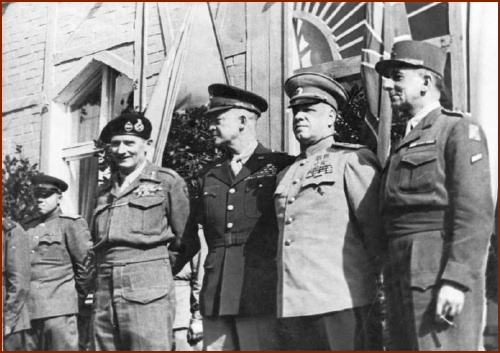
I don’t know if I’ll make many friends with this paragraph, and I don’t mean any disrespect to any man or woman who ever served in our Armed Forces, but an army isn’t worth a damn unless it has good, strong leadership. Throughout history, there are lots of stories of brave armies led to their defeat and slaughter by lousy generals; and plenty of other stories of underpowered armies led to victory by great generals. Anyone who’s read about our Civil War knows stories like these, and they occur in European history as well. Victory and defeat don’t rest on the shoulders of the soldier, they reside in the brains of the generals.
Ike was one of the better ones. I don’t think he’s rated as the greatest American general ever (I think that title tends to fall on Lee or Patton or even George Washington), but there can be no doubt he had the greatest challenge of any of them. He had to face a highly skilled, highly entrenched opponent, who had (in some cases) superior weaponry and better planning (at least in the early parts of the war). Not only that, he had to rescue no less than an entire continent from the greatest scourge mankind has ever seen. This was an enemy unlike any faced by Americans in our entire history. This was an enemy who actually sat down, in offices, using businesslike precision, and plotted the extermination of, by some counts, 11 million people! [See link below for more on this]. This was much, much more than simple warfare. The stakes were much higher.
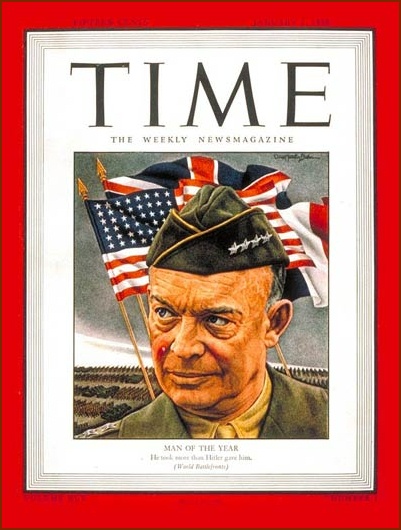
I’m hoping that, by now, you see why I’m nominating Dwight D. Eisenhower, Supreme Allied Commander Europe, as the Greatest American. Yeah, he didn’t beat the Nazis all by himself (no one achieves anything by themselves). Yeah, he made a lot of blunders and mistakes and some (like the continued delay of the invasion of Europe) probably led to further deaths in the Soviet Union. I still think his achievement earns him the title of Greatest American. He was a fine president, the 50’s were a good time in this country. He sponsored the interstate highway system, connecting us in a way we never were connected before. He started the battle against Communism (although he didn’t act to combat McCarthyism). He tried to integrate our racially divided nation (with admittedly limited success). He even tried to warn us about the growing power of the military-industrial complex, you don’t hear too many politicians doing that these days.
Most impressive, in my view at least, he was a humble man. His retirement home, now the Eisenhower National Historic Site near Gettysburg, Pennsylvania, is probably the humblest house ever inhabited by any former President. Hell, it’s not much different than the farmhouse next door to my own boyhood home. Personally, I think humility is one of the best characteristics a human being can ever have. Arrogance is for assholes, humility is for great people. Personally, I think Eisenhower was more of the latter and less of the former.
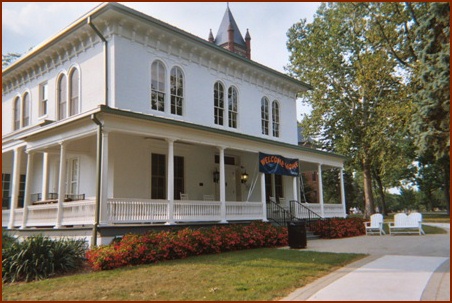
[I normally don’t ask for direct feedback on a post, but I’d love to hear your thoughts on the “Greatest American” question. Also, I didn’t have a camera when I visited Ike’s house, all pictures on this post are public domain photos taken from the NPS or Wikipedia or other sources.]
===========================================
Links:
Eisenhower National Historic Site
PowerKills, R. J. Rummel’s works on democide


 Clara Barton National Historic Site is truly unique amongst all of the historic sites in the National Park System. To my knowledge, it is the only site that was originally built with honorable, selfless intentions. I can think of no other site that was built upon as many good intentions as the collection of buildings erected by Clara Barton and her American Red Cross organization on the outskirts of Washington, DC.
 Clara Barton’s home doesn’t have a magnificent name, she was beyond such vainglorious honorifics. It’s not lined in comfort or affluence, she was neither born into wealth nor had a desire to accumulate it. It doesn’t even have any remarkable architectural elements, such things are trivialities compared with the sufferings of man. What her home did have were dozens of bedrooms, lots of storage and warehouses, proximity to Washington, DC, and easy access to the main byways of the nation. On her property, she could house those left homeless by disaster, stockpile and ships tons of emergency supplies, and lobby Washington endlessly on behalf of those who needed help.


 America In Context