Feeds:
Posts
Comments

Posts Tagged ‘history’

The Greatest Moment in American History

When one asks the question, “what was the greatest moment in American history?”, there are a lot of potential answers.

Some could say July 4th, 1776, the birth date of the United States. Well, yeah, declaring independence from Great Britain was a great moment, but it did miss the mark. It started the country down the right path, but the Founders still couldn’t resolve the slavery issue. The inability to do that would lead to decades of strife. So a good moment, but not great.

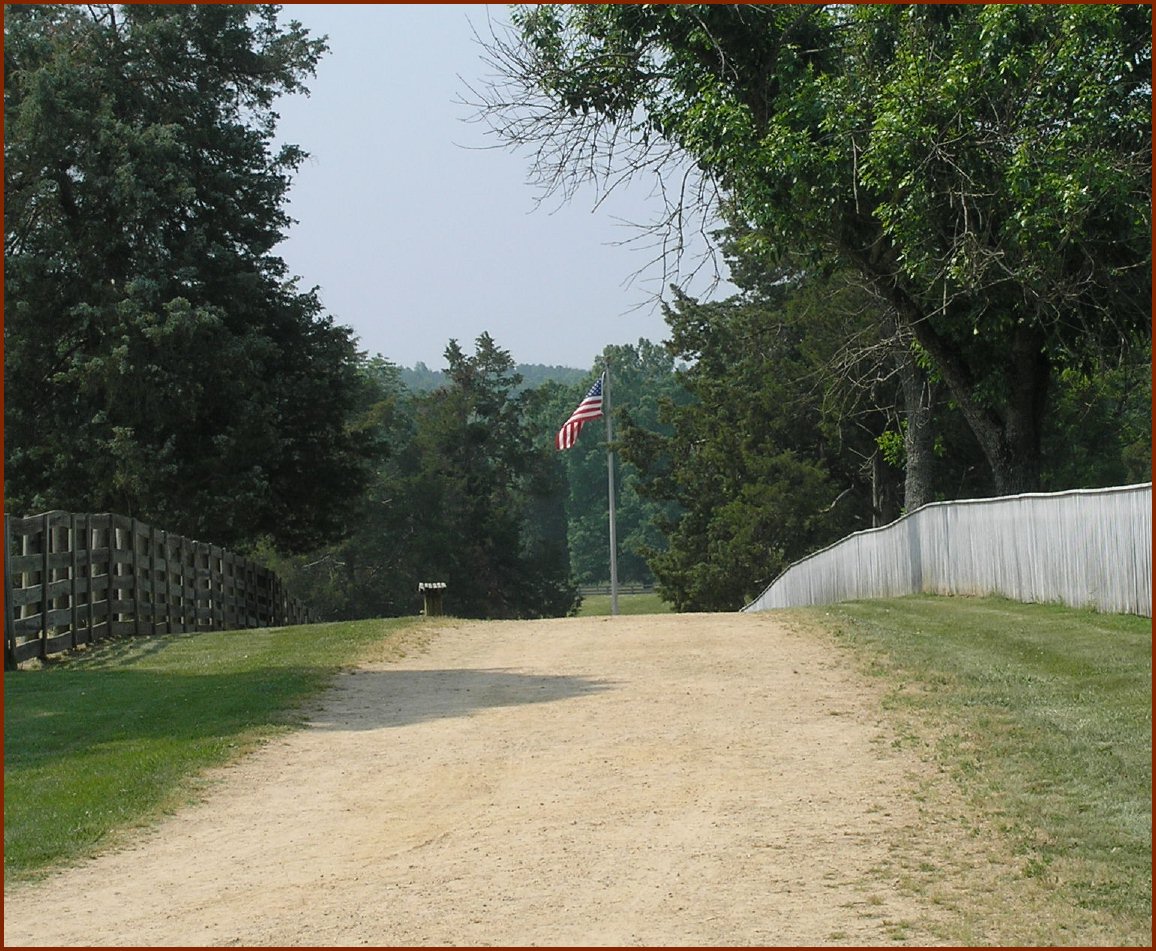
Flag on Distant Path — © 2008 America In ContextOthers look at the D-Day invasion of Nazi-held Europe to be America’s shining moment. Undoubtedly, it was an incredible feat of will and bravery on the parts of thousands of American soldiers and the men who led them, but I view D-Day as a great moment in world history, not American history. We were part of something much bigger than America itself, which is, of course, tremendous, but it’s not uniquely an American moment.

Some will also say America’s great moments revolve around technical or scientific achievements, like the moon landings or Jonas Salk’s discovery of the polio vaccine. I’m not at all belittling the great successes of those scientists and engineers. In the case of Salk, his work aided the entire world, not just our own egos. But there is something fundamentally true about science: eventually, someone will figure it all out, it’s inevitable (unless the Kansas Board of Education takes control of the planet or something…). I’m looking for moments of human greatness, not of scientific achievement.

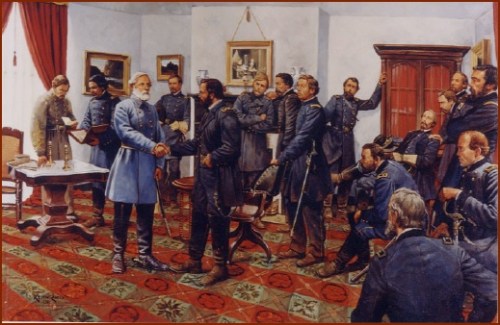
No, I say that the meeting between Gens. Grant and Lee at Appomattox is America’s greatest moment.

Now I know what you’re thinking: being from Massachusetts, I’m clearly a Union sympathizer and take great pride on the Union ass-whupping of the Confederacy. All I can say is “nope”. The victory isn’t what’s important about Appomattox. Victory was guaranteed: the Blues not only outnumbered the Greys, but they also had a stronger industry and greater resources. Victory was certain. Besides, there have been many other American victories throughout the decades, and none of them come close to being the “greatest moment,” either. It’s not victory in battle that makes a great moment.

I can sum up the reason why I feel the events at Appomattox are America’s Greatest Moment in one sentence: the American Civil War ended.

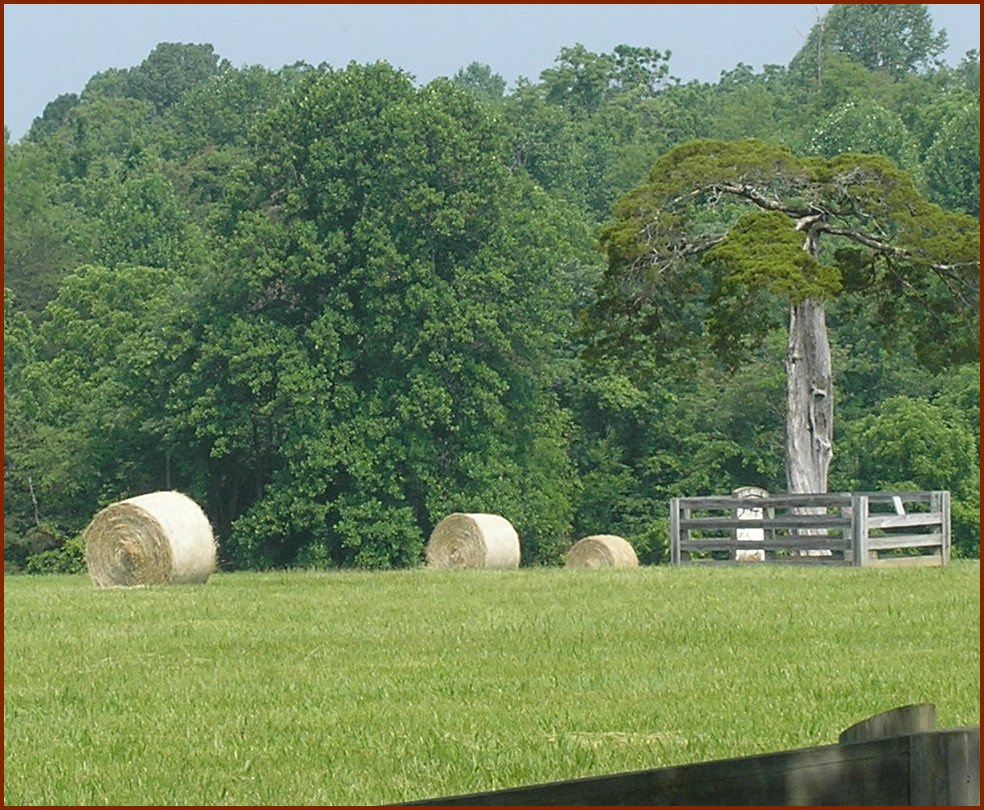
Hay Bales — © 2008 America In ContextPeople don’t understand how rare it is for a civil war to actually end outright. History shows how these things usually end: in guerilla warfare, or terrorism, or oppression, or genocide, or economic collapse, or a plethora of other horrible ways. So very, very rarely do the two sides simply reconcile, reunite, and get on with their lives. Yet this is exactly what happened to the United States in 1865. It ended this way because of the dignity and grace of the two great opposing figures: Confederate General Robert E. Lee, and Union General Ulysses S. Grant.

The scene was the Virginia hamlet of Appomattox. Lee’s Confederate Army had been chased out of Richmond and found itself surrounded by Grant’s superior – and better fed – force. Lee had no choice: he surrendered his armies to Grant, in a dignified manner befitting the son of Southern aristocrats. Grant, in a manner seemingly not befitting his prior reputation, accepted in an equally dignified manner.

For months prior to this momentous day, the North’s newspapers and politicians had mapped out a horrid path. They demanded financial reparations, extracted from the very hides of the Southern elitists who marched their states to secession. They also advocated public executions for Lee, Confederate President Jefferson Davis, and others. “Treason must be made odious; traitors must be punished and impoverished!” Of the Confederate capitol, Richmond, Northern newspapers cried “Let Her Burn!”, regardless of who happened to be living there at the time. A graceful end was not what the North had in mind.

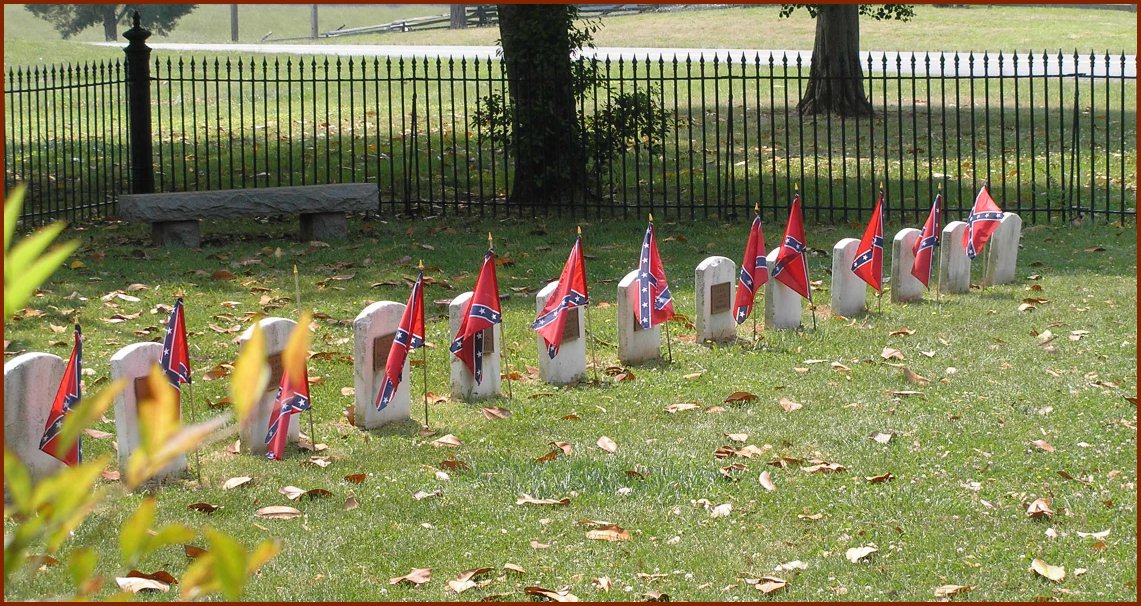
Last of the Fallen — © 2008 America In Context

The South had also been thinking of this day for months. Some in the command structure urged a continuation of war in the form of guerrilla warfare tactics, designed to disrupt and hamper the conquerors. Hit-and-run raids, sabotage, assassination, all run from the Appalachians and the dense swamps of the South. This is usually the parting shot by the conquered: a continuation of war from the shadows, perhaps (and often so) even devolving into direct acts of terrorism.

So there we were, after nearly four years of horrible, bloody conflict, at a point of immense decision. How would the Civil War end? Would the North seek revenge against the secessionists? Would the South crawl into the shadows and fight on?

Fortunately for us, these two men, Lee and Grant, were the finest two men we could possibly expect a war-torn nation to deliver. Grant was magnanimous: the beaten army must simply lay down their arms, and go home. Lee was reciprocally honorable: he had his men do exactly that.

Clover Hill Tavern & Guesthouse — © 2008 America In ContextSo there we were. On a fine April day in 1865, two armies met, shook hands, and went their own separate ways. Yes, the Union clearly won, and would clearly take charge. But there would be no guerrilla movement; no reciprocity; no retribution; no terrorism; no genocide. This is such an amazingly rare occurrence in world history, it’s absolutely remarkable.

Yes, I’m simplifying. There were a few more battles after that, but one by one, the remaining Confederate armies in North Carolina, Alabama, Oklahoma, and elsewhere would surrender, all amicably under the “Spirit of Appomattox”. Jefferson Davis was imprisoned for two years, but his bail was paid by wealthy friends north and south, and he became a free man (even writing a book about his experiences). There were a lot of controversies and entanglements around Reconstruction, and the freed slaves would still have decades of hardship ahead. To this day, we still have conflicts over the Confederate flag, so the wounds haven’t fully healed almost 150 years later. But it could have been a lot worse. Look at Algeria, or Cambodia, or Lebanon, or Bolshevik Russia, or the Congo. Long-lasting (or even never-ending) bloodbaths, all of them.

The U.S. Civil War was a terrible conflagration that killed over 600,000 men and laid waste to entire swaths of the countryside. But in the end, even with all that trauma, America emerged from the Civil War a far better country than it was when it entered. That’s largely thanks to the decency of two honorable men, meeting in a small Virginia hamlet. Therefore, I decree the Meeting at Appomattox to be the Greatest Event in American History.

The Surrender by Rocco — public domain photo courtesy of the National Park Service

My other original photos from Appomattox can be found here.

Links:

Appomattox Court House National Historical Park

Google map to Appomattox

Read Full Post »

[Alcatraz is part of the Golden Gate National Recreation Area.]

Missed Opportunity – Sort Of

I actually didn’t make it to Alcatraz Island itself during my recent trip to San Francisco. If you go, don’t make the same, dumbass mistake I did. Call ahead and get your tickets in advance! Don’t assume visiting off-season will help you …

An Alcatraz tour an impossibility, I had to settle for second- (or perhaps third- or fourth-) best: a craptastic bay cruise put on by some local outfit. (I’d also add in “expensive”, but everything in San Fran’s expensive, so why bother mentioning it). The boat was a pit, the crew uninspired, and they had this annoying tape of some drunken lout reading a horrible script over lousy speakers. I had to block out these fabulous accommodations, and just zone in the bay itself.

San Francisco is really beautiful, and a great place to take a quick cruise. The bay is frothy and windy and cold, but the views are terrific! You’ve got the city itself, the tony suburbs of Sausalito and Tiberon, the park on Angel Island, and, of course, the magnificent Golden Gate Bridge. The greater Bay Area is truly beautiful.

Well, until you get to Alcatraz Island, that is.

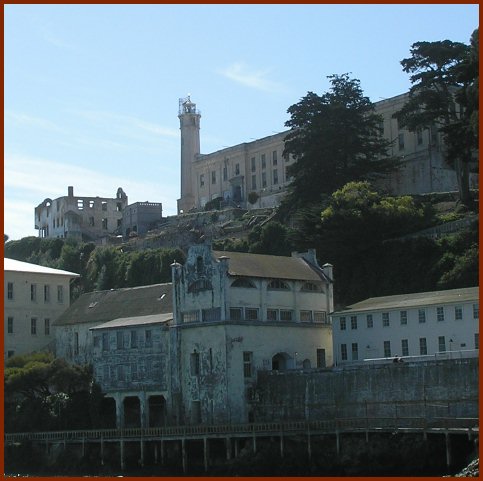
Seals and Alcatraz — © 2008 America In Context

In my travels from sea to shining sea, I’ve never seen a place so truly ugly, so exuding of evil from its very pores, as Alcatraz. Yeah, I’ve seen a lot of miserable slums and decrepitude, but nothing like this. Its ugliness lies in such stark contrast to the beauty of the Bay, it’s shocking. It’s simply … vile. I’m not sure I want to set foot on the island now. Yeah, it might be fascinating, but it’s a morbid fascination: a fascination with criminals and punishment, two things that don’t particularly interest me.

It’s Gotta Be a Sickness

I don’t find crime interesting in the least. I find it repugnant. On top of that, I find it repugnant that people are fascinated by crime. Well, let me be more specific, here. I can see how investigating crimes, tracking perpetrators, and interpreting the criminal mind can be fascinating. I’m a big fan of CSI, for example, and not just because I’ve had a crush on the lovely Marg Helgenberger since China Beach. There’s a whole science to criminal investigation that is incredibly fascinating.

Pit of Hell — © 2008 America In ContextWhat I do find repugnant are those folks who dwell on criminals and criminal acts themselves. I’m talking about those who follow cases that have nothing whatsoever to do with them or anyone they know, just for the sheer sick pleasure of doing so. I’m talking about those who follow the lives of criminals, or the suffering of the victims, with a morbid, twisted pleasure at a level much, much worse than traffic-accident rubbernecking or attraction to snuff/torture films like Saw or Hostel. I’m talking about folks like Nancy Grace and other media scumbags who will dwell on the horrors of individual crimes solely for ratings, couching it under terms like “news”, gratuitously amplifying stories to ludicrous extremes that a term like “exploitation” doesn’t seem to do it justice. And yes, I’m talking about folks who watch those shows, too. Jon Benet Ramsay, Nicole Brown Simpson, Ronald Goldman, Laci Peterson: these were all victims, folks! Their deaths are tragedies, not entertainment! Show a little bit of respect for the victims and their families, and leave them alone! And don’t give the media weasels the gratification of high ratings, turn the channel to something more wholesome, like South Park or WWE Wrestling or something.

Crime? Or Punishment?

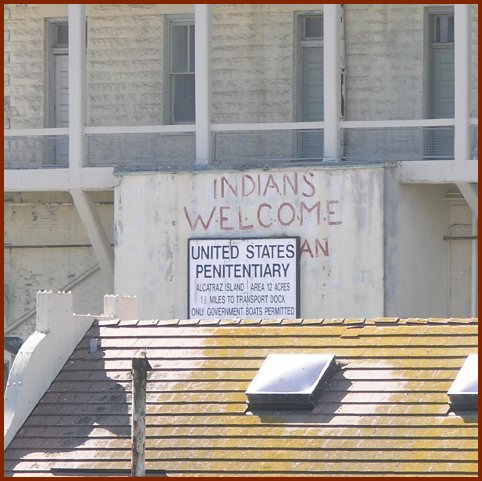
I’m sure there are a lot of visitors to Alcatraz who have this morbid fascination with crime and the criminal underworld. But there are also others who simply want to see “The Rock” out of curiosity, and that’s fine. The stories of Al Capone and Machine Gun Kelley are interesting, and there are the Alcatraz ghost stories, and the story of the American Indian occupation in 1969. So there is a lot of cool stuff about the island.

But, me being me, I see Alcatraz and have to think, not about crime, but about punishment.

Indians Welcome — © 2008 America In ContextCrime, unfortunately, is a reality in America. It’s a price to pay for living in a free society (ironically, the most “crime free” nations throughout history were really harsh dictatorships). So how is a free, advanced society supposed to handle crime? I look at how we do it here in America, and I have to think “there must be a better way.” But I can’t figure out what that way is. We seem to focus an awful lot on punishment, but not a lot on rehabilitation. But rehabilitation itself seems a farce, look at recidivism rates. Yet we can’t just keep punishing, for those who chronically punish are themselves lessened by the act (to see more views on what I mean by that, see my Andersonville post). And if punishment is bad, what about the death penalty? But contrast execution of criminals with lifetime imprisonment at public expense, and something doesn’t quite compute there either. It seems like the right answer is to stop creating environments where criminality develops, but until we take seriously the problems of inner city poverty and development, and find a real resolution to the drug problem, that’s a complete pipe dream. Of course, a lot of criminals have nothing to do with inner cities or drugs (John Wayne Gacy, Timothy McVeigh, Charles Manson, etc.)….

I don’t know what the right answer is. Clearly, with about 2.5 million prisoners nationwide, and a recidivism rate of about 50%, America hasn’t figured it out, either.

Bleagh, what a wretched topic. I’m gonna go watch South Park now.

The Rock and the Bay — © 2008 America In Context

See my other photos of Alcatraz Island here.

Links:

Alcatraz Island (part of Golden Gate National Recreation Area)

Alcatraz History

Alcatraz is Not an Island

Bureau of Justice Statistics

Google map to Alcatraz Island

Read Full Post »

Failure In Success

Antietam is one of the great battles of the American Civil War, involving 130,000 soldiers (infantry, cavalry, and artillery). There’s only one way to describe the Battle of Antietam: a bloody, awful mess. It is remembered in history as the single, deadliest one-day battle ever fought on American soil. The Union won the field that day, in spite of bad command decisions by General George McClellan and his field commanders. Lee was driven away, his weaker numbers unable to take victory, despite his own tactical brilliance. By the end of the day, over 3600 men were dead, and another 19,000 injured (and likely dead shortly thereafter, thanks to medical practices in the 19th century). A bloody, awful mess, indeed.

Confederate Dead — public domain photo courtesy of Antietam on the Web

A lot of men died in the Civil War. Over 600,000 men gave their lives on the field of battle through the course of the war, and (as always happens in war) an uncountable number of civilians lost theirs as well. But Antietam holds another special place in American history. The pre-Grant Union Army could do what only the pre-Grant Union Army could do: it snatched defeat from the claws of victory. If Gen. McClellan was any kind of able commander, instead of the pompous ass he was, he would have crushed the Confederate army right then and there, and ended the war within 18 months of its inception at Fort Sumter. But McClellan lacked something that defines winners from losers: energy and drive. He allowed his forces (thousands of whom didn’t even fire a shot) to rest on their laurels while Robert E. Lee’s men retreated southward. If only McClellan had acted then and there, and whupped Lee in the fields of Maryland, the war would have been over.

Lincoln and McClellan — public domain photo courtesy of Antietam on the WebI really want to let that soak in a bit. If McClellan had acted, the Battle of Fredericksburg would not have happened (2,000 dead). Spotsylvania would not have happened (4,000 dead). Chancellorsville would not have happened (est. 5,000 dead). Chickamauga would not have happened (est. 6,000 dead). The Battle of Gettysburg would not have happened (8,000 dead). Richmond would not have been sacked and looted. New York would not have had its draft riots. Atlanta would not have been burned to the ground. Virginia would not have had its entire countryside scoured by war. And maybe an assassin would not have claimed the life of the greatest President we ever had.
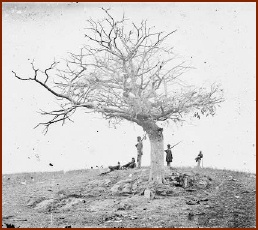
But McClellan sat on his lazy ass, Lee got away, and country had three more years of war. Good job, Georgie!

I suppose there is success in failure as well. One good thing came out of Antietam (beyond McClellan’s immediate firing): Lincoln’s most famous, yet most misunderstood, act — the Emancipation Proclamation. Lincoln had been working on it for some time, but needed the right moment to release it. As lame as McClellan’s actions were, he gave Lincoln that moment: a Union victory over the Confederate army. Lincoln released his document to the public, gave a wonderful speech, and America turned a vital corner away from slavery (read more commentary on Lincoln and the Emancipation Proclamation here).

Walk the Path of History

A Lone Grave — public domain photo courtesy of Antietam on the WebEven though I love the National Park Service and the sites they protect, I have to admit: many of the Civil War sites are nearly undecipherable. You have to really use your imagination to envision the order of battle or the strategic importance of the terrain. It’s hard to imagine a line of Union artillery in a Wendy’s parking lot. What were they firing at, the Avis Car Rental?

Antietam, on the other hand, is a great park to envision an old battle. The Dunker Church still stands, the Cornfield has been replanted. Bloody Lane is still discernable, and the sturdy Burnside Bridge remains. The latter represents the greatest blunder of the Civil War behind Pickett’s Charge. Union Major General Ambrose Burnside ordered thousands of men to storm across the stone bridge, where they were easily slaughtered by well-placed Confederate riflemen. Old Dumb Ass didn’t realize he could send his thousands of troops across the creek itself, where their numbers would simply swarm over the enemy positions. The ruddy thing was only a couple of feet deep! Nothing I could write could explain the idiocy of funneling all your men across a tiny bridge where they could be slaughtered like crawdads at a Cajun restaurant. The Antietam National Battlefield preserves this land so perfectly that a short visit and some clever observations will reveal what should have been so obvious in 1862.

Antietam is a wonderful park to visit. It’s not a long drive from Washington, DC. Next time you’re in the nation’s capital, stop by Antietam. Make sure you stop by for a pint at Brewer’s Alley in Fredericksburg, MD!

Burnside Bridge — public domain photo courtesy of Antietam on the Web

Sadly, I didn’t own a digital camera when I visited Antietam. Historical pictures courtesy of a terrific Civil War website: Antietam on the Web.

——————————–

Links:

Antietam National Battlefield and Cemetery

Antietam on the Web

Brewer’s Alley Restaurant & Brewery

Google map to Antietam

Read Full Post »

A Monument to Failure … And Fine Tailoring!

What can one say about a site dedicated to the memory of one of the worst Presidents in U.S. history? Not much, really.

Andrew Johnson was, indeed, one of the worst Presidents ever. Talk about wrong place/wrong time! Why, oh why, did Lincoln have a lout like Johnson as Veep in 1865? Well, politics, of course. Just like today, the vice presidential candidate is primarily chosen to gain the votes of a certain constituency. As military governor of Tennessee, it was hoped that Johnson’s nomination as Vice President would bring more War Democrats into the Republican Party. Of course, it did, and, of course, we were stuck with that choice after Honest Abe was shot in the head.

Andrew Johnson — publid domain photo courtesy of WikipediaJohnson would later go on to near-total failure as President. He started Reconstruction on horrible footing, famously vetoing the Freedman’s Bureau: “This is a country for white men, and by God, as long as I am President, it shall be a government for white men.” He also blocked initial passage of the 14th Amendment (which includes the extremely important Due Process and Equal Protection Under the Law clauses). Real enlightened there, Andy…

Johnson would later be impeached, but acquitted, just like another, more recent President. Let’s let that sink in for a moment: here we are, America, over 230 years old, and we’ve had back-to-back Presidents that can be mentioned in the same breath as poor, miserable, drunken, uneducated Andrew Johnson: one for impeachment, and the other for incompetence.

He wasn’t a total failure. He did pressure the French to get out of Mexico. I’d rather have taco stands than escargot wagons on the street corners of San Diego any day. His Secretary of State, William Henry Seward, negotiated the deal for Alaska, which is a wonderful place. Of course, Seward was appointed by Lincoln, so even then, Johnson was effectively useless, but hey, gotta give our Presidents props wherever we can, no?

I guess it goes to show that anyone, no matter how incompetent, can get a few things right after all. According to legend, he was a damn fine tailor in his younger days! I’m sure, in 50 or 100 years from now, there will be a site in central Texas dedicated to the damned fine brush-clearing skills of another lackluster American president.

Good People, Though

I do want to state, however, that I think Greeneville itself is a real nice place. I liked walking around the town as I visited Johnson’s home. It’s clean, and quiet, with a couple of good diners and a pleasant, small town atmosphere. It’s also really proud of its heritage. I met two nice ladies who were so proud of East Tennessee’s history, they begged me to take the town’s official history tour that afternoon. But, alas, it wasn’t meant to be. I had to head back to my motel near the Smokies before that great tourist trap known as Gatlinburg got too ridiculous.

I still have a fondness for tiny little Greenville, Tennessee.

Johnson Home — public domain photo courtesy of Wikipedia

Sadly, I didn’t own my digital camera when I toured Andrew Johnson NHS, so no pictures. Sorry.

Links:

Andrew Johnson National Historic Site

C-Span Survey of Presidential Leadership

Google map to AJ NHS

Read Full Post »

« Newer Posts - Older Posts »