There’s something uniquely moving about the Korean War Veterans Memorial. The focal point is a series of nineteen stainless steel soldiers, in rain gear, moving through the muck.
That’s it. That’s all it is. No big, granite arches*, no marble columns, no big, bold, brash, sweeping landscapes. Just nineteen men, nameless men, marching through the slop, hoping to survive to get to the other side. To me, this monument is a stern reminder:
War isn’t about guns.
War isn’t about tanks.
It’s not about bombs or bullets or planes or ships. It’s not about politics or economies or resources or vendettas.
War is about people: the people who march, the people who fight, the people who hide, the people who flee, the people who live … and the people who die.
* I visited the site in 1998. A memorial wall was added in 2022, listing the names of Americans who died in the war, I have yet to see it at the time of this posting.
(I did not have a digital camera when I visited this site in 1998, the above picture is from the Department of Defense.)
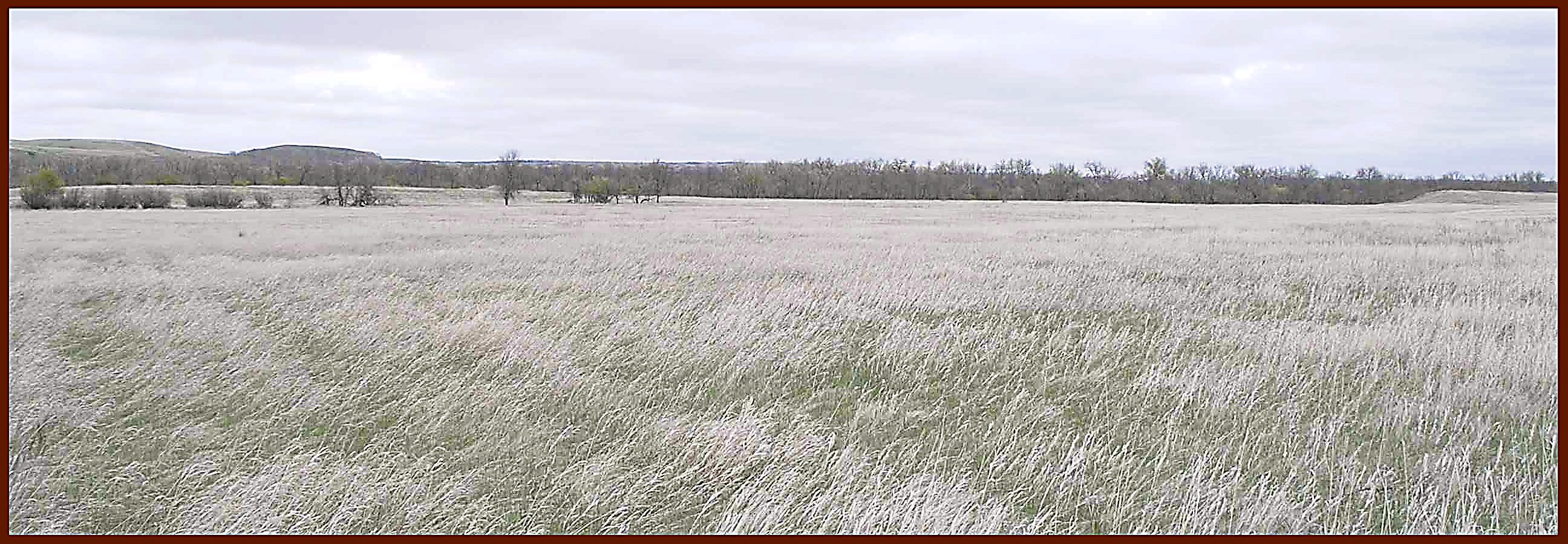
Another tiny little site, out in the middle of nowhere. A small slice of land, barely four square miles, preserving a few reconstructed mud huts and a view of a minor Missouri River tributary. Fit for the occasional grammar school field trip and not much else.
Through all the denialism around environmental degradation and global warming, I’ve become convinced the human soul is incapable of understanding the concept of absence. We are quite capable of observing the world around us. We can see the moon and the stars and the distant mountains and the dandelions at our feet. We can see what we have, are enthralled by what the other guy has, and are intrigued by what might be hiding behind that mountain over yonder. What we can’t contemplate is what isn’t there. We can’t lament the old-growth forests of New England, because we’ve never seen one. They’ve been gone for decades, or even centuries. They’re not here, so we don’t miss them. Nobody cares that they’re gone.
A couple decades ago, there were a series of logging protests in Idaho, Oregon, and Washington. The locals were furious that a bunch of East Coast types flew out there to chain themselves to old-growth trees and interrupt logging. I can understand why they’d be pissed off. I would be pretty angry if some guy flew 1000 miles to get in my grill because I drove a foreign car or was an avowed atheist. But the folks of Idaho should understand something as well: we don’t have old growth forests on the East Coast any more. They’re gone. They’ve been gone for at least a hundred years if not two. The eastern United States is a scarred landscape, the result of clearcutting, mountaintop-removal mining, abandoned industrial complexes, sleazy strip malls, and horrid public housing projects. Most of the natural beauty in the east is gone, and gone forever. All we wanted was for the western states to preserve theirs before it, too, is gone.
This same idea applies to the native cultures of the Americas. They’re mostly gone, and those that remain have been scarred by decades and decades of suppression, poverty, extermination, and broken promises. They’re barely recognizable today. But we don’t understand what that really means. Indian reservations have been the way they are our entire lifetime, and for so many generations before us, that we can’t even fathom what native tribal life must have been like in the long, long ago. It’s unfathomable because it’s gone. Gone forever, there’s no bringing it back.
Imagine what life in America would have been if, instead of driving the native populations back and out, our forefathers decided to share the land with them. Would our country have developed any differently? Would we never have connected east-and-west with the Golden Spike? Would there still be American bison on the flatlands of Ohio? Would there be states in the Union with all-Native legislatures and Congressional representatives? What would the U.S. flag look like? What would our architecture look like? What would that great cultural tradition — rock & roll — sound like, infused not just with the minstrel songs of sharecroppers, the folk tunes of Dust Bowl migrants, and the swing of urban jazz, but also with the steady rhythms and chants of the Sioux? Wouldn’t that be kinda cool?
We’ll never know what the impact of Native American culture would have been on this country, on our government, on our society, or on our lives. And we can’t … because it’s gone.
[All pictures on this page are mine and thusly copyrighted.]
Three things I never thought I’d see in my lifetime: a global pandemic that would kill 6 million people worldwide; a non-peaceful transition of power between U.S. presidents; and a ground war in Europe.
These are three things I would have rather not seen.
I’ve been stewing and stewing on Ukraine for the past couple of days, as I suspect most of you have. I have some thoughts, some of them ugly. As always, I’m not a true historian nor a military expert, so go ahead and refute my positions in the comments.
Sanctions Need to Be Harsh & Broad
As I mentioned in my last post, war is hell. Over the past few decades, thanks to smart bombs and modern sympathies, we’ve come to believe in “war lite”: we can invade countries yet spare civilian casualties, and that makes us “better” somehow. These thoughts pervade the Biden White House today: let’s have targeted sanctions against oligarchs and Putin’s family, and call it a day.
What a bunch of bullshit. The Russian people are letting this happen*, they have to be convinced to end it. No more of this ‘targeted sanctions’ crap. Sanctions need to be broad-based and applied to the entire Russian economy. Cancel all Russian visas, send all Russian citizens without Green Cards or higher status back. Stop all artistic, scientific, and educational collaborations, immediately. Eject any official Russian teams from all international sporting events. Stop all trade with Russia (and Belarus, cuz fsck those guys). Sure, have exceptions for medical supplies and agriculture, that seems appropriate. But most importantly, stop energy trade and enact a SWIFT block. We have to hit them hard, make them (literally) pay for their actions.
The point is to bring enough economic pain that the Russian people demand Putin end hostilities. Russia has fallen to revolution before, just sayin’.
*I know that there have been intense anti-war protests in Russia. I’m talking about the broad-based public, who are, at best, apathetic to the whole thing.
Europe and America Needs to Be Strong
Americans and Europeans are soft. We’re pussies. 75 years of relative peace will do that to you. We like our gas-guzzling SUVs and McMansions heated to a comfy 72 degrees. We like our kale salads and brioche toast and $2.99 gallons of milk and stock market growth fueling our 401(k)s. Well, you know what enables all that great prosperity? Peace, that’s what. And Putin ruined all of that.
We have to be willing to take it on the chin to shut Putin down. What’s the alternative? More war? Is your 401K worth half a million casualties? What happens if we whimp out now and end up in a real war in three years? This bullshit needs to stop right now, and we have to stop being whiny pussies about gas prices.
Stop China Tariffs
Let’s offer an olive branch to China. In exchange for a condemnation of Putin’s actions and cooperation (or at least a public declaration of their neutrality) against Russia, offer to eliminate all of Trump’s anti-China tariffs. They were stupid anyway. That’ll help with supply chain and inflation problems, too. There’s a *serious* risk of a China/Russia alliance, and if that happens in earnest, we are seriously fscked. Let’s try to get ahead of the problem for a change.
On a related topic, remind the countries of the Arabian peninsula how we saved their collective asses from Iraq, and get them to take up the slack from any Russian oil embargo by upping their production. Bunch of ungrateful bastards.
Let’s fire it up, using any media at our disposal. The message to broadcast to the Russian people? World War II killed 20 million Russians. War is bad for you. You need to stop. Just to put that number into perspective, that’s over 10% of the total population of the country at the time! Imagine if 34 million Americans died over a five year period. The Russians suffered more casualties than any other country in WWII. The Russian people know what death is, what war is, and they don’t like it. Remind them.
Open Up More Fronts
Time to ship arms to Georgia, Armenia, Azerbaijan. Let them kick up their rebellions, strengthen their own borders. Time to have serious talks to the various ‘Stans, remind then that Putin and Russia are anti-Islamic, and a clear threat to their own independence. These countries form 5,600 miles of borders with Russia, that’s an awful lot of threat for them to deal with (in contrast, the U.S./Mexico border is only 1900 miles).
Call Up the National Guard
Call them up. Right now. Prepare for war. Better to prepare for war and not have it happen, than have it happen without being prepared. Plus it’ll show we mean business. Make some noise. Get planes in the air. Time for some exercises.
Smack Down Collaborators
There have been a lot of K Street lobbyists working for Russia over the past few years. Let’s out those fsckers. Publish the names of their directors and their high-paid lobbyist staff. I implore all journalists to report these clowns, loudly and broadly.
Then there are the Russian collaborators in Congress, like the shitheels who traveled there on the 4th of July, 2018, to kiss the ring. Get their names out. Nothing like a good public shaming.
Finally, can we please, for the love of God, stop platforming Putin’s ultimate Tangelo Toadie. FFS, I’m sick of hearing from that guy. He’s a goddamned traitor and deserves to be treated as such.
This Sucks
None of this should be happening. It’s madness. It’s stupid. It’s goddamned outrageous. But, here we are. It should come as no surprise. I’ve come to a general conclusion that we’ve had (relative) peace for so long, we’ve had economic growth for so long, we’ve had it so good for so long, we’ve all forgotten what true hardship, true famine, true catastrophe, true war, really is.
I’ve often said that the only reason the world is turning back to fascism and autocracy is because all the heroes of World War II, and all the victims of the Holocaust, are dying off. 25 years ago, when these people were alive and in charge, none of this shit would have even been possible. Today, they’re all gone, and all we have is History Channel war fetishism, social media disinformation campaigns, and growing prejudice and tyrannical thought (FFS, book burnings are back!!). So, we’ve gone around full circle. War, tyranny, injustice, persecution: it’s all back. In full force.
The question is: are we brave enough to stop it? Or are we too concerned about our 401(k)s?
One of the first history books I read for my own enjoyment was A. J. Langguth’s 1988 work, Patriots: The Men Who Started the American Revolution. I enjoyed that book immensely, Langguth does a good job narrating the sequence of events leading up to American independence after the Battle of Yorktown, and how the Founding Fathers shaped those events.
Langguth’s style is to dedicate each chapter to an individual as they affected events. Patriots, for example, starts off with a chapter devoted to James Otis, the Boston lawyer who spoke against bogus British practices in 1761. It then rolls from statesman to statesman, as Langguth relates the iconic tales of American rebellion. It’s a good book, I recommend it to anyone wanting to learn about the Revolution beyond a high-school level.
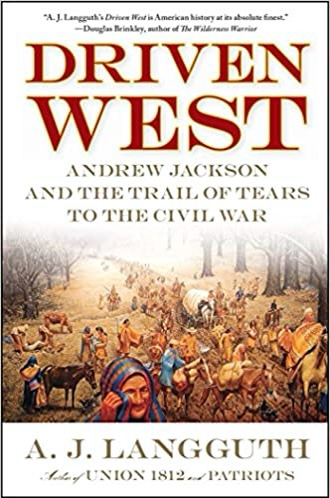
That format works for a book about individuals, like Patriots. Driven West, however, isn’t that kind of book. It’s trying to tell the story of a great travesty: the uprooting of thousands of native peoples from their homelands in the Deep South, and their deadly relocation to the parched scrublands of Oklahoma. This is not a story about personalities, it’s a story of betrayal and trauma and sadness and death. Sadly, Mr. Langguth didn’t shift gears to a style that would suit this type of material.
He dedicates chapters to the titular 7th President, a man synonymous with native oppression. He dedicates chapters to Henry Clay, who opposed Indian relocation throughout most of his career; to Major Ridge, a key Cherokee negotiator; to Sequoyah, the creator of the written Cherokee alphabet; and a few others. It’s not like the cast list is any less stellar than during any other event in history, it’s just misplaced for the topic at hand.
The story of the Trail of Tears isn’t a tale of presidents and congressmen and chieftains. It’s a story about the 60,000 people who were uprooted from their homes; of the estimated 10,000 who lost their lives as a result; and of the decades and decades of oppression of the native peoples that followed. Focusing on individual personalities throughout this book cuts the philosophical and emotional core out of the story. Langguth spends barely a third of a chapter on the marches themselves, or of the trauma faced by thousands of faceless refugees as they lost their homes. I think the book suffers from this lack of attention. This is not a cry for schmaltzy heart-string tugging, this is a statement that a good writer needs to find a narrative style that suits the core of the story. A personality-driven story works for the Revolution, it doesn’t work for the Trail of Tears.
The book still contains a lot of value. There are many tidbits of this episode that Americans don’t know. Langguth covers tribal ownership of slaves, a travesty on top of a tragedy. He covers the massive inter- and intra-tribal infighting, up to and including murder, that occurred throughout the era. He covers all the back room shenanigans and profiteering that undercut any last smidgeon of decency in the whole wretched affair. And he covers the often-forgotten stories of Cherokee support for the Confederacy in the Civil War. All of these are useful, insightful additions to the book, and worthy of discussion.
Driven West provides thorough coverage of a sordid era of the nation’s history. Sadly, it misses the proper, emotive link to the true heart of the tale.
Many years ago, I started on a personal quest to visit every site in the U.S. National Park System. This is not an easy task, there are over 400 of them!! The journey has been a fascinating one. I have learned more about the natural world, American history, and the breadth and depth of our culture, than I ever thought I could have. On this blog, I’ll share experiences, observations, and insights from my trips. I hope you’ll enjoy your stay here, and I appreciate your comments and feedback!
States
America in Context Post Progress
NPS Sites: 406 (see FAQ)
Sites Visited: 258
Sites Blogged on AiC: 73