Feeds:
Posts
Comments

Posts Tagged ‘history’

Community College English 101

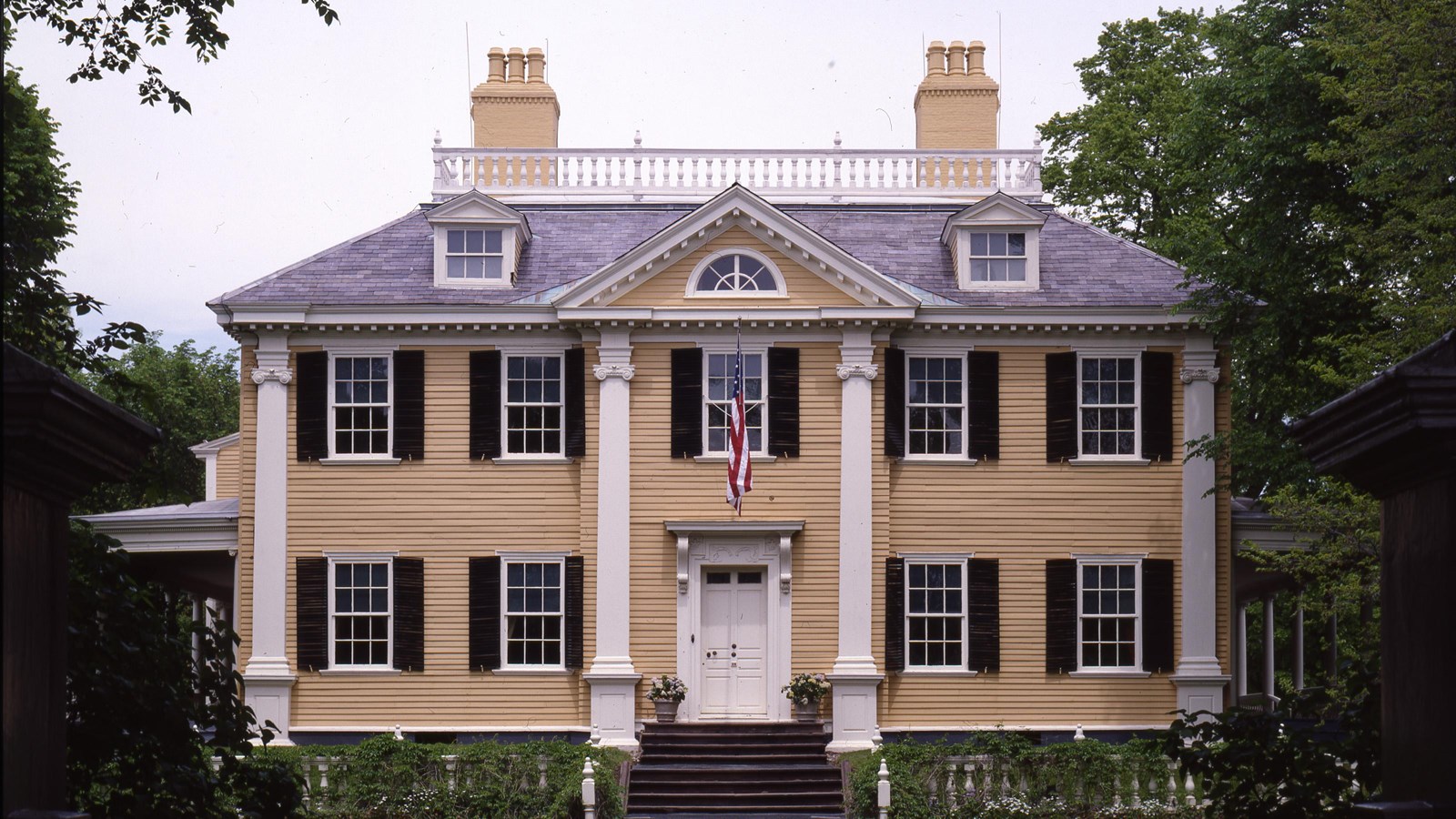
The Longfellow House in Cambridge is a beautiful, historic house. Built in 1759 in the Georgian style, it was originally occupied by Jamaican plantation owner John Vassall. A staunch loyalist, Vassall saw the writing on the wall and fled to England, just in time for George Washington to use it as headquarters during the early years of the Revolution. After the war, the house was purchased by Washington’s apothecary general, Andrew Craigie. His financial acumen was less than stellar, forcing his widow Elizabeth to take in boarders in 1819, including the soon-to-be-renowned poet Henry Wadsworth Longfellow. Later, Longfellow received the home as a wedding gift, and it stayed in the family or their trust until the entire building, its furnishings, and the grounds were donated to the National Park Service.

National Park Service photo

That’s all nice, but when I hear “Longfellow House”, I am reminded of my goofy college days.

My family was never particularly well-off. I was a sharp student, but we didn’t have the means to send me to college. So I took what I earned from part-time jobs and went to community college.

Springfield Tech was a good school with a solid electronics program. I already knew Ohm’s Law, Coulomb’s Law, and a variety of formulas and principles, so I had a bit of a head start. I loved those classes, the labs, mathematics, even physics (although it was taught by a professor I’m certain died three years prior).

Then came the dreaded mandatories. First day of first semester, when I had barely any understanding of what to expect, began English 101. I have long forgotten the name of the professor, but I’ll never forget his entrance. Tweed jacket and vest. Dignified salt & pepper beard. And a beret. Yes, a goddamned beret.

I don’t remember all of Professor Beret’s lessons, the one that sticks in my mind is our foray into Robert Frost. I’m talking about that old standby, which most kids learn in high school, “Stopping by Woods on a Snowy Evening”. The discussion came down to the old, self-wankery standby: “what does this poem mean to you?”

Me, being a bit overeager to discuss such heady topics in the presence of adults, instead of with a class full of hormonal teenagers, piped up with “well, a guy is evaluating his life choices. Shall he return to the life he knows, in comfort, or should he take another path, to see if he can become something special.”

“Um, no,” said Prof. Beret. “It’s about suicide.”

What? Well, apparently, if you decide to take that lesser-traveled path, you want to die by freezing to death …

Holy leaping Christ, what the fuck?

Anyway, that lesson tarnished me on poetry forever. I realized that not only do I not easily pick up on symbolism, but people who put poetry up on philosophical pedestals are fucking crazy.

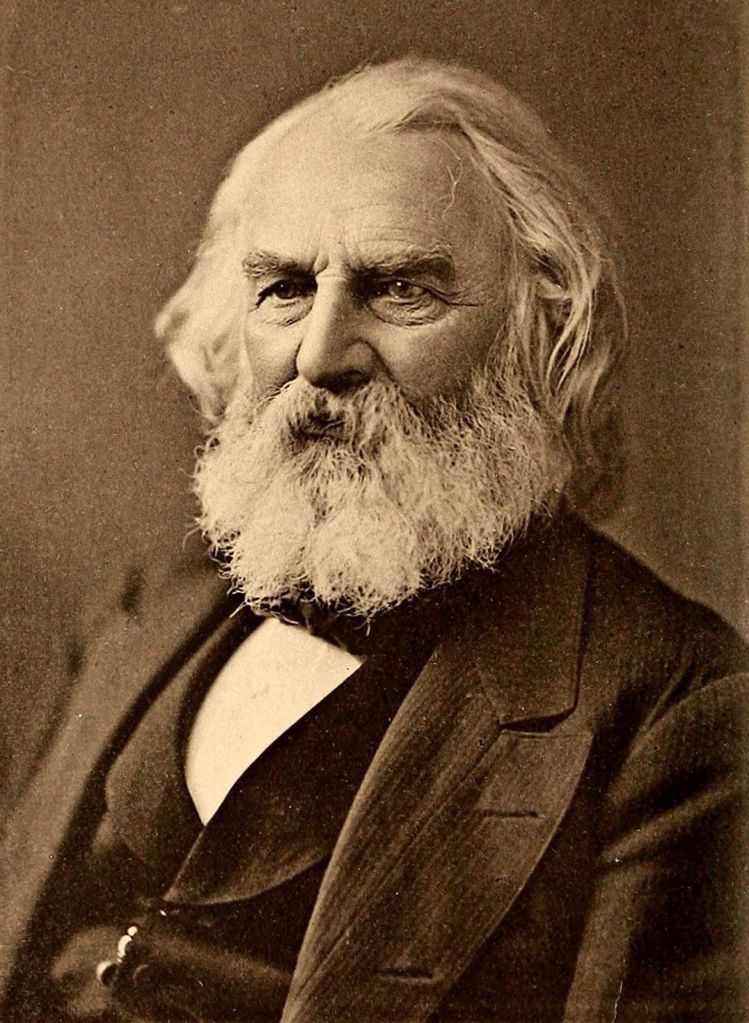
Brittanica.com

In preparation for this essay, I read many poems from Longfellow: The Complete Poetical Works. Most of his works are direct homages to nature and the art of living. There’s not a lot of deep symbolism, just well-structured odes, definitely tame by today’s standards. There’s no doubt he was big for his time, but now it’s all quaint recollections of seeing a shooting star and such.

I’ll leave you with one of my favorites:

The Burial of the Minnisink

On sunny slope and beechen swell,
The shadowed light of evening fell;
And, where the maple’s leaf was brown,
With soft and silent lapse came down,
The glory, that the wood receives,
At sunset, in its golden leaves. 

Far upward in the mellow light
Rose the blue hills.  One cloud of white,
Around a far uplifted cone,
In the warm blush of evening shone;
An image of the silver lakes,
By which the Indian’s soul awakes. 

But soon a funeral hymn was heard
Where the soft breath of evening stirred
The tall, gray forest; and a band
Of stern in heart, and strong in hand,
Came winding down beside the wave,
To lay the red chief in his grave. 

They sang, that by his native bowers
He stood, in the last moon of flowers,
And thirty snows had not yet shed
Their glory on the warrior’s head;
But, as the summer fruit decays,
So died he in those naked days. 

A dark cloak of the roebuck’s skin
Covered the warrior, and within
Its heavy folds the weapons, made
For the hard toils of war, were laid;
The cuirass, woven of plaited reeds,
And the broad belt of shells and beads. 

Before, a dark-haired virgin train
Chanted the death dirge of the slain;
Behind, the long procession came
Of hoary men and chiefs of fame,
With heavy hearts, and eyes of grief,
Leading the war-horse of their chief. 

Stripped of his proud and martial dress,
Uncurbed, unreined, and riderless,
With darting eye, and nostril spread,
And heavy and impatient tread,
He came; and oft that eye so proud
Asked for his rider in the crowd. 

They buried the dark chief; they freed
Beside the grave his battle steed;
And swift an arrow cleaved its way
To his stern heart!  One piercing neigh
Arose, and, on the dead man’s plain,
The rider grasps his steed again. 

=======================

Despite my difficulties with a certain English 101 professor, I did get a great education at that school.

Links:

Longfellow House National Historic Site

George Washington’s Revolutionary War Itinerary

Searchable database of Longfellow poems

Map to the Longfellow house

Read Full Post »

Contemplation

I was very fortunate when I visited Lincoln Home NHS. Due to some unknown confluence of circumstance, I toured the park when there were virtually no other visitors. There were maybe a dozen in all, including the four who accompanied me on a tour of the house.

I am a little sad when important historical sites have no visitors. I worry that Americans are failing their children by ignoring their own history, being otherwise enrapt in their video games or casinos or cruise ships. But I’m also more than a little grateful, for it gives me time to experience the importance of place, ponder the passage of time, and contemplate the importance of it all.

The site covers a scant four blocks, but the houses therein are well-preserved in 1860 style. The effect is quite immersive: sans many other tourists, it is easy to imagine yourself in 1846, walking towards 413 S. 8th St., dressed in your finest frock coat and sporting your best cane, so you can wish the newly-elected Representative Abraham Lincoln a fine good morning and sincere congratulations on his recent victory. Perhaps you truly believe the sentiment, perhaps you are hoping to curry favor, but regardless, you have performed proper pleasantries as is expected of a gentleman, and now must visit the mercantile to see if your package has arrived.

I believe that vacations should include not only excitement, awe, and wonder, but also quiet, and also contemplation. With summer upon us, here’s hoping you find all five during your next vacation.

————————

Pictures are mine and thusly copyrighted.

Read Full Post »

A Piece of the Action

Nestled in the middle of rural Spencer Country, Indiana, west of Christmas Lake Village, and just off State Route 162, is a small, unassuming bit of parkland. Inside, you’ll find meandering trails; a replica of a 19th century farm (complete with live animals!), and yet another shrine to Abraham Lincoln. And why not? Here, on this plot of land, the 16th President of the United States grew from a boy into a man. Here, young Lincoln worked the farm, built fences, attended school, went to church, was inspired to practice law, and lost his mother to milk sickness.

It took about 40 years for the country to fully appreciate and honor Abraham Lincoln, and boy did they appreciate him! The Lincoln Head Penny was first struck in 1909, the Lincoln Memorial was funded by Congress in 1910. Lincoln, Nebraska was early to the game, renaming itself from Lancaster in 1869, but dozens of counties and innumerable schools, streets, avenues, and parks weren’t renamed until that first decade of the 20th Century.

There apparently was a fight for “hometown rights” amongst several towns and states. He was born on Feb. 12, 1809, in LaRue Country, Kentucky. But his father, Thomas, packed up the family and moved them to Indiana in 1816 (partly to avoid competing with slaveholding farmers, and partly because land titles in Kentucky were, shall we say, flexible). Lincoln lived in Indiana for the next 14 years of his life, and then went on his own, moving to New Salem, Illinois. Illinois would remain his home state until he made his fateful move to the White House some thirty years later. Once “Lincoln fever” struck, all three states & towns wanted a piece of the action, and tried to claim the President as their own. Each of them built their own shrines, and claim they were “Lincoln’s home”. All are now in the National Park System, and hey, the more parkland and historic properties we can preserve, the better.

There is a bit of philosophy buried in this saga: what marks the life of a person? Is a person’s life dictated by the circumstances of their birth? Or is it in childhood, those most formative of years, whilst under the care of one’s parents? Or is a person truly formed in adolescence, when one learns to work and function in society? Or is a person what they made themselves into as adults, through labor or service or duty? The pragmatic answer, of course, is a life is in continual formation, from birth in a continuum through to death, but that seems like a dull answer, as 19th century philosophy goes.

Up next: an exploration of Franz Joseph Gall’s developments in phrenology.

(No, not really, but we will talk more about Lincoln in the next post).

Read Full Post »

Freedom and Repatriation

The Lincoln Memorial might be our greatest national symbol. It’s everywhere: our currency, our iconography, our culture. Presidents have spoken in front of it. Martin Luther King gave one of his most moving speeches from its stairs. Numerous musical artists including, famously, opera singer Marian Anderson, performed to massive crowds gathered there. It’s appeared in everything from Mr Smith Goes to Washington to Forrest Gump to Planet of the Apes. There’s not much I can add to the lore of it, other than to say every American should make the pilgrimage at least once.

Instead of posting some weak trivia list about the Lincoln Memorial, I’m going to write about The 1619 Project.

Marian Anderson, 1939 (Library of Congress)

————————

The 1619 Project was a collection of essays published by the New York Times in 2019, and again in book form in 2021. I’ll let historian and journalist Lerone Bennett, Jr. explain:

A year before the arrival of the celebrated Mayflower, 113 years before the birth of George Washington, 244 years before the signing of the Emancipation Proclamation, [a] ship sailed into the harbor at Jamestown, Virginia, and dropped anchor into the muddy waters of history. It was clear to the men who received this “Dutch man of War” that she was no ordinary vessel. What seems unusual today is that no one sensed how extraordinary she really was. For few ships, before or since, have unloaded a more momentous cargo.

Bennett, Lerone Jr, Before the Mayflower, 1962

That ship was the White Lion, the year was 1619, and its cargo was “twenty and odd” captives from west Africa.

The central premise of The 1619 Project is this: the collective history Americans hold dear grossly underrepresents the impact and long-lasting effect of slavery on this country. In a series of long-form essays, a variety of authors, journalists, and historians lay out the case that slavery affected America’s viewpoint on everything from property rights to citizenship to economics to the very definition of democracy. These essays are hard-hitting, blunt, and brutal, and together assemble a very sobering read. Of course, they cover the obvious, like the 3/5th clause of Constitution and the collaboration between the KKK and law enforcement in the Jim Crowe South. But they also make links that might not be so obvious, including throwing some shade on our best president, Abraham Lincoln.

Before I go on, let me state up front that this is not intended to demean or degrade the Great Emancipator. Frederick Douglas called him “Tender of heart, strong of nerve, of boundless patience and broadest sympathies, with no motive apart from his country. […] Take him for all, in all Abraham Lincoln was one of the noblest, wisest and best men I ever knew.” Booker T Washington said “[M]ay I say, you do well to keep the name of Abraham Lincoln permanently linked with the highest interests of the Negro race. He was the hand, the brain, and the conscience that gave us the first opportunity to make the attempt to be men instead of property.“ But W.E.B. Dubois was probably more accurate in his own assessment: “Abraham Lincoln was perhaps the greatest figure of the 19th century. Certainly of the five masters – Napoleon, Bismarck, Victoria, Browning and Lincoln, Lincoln is to me the most human and lovable. And I love him not because he was perfect but because he was not and yet triumphed.”

Laborer with Lincoln Memorial (Library of Congress)

Lincoln, as great as he may have been, had one small problem, a bit of a character flaw, or at least a lapse in judgement. That problem was the American Colonization Society. Founded in 1816, the ACS was an unlikely group of early abolitionists, Southern slaveholders, and politicians of all persuasions. These men felt the chief concern of the time had a solution, and that solution was the repatriation of freed Blacks to Africa.

The abolitionists were afraid freed Blacks would simply never fit in, becoming a permanent underclass throughout the North. Slaveowners felt these freedmen would work tirelessly to free their brethren, perhaps engaging in violence or insurrection or even murder. Politicians were afraid they would taint voter rolls, influence elections, and threaten established power. Honestly, it’s hard to say their fears were unjustified, and Lincoln himself seemed to share those fears. Although he was not a member of the ACS, Lincoln espoused the idea of Black relocation as early as 1851. By 1862, he created the position of Commissioner of Emigration, and convinced Congress to appropriate $600,000 to ship freed Blacks to another country.

Black freedmen were appalled. They wanted to be free, yes, but not like that. By this time, some 240 years had passed since the White Lion docked. Generations of their forebears lived in houses, worked the soil, raised their children, all on these shores. They knew not of other lands, knew not of Africa, nor of any other land but America. Repatriation was a deplorable option. The United States, as flawed as it was, as dangerous and hostile as it was to slaves and freedmen alike, was still their home.

They would prove this in short time. After Lincoln’s official Emancipation Proclamation — which did not include any references to repatriation — some 200,000 Black men served in the Union army. That’s an astounding 78% of military-aged men! They took the Civil War personally, it was their fight, for their freedom, in their country.

Colored Troops, Port Hudson, LA, 1864 (National Archives)

———

Lincoln was an imperfect man. His emigration plan was a terrible idea. But he listened to the criticisms, dropped it, and changed the course of American history. Unfortunately, we still stumble across repatriation now and again. In this country, we debate the disposition of the Dreamers, young people smuggled into this country when they were very small, at no fault of their own, who are often threatened with deportation to countries they’ve never known. And right now, in the Middle East, ancient animosities are used as excuses to forcibly evict people off lands they’ve inhabited for decades if not centuries. In these cases, and many, many others, nobody cares. These “intolerables” would be better off gone, some would think.

But no one should be forced from the only home they’ve ever known. This has to be a fundamental precept of freedom.

———

I highly recommend The 1619 Project. I consider it vital reading for anyone wishing to understand this country, past and present.

———

Links:

Read Full Post »

« Newer Posts - Older Posts »