Feeds:
Posts
Comments

Posts Tagged ‘nature’

Mother Nature Gives a Sign

Imagine you’re part of a wagon train during the great westward migration. For days on end you’ve seen nothing but flat grassland prairie. You’re only marker on the trail is the rising and setting sun, and the North Star. You wonder if you’re even making any progress, of if you’ll even manage to keep your sanity amongst the boredom.

Suddenly, it looms before you. Chimney Rock, sticking straight up into the sky, visible for miles around. The first sign that the plains are ending, the first sign that the next phase of the journey – the crossing of the great Rocky Mountains – is coming. At least it represents change.

Chimney Rock © 2008 America In Context

The story of Chimney Rock is the story of westward migration, but (like most of the nation’s natural landmarks), it was also of sacred importance to the native people of the land. Then again, like almost everything else, that meant little to the newcomers, the white man. Just like the land and the environment, Chimney Rock was a cast-off on the way to prosperity, something to be used and then discarded. The sacred pillar was even used for target practice by army gunners during the Indian Wars, how’s that for a slap in the face?

When I see Chimney Rock, I don’t see the spire as a pointer to riches in California. I see the Great Nature Spirit giving us all the finger.

The Finger © 2008 America In Context

[A short post for a small site. Pics are mine & copyrighted thusly.]

Links:

Chimney Rock National Historic Site

Google map to Chimney Rock

Read Full Post »

Babies on the Rocks
Little Catoctin Mountain Park is sort of a red-headed stepchild of the National Park System. It’s just a “park”, not a “national park” nor a “national monument” nor a “national historic park” nor any other such designation. It doesn’t have any grand natural wonders: no canyons, no snow-capped peaks, no staggering escarpments, no 2,000-year old trees. It doesn’t have herds of buffalo, grizzly bears, elk, or endangered manatees. Maybe a few bald eagles, that’s about it.

It does fit two good niches, however. First, a portion of Catoctin was carved out and turned into the Presidential retreat of Camp David, site of important moments in American history from FDR’s war councils, to the Sadat-Begin summit in ’78, to Iraq war lie crafting by the Bush administration. I’m sure having a National Park Service site as a neighbor helps with Camp David’s security and secrecy (although ask any pizza delivery guy in the area and you’ll get instant directions to the place, proving that even the greatest military power in world history still travels on its stomach).

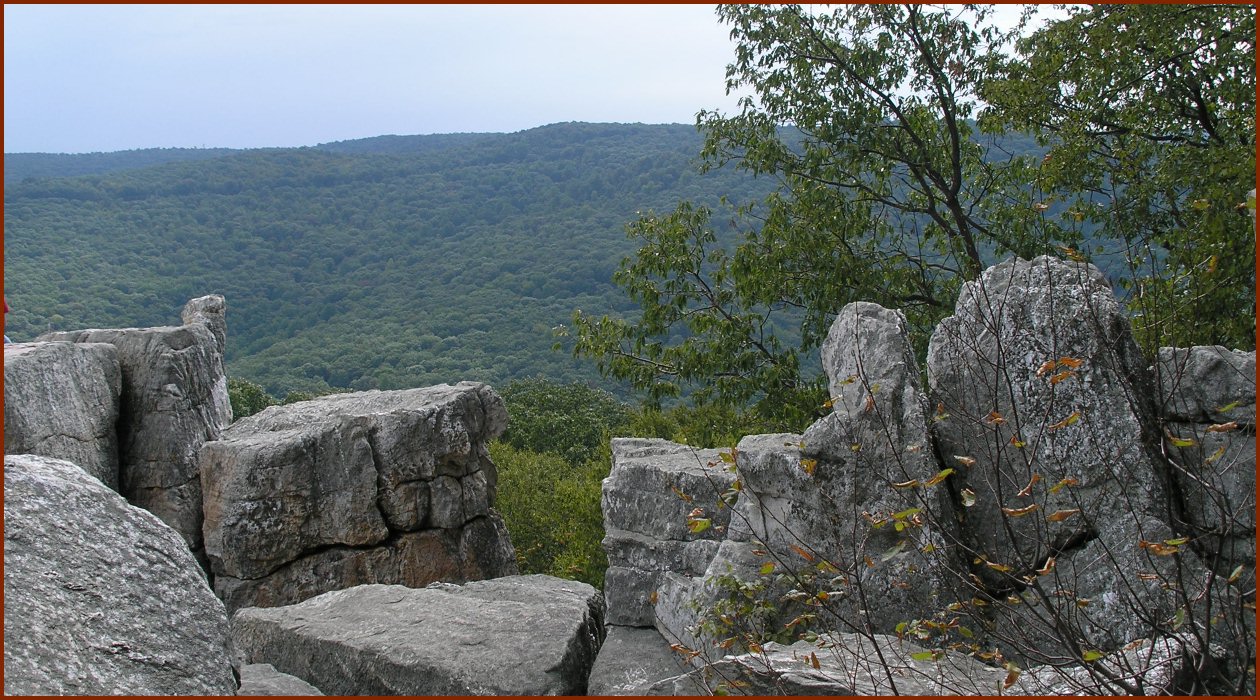
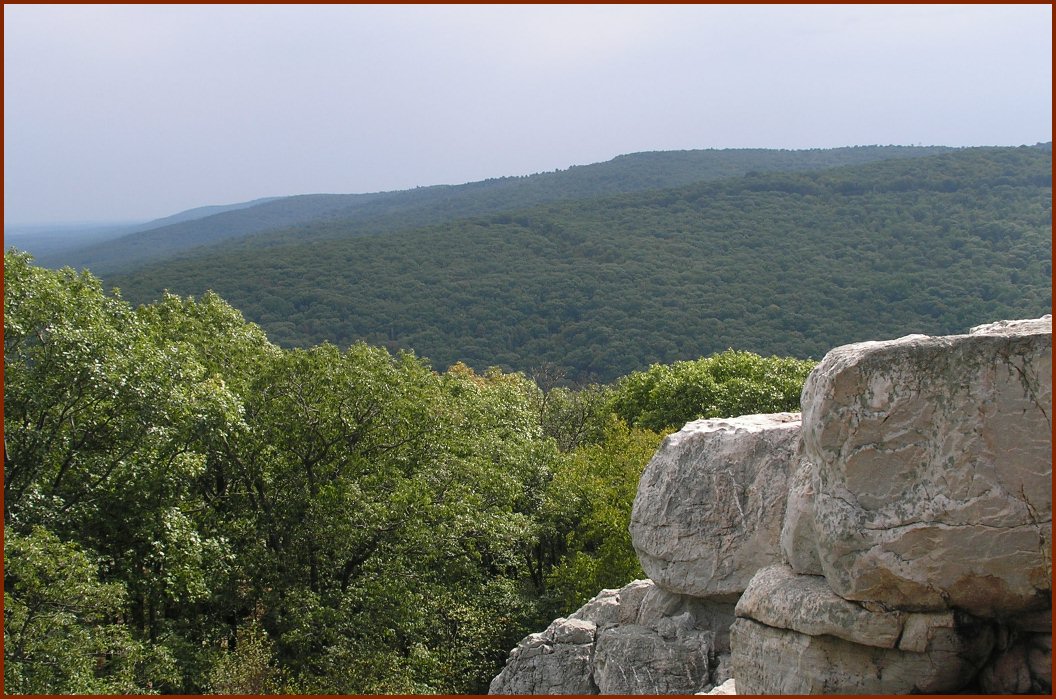
Vista © 2008 America In Context

The second, and in my opinion more important, niche that Catoctin fills is it’s status as a destination campground available to millions of people in the greater Baltimore-Washington metropolis. I’m a firm believer that everyone should have access to the great outdoors, especially those in the big cities who might otherwise not even think about trees & forests. In Catoctin’s case, it provides access for millions in just an hour’s drive or so. It certainly seemed quite popular when I visited: the campground area was nearly sold out, and dozens of folks were hiking the trails.

Wolf Rock © 2008 America In ContextThere’s a popular spot in Catoctin called Wolf Rock, a flat granite expanse full of cool nooks & crannies. Hopping over all the crevices is pretty entertaining, especially for the pre-teens in the crowd. Boys and girls alike were having all sorts of fun clambering over the rocks and jumping the various pits & cracks in the rock face. Just good, old-fashioned, dangerous fun, the kind kids have been having for hundreds of years. I’m not one of those adults who think kids should be prevented from having dangerous fun, the danger is part of the fun and needs to be embraced by kids. After all, it’s healthier than sitting in a sheltered environment playing video games. Let’s see: a slight risk of a head injury, or a near certain future of obesity and Type 2 diabetes? I’ll take the craggy rocks, thank you.

Say No To Crack © 2008 America In ContextBut let’s get realistic here. After my own brief experience hopping craggy rocks (much more difficult on 40-year-old joints than 12-year-old joints), I headed back to the trail. I passed a group of young adults with backpacks, obviously ready for their own turn on Wolf Rock. Turning for a polite “good morning” to my fellow park enthusiasts, I noticed one of them actually had a baby on a backpack carrier, ready to walk on craggy Wolf Rock! Now I think kids need to be exposed to the risks of the world, and I don’t think parents of young children should be captive in their own homes, but come on! It’s a craggy rock face full of sharp points and deep crevices, and you bring your baby with you? Come on, kiddies! You’re parents now, show some responsibility, for God’s sake! Taking the baby into the woods is fine, but be careful where you’re walking, folks.

I’ve seen lots of people doing stupid things in the National Parks, but bringing a baby onto Wolf Rock is definitely in the Top Ten Stupidest list.

Rolling Hills © 2008 America In Context

[All pics on this post are mine and copyrighted thusly. This is just about the extent of my pics of Catoctin, however. It’s a nice spot, to be sure, it’s just not particularly photogenic. A couple more photos can be found here]

Links:

Catoctin Mountain Park

Brief History of Camp David

Google map to Catoctin Mountain Park

Read Full Post »

Trespassers

Tsegi. That’s what Canyon de Chelly is to the Navajo people. Home.

It’s an odd sort of thing, and a great controversy I might add, that this national park site is also a home. Canyon de Chelly is not only home to many families of Diné (the real tribal name of the Navajo), but several of those families live in a truly traditional, simple manner, quietly farming the fertile soils of the valley floor, shunning modern conveniences and menaces. Thankfully, the Park Service in conjunction with the Navajo Nation restricts visitor access to the valley floor. I’m sure it’s a hard life, but I have great respect for the people who live it. Frankly, there is a lot of appeal in the simple life (and no, I’m not talking about a crappy reality show starring two talentless bimbos). Look at where our complicated lives have led us? Fat, lazy, conceited, arrogant. Perhaps a little simplicity is just what this country needs.

Canyon de Chelly is a gorgeous place. Absolutely stunning. I visited on a cloudy, drizzly day, and it was still a beautiful spot. The sandstone walls interact with daylight and cast a golden hue over the entire canyon. Climbing down to the canyon floor lifts one spirits, troubles are left on the canyon’s rim as you descend in golden splendor to a simpler, wholesome time. Of course, you have to turn around and go back up again, but for a while, you can just revel in the beauty of the spot. It can be downright spiritual (if you believe in such things).
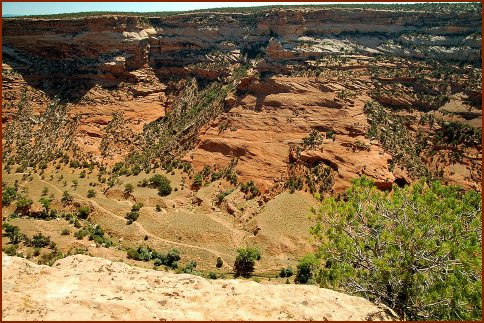
Massacre Cave Overlook © 2006 Scott Speck Fine Art Photography

This place does have “spiritual significance” written all over it. First, there’s the natural beauty. Then there are the old Anasazi ruins sitting in the niches of the canyon walls, direct reminders of native ancestors, ghosts of the past. These aren’t malicious ghosts, the aura given off (again, if you believe in such things) is good, as if these spirits are guarding over the inhabitants of the canyon, guarding over you as well as long as you respect the land on which you trod, as long as you respect the rights of the residents of this land. Then there’s glorious Spider Rock, which has special significance to the Navajo (and, I’m sure, to the tribes who lived in the canyon before them). I know I’m laying in the mysticism really thick here, but such are my memories of my visit to Canyon de Chelly. I’m quite fond of Native American spirituality, that special connection between man and the natural world that most religions pave over as they build their next UberChurch, or blow up with bombs strapped to the waistbands of their children.

Cliff Dwelling © 2006 Scott Speck Fine Art Photography

I do have to say one negative about my visit. This was my first visit to a real Indian reservation, and frankly, I felt really uncomfortable. Although the Navajo reservation is better than most, there is a great deal of poverty and not much opportunity on Indian reservations in America. It’s painful to look at, for this is a people who were truly victimized by the country, and not just some folks who fell on hard times. These people have had hard times for hundreds of years, hard times because they were forced to have hard times by people who were afraid of them. And now we populate their reservations with fast-food outlets & alcohol, yet make such cumbersome rules that industry doesn’t have much of a chance (unless, of course, casinos pay off Congressmen to allow gambling, but that’s another issue).

Looking Towards Cliff Edge © 2006 Scott Speck Fine Art Photography

I, a white suburbanite tourist, was clearly the outsider in the Navajo reservation, and I felt like a trespasser. The locals do look upon you with quiet contempt, contempt passed down through sadness from generation to generation. I don’t begrudge them their contempt, for it’s hard to feel anger at them when their people have faced oppression of some kind or another for hundreds of years. Contempt is part of their very being now, every generation knows full well of the damage inflicted upon previous generations, they are reminded of it on a daily basis as they live their lives. I know I shouldn’t feel guilt for the sins of my fathers, but I can’t help it. It’s my Catholic upbringing, I feel guilty about pretty durn near much everything. At least, in this case, there’s a reason.

I would like to see nothing more than all the native tribes of this country get out of poverty. I’m not a big fan of casinos, for they don’t add any value to the people or the country. I’d love to see clean industries, or efficient agriculture, or cultural attractions, or something viable, sustainable, and effective, in place at all of America’s Indian reservations to bring these folks out of poverty yet keep their cultural identity intact. Why hasn’t this happened yet? In this enlightened day and age, why are there still these pockets of poverty? It’s because no one’s trying, that what I’ll wager. I haven’t researched it fully, but I’m sure there are a lot of stupid rules and regulations about such things happening on Indian lands, and damn it, they should be changed. It’s a national embarrassment, to be frank.

It’s long past time we fixed it.
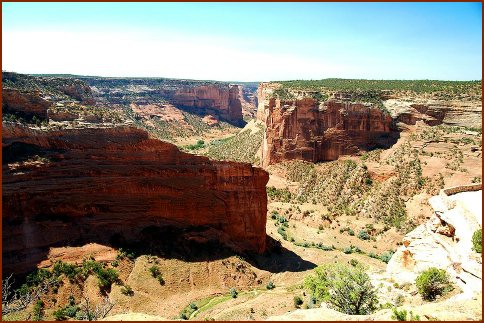
South View © 2006 Scott Speck Fine Art Photography

[Sadly, I didn’t own a digital camera when I visited the Canyon. These photos are taken, with permission, from Scott Speck’s Fine Art Photography. More terrific Canyon pictures, in large-scale glory, are here. He has a real interesting eye for photography, check out his site for more.]

========================================

Links:

Canyon de Chelly National Monument

Fine Art Photography by Scott Speck

Navajo Nation Tourism Department (including horseback tours of the canyon)

Google map to Canyon de Chelly

Read Full Post »

Quick Shout-Out

Just found Ian Shive’s blog, added it to the blogroll to the right. He’s a brilliant nature photographer, takes some truly magnificent pictures. Check it out! This is how the pros do it …

Read Full Post »

« Newer Posts - Older Posts »