The South: Not Just for Civil War Geeks
Yankees typically vacation in the South for two reasons. Most of the time, we cross the Potomac and head to the beautiful beaches and sea towns along the Atlantic and Gulf coasts. Once there, we race rented jet-skis, play golf, crowd ocean-view restaurants, soak in the sun, and make general drunken nuisances of ourselves. We likely complain a lot, occasionally tip well (but more likely not), and then scurry back to our cul-de-sacs in the suburbs and harp on “funny sounding southerners” while trying to figure out how to screw our neighbors out of something or other.
The other reason vacationers head south is to tour Civil War sites. The greater Fredericksburg area is popular, but Richmond, Appomatox, Fort Sumter, Chickamauga, and Vicksburg are on that list as well. This is pretty good for the southern states. Most of these sites are well away from the coast in areas that could use some tourist dollars. And I like to think “history tourists” are better behaved than their sunburned, drunken brethren (although I’m sure we’re annoying in our own special way).
But here’s what’s forgotten, even by the history tourist: the South was crucial to colonial victory in the Revolutionary War, and has a lot to offer for students of that conflict. North and South Carolina had special significance during the Revolution, perhaps even more so than they had in the Civil War. South Carolina was literally riddled with battles of all shapes and sizes, and North Carolina was the site of one of the most pivotal battles of that entire conflict: the seldom-discussed Battle of Guilford Court House.
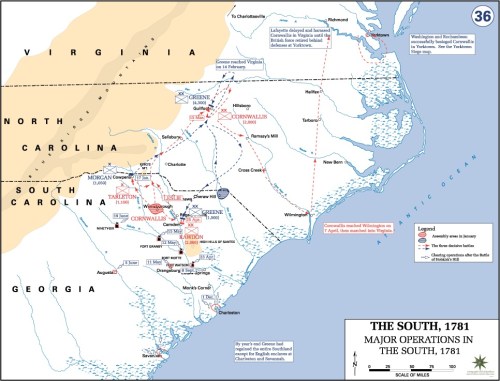
The early stages of the war were fought in the troublesome northern colonies, home of the original irksome Tea Partiers and a certain troupe of rabble-rousers in Philadelphia and New York. Those battles are legendary and often-taught in schools and shown on the History Channel: Lexington and Concord, Ticonderoga, Bunker Hill, Trenton, Saratoga. Those sites get all the visitors and all the attention when it comes to Revolutionary War tourism. Little attention is paid to the Southern Theater of that war, except Yorktown of course. That’s really sad: what happened in the Carolinas actually assured victory for all the colonies and assured the new United States would be as big and bi-coastal as it is today. What started in the North concluded successfully in the South.
The battle had shifted in upstate New York. The battle of Saratoga was a huge victory for the Continental Army and colonial militias. General Horatio Gates defeated and surrounded General Burgoyne’s redcoat troops in a humiliating defeat for the British. It was quite a stunning victory, really, and not only cost the British dearly in men and arms but also encouraged the French and Spanish to enter the fray on the side of the fledgling Americans. The Brits were going down for a defeat, something that simply would not stand in the eyes of the landed gentry, Parliamentarians, and King George. So the Brits came up with a new strategy.

Their new goal became not subduing all the colonies, but weakening their power by attacking the supposedly “soft” underbelly: Georgia and the Carolinas. The Brits were convinced the lower colonies were full of Loyalists, unwilling to surrender the honor of being part of the Empire to join with a band of Puritanical misfits and wannabes. All the Brits had to do was get past the coastal defenses and move into the interior where the North American landed gentry would gladly join them. With the low colonies firmly in British hands, resource-rich Virginia would fall, and to hell with the miscreants in Pennsylvania and Massachusetts. They could have their little country, firmly surrounded and contained by Britain and her loyal followers.
In March of 1780, they besieged and eventually conquered Charleston, the biggest port south of the Chesapeake. They then moved inland, fighting and skirmishing all over interior South Carolina, picking up some Loyalists along the way but also (foolishly) stretching their supply lines and slowly whittling away at their core group of highly trained soldiers. But in their eyes, they were doing exactly what they wanted to do. Georgia was effectively out of the fray, South Carolina was theirs, and North Carolina (theoretically full of loyal British subjects) would be won. Then they could gather their strength and take back the Chesapeake Bay ports and the colony of Virginia.
 After a series of mixed-result battles throughout South Carolina, bold Lord Cornwallis (descendant of barons and earls and nephew of archbishops and governors) lightened the load of his armies by abandoning equipment and supplies, and led them all into North Carolina in hot pursuit of the fleet-of-foot Continentals led by that much-beloved Quaker, General Nathanael Greene of Rhode Island. A brave and very astute commander, Greene’s motto became “we fight, get beat, rise, and fight again”, directly copying a strategy made famous by Fabius Maximus centuries earlier: war through attrition.
Greene did that over and over in the southern campaign, and culminated that strategy at Guilford Courthouse near Greensboro. He met Cornwallis’ 1900 crack troops with over 4000 of is own. He knew his men didn’t have the skill or fortitude to defeat Cornwallis, but he’d have them pound the British as much as they could. Worked, too. Worked fabulously well. The Brits won the battle due to superior tactics and arms (and, supposedly, through the use of nasty friendly-fire tactics), but they paid a high price for their victory. Cornwallis lost a quarter of his men and (due to “lightening the load” weeks earlier) most of their supplies. Cornwallis had no choice but to retreat over inhospitable land to coastal Wilmington. The British lost their chance to split the Colonies forever, and were eventually met with defeat in Yorktown months later.
There’s a lot we don’t know about the history of our own country. We tend to remember a few key events (poorly), but miss the whole. It’s quite interesting, actually, how one event leads to another, how a series of small defeats can lead to a great victory and the eventual redirection of history. The Battle of Guilford Courthouse is one such event.
Oh, and North Carolina is my favorite Southern state. Just thought I’d toss that out there. 🙂

[I didn’t own a digital camera when I visited Guilford Courthouse, so no pictures. All illustrations & maps are public domain.]
==============================================
Links
Guilford Courthouse National Military Park

 It all started with the settlement of interior North America. The French got their first and got busy. By the mid-18th century they had settlements from modern-day Quebec down the St. Lawrence River to the Great Lakes and down the Mississippi to New Orleans. They also had spots on the Ohio River and other tributaries. They were in a pretty good position actually, but their settlers were more concerned with fur trapping and trade than continental domination. The Seven Years’ War with England (called the French and Indian War by us Yanks) came along, the French got beat pretty badly and, in the Treaty of Paris, England gained possession of all those forts. Of course, the Brits being the Brits, they figured they could just plop some redcoats in the forts and claim lordship over the lands. The French settlers still worked their farms, collected fur pelts, and paddled up & down the river in trade like they had for a generation, while theoretically under British “control”.


 America In Context