Feeds:
Posts
Comments

Posts Tagged ‘travel’

Mistakes Were Made

I really screwed up my trip to the Smokies. For some strange reason, I decided to stay at a resort named Fontana Village, south of the park boundary in North Carolina. It was close to the park, yet away from the tourist trap of Gatlinburg. It sounded nice enough: cabins, horses, kayaking, bike rentals, sports fields, etc. I thought it’d be a good place to unwind and enjoy nature without a lot of noise or nonsense. So I booked it and made my way down.

I had a light breakfast as usual, I get so nervous flying I try not to eat much beforehand. I flew into Charlotte, picked up a rental car and then drove all the way to Fontana. It’s pretty remote, about a four hour drive, didn’t stop for lunch, just grabbed some snacks from a Quik-E-Mart. Got to Fontana just as it was getting dark, and because it’s off the beaten path, it was really dark. Nice, windy roads as well. I knew that once I got there, that was it for the night. I arrived, check in and, well, the place was dead. Right away, I realized what a horrible mistake I made. It was October, way off-season. I was one of maybe 8 guests in the whole place, just about everything was closed. Dinner in the hotel restaurant was trucked in from God-knows-where, and it was lousy: some sort of overcooked chicken tetrazzini nightmare. Restaurants were hours away, I was beat, so I choked down what I could (not much) and went to bed.

Morning came, and there was not much available for breakfast, either. Single-serving corn flakes, 6-oz cups of OJ. Disastrous. But hey, I was near the park. Forget about the lousy accommodations, I didn’t travel all that way to sit in a hotel room anyway. So I grabbed my gear, and headed to the woods (the Twentymile Trail, to be specific).

Oh good God it was awful! The prior day’s malnutrition hit me like a sledgehammer to the sternum. I was so low on energy, I could only walk about 10 minutes before needing a breather. I was sitting on every stump, lump, rock and log I came across. It was torture. The peanut-butter crackers I brought weren’t doing the trick, either. Why, oh why, didn’t I swallow my pride and eat more tetrazzini? Why didn’t I grab a yogurt at the weak breakfast buffet (there was yogurt, wasn’t there)? I felt like I was on a forced march in Bataan or something, except it was a chilly autumn in North Carolina instead of summertime in the fetid tropics. Every step was agony. Every breath was labored. I could hear the pulse from my pounding heart in my eardrums. It was awful.

I met a man, 20 years my senior, trotting happily down the trail, not a care in the world. Definitely walking a faster pace than I. Cheerful and friendly, he piped up. “Good morning” he chirped. “Top of the trails just around the bend, wait till you see it!” “Thanks” I groaned, trying to conceal my fatigue through a hearty façade. I waited until he passed behind the trees, and continued the slow, painful, protein-deficient struggle to the top of the hill … and then I saw it.

Around a bend, a gap formed in the trees. The morning fog burned off, the sun started to peak through. I lifted my weary head, and looked out. The sight took whatever feeble breath I had clean away. I was overlooking a sunlit carpet of red, orange, and gold, as far as the eye could see. I was looking at the majestic, glorious tops of the great forest of Smoky Mountains National Park, and it was fabulous. I felt like Bilbo Baggins, poking his head from the gloominess of Mirkwood and seeing hope in the butterflies. It was spectacular, and awesome, and inspiring, and rewarding.
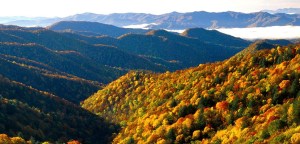
I turned back down the trail, and with gravity’s assistance, I made it back to the lodge. After a quick shower and nap, I hopped in the car and drove an hour or so to the nearest restaurant, sat down, and ate a steak the size of a toilet seat.

It’s a truly spectacular park, after this ill-fated hike I spent another 3 days in the area and it was wonderful. I only spent one night at Fontana Village, though :-P. Now before folks complain, let me just say I went off-season, and it was 15 years ago. Whether Fontana Village is any better in the summer, or has improved the place since then, I cannot say. But I can definitely say an autumn trip to the Smokies is well worth any lodging hassles.

===========================================
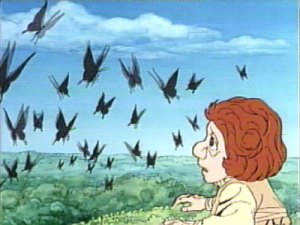
[I didn’t own a camera when I took my trip to the Smokies. Pictures are all in the public domain as far as I can tell. If you know of any copyrights that apply, please let me know. Bilbo’s image is copyright 1977 by Rankin/Bass Productions.]

Links:

Great Smoky Mountains National Park

Fontana Village

The Story of the Fontana Dam

Google map of GSM NP

Read Full Post »

Iconography and Foolishness

How incredibly iconic is this image?

This is a picture taken in 1869 at the joining of two great railroads — the Union and the Central Pacific — in 1869. Setting aside the poor quality of mid-19th century photography, this is terrific photo. How better to depict years of labor by hardworking Americans and immigrants, and the importance of joining the battle-scarred and reconstructing East to the Pacific Coast, a land of wealth and promise, than this image? You see the engineers and work crews of the two big railroads, sharing champagne and smiles at the importance of the moment. This event was celebrated with drink and fiddles, dance and jubilation, pomp and circumstance. The joining of the railroads, one of those moments that marked significant change for this nation, beautifully captured for all time in this great iconic image.

Important it was, too, for this country was made strong by the railroads. Like the Internet of today, the railroads meant everything to 19th century America. They expanded commerce. They enabled safe travel. Because the telegraph shared the right-of-way, they improved communications. Most importantly, they tied the country together, and they eventually did more to unite the country than the War Between the States. No longer would you have to spend weeks of misery traveling across the country on horseback or in wagon trains, subjected to the harshness of the elements and the dangers from bandits and natives. You could now board a train in Philadelphia and — depending on your fortitude — eventually disembark in San Francisco.

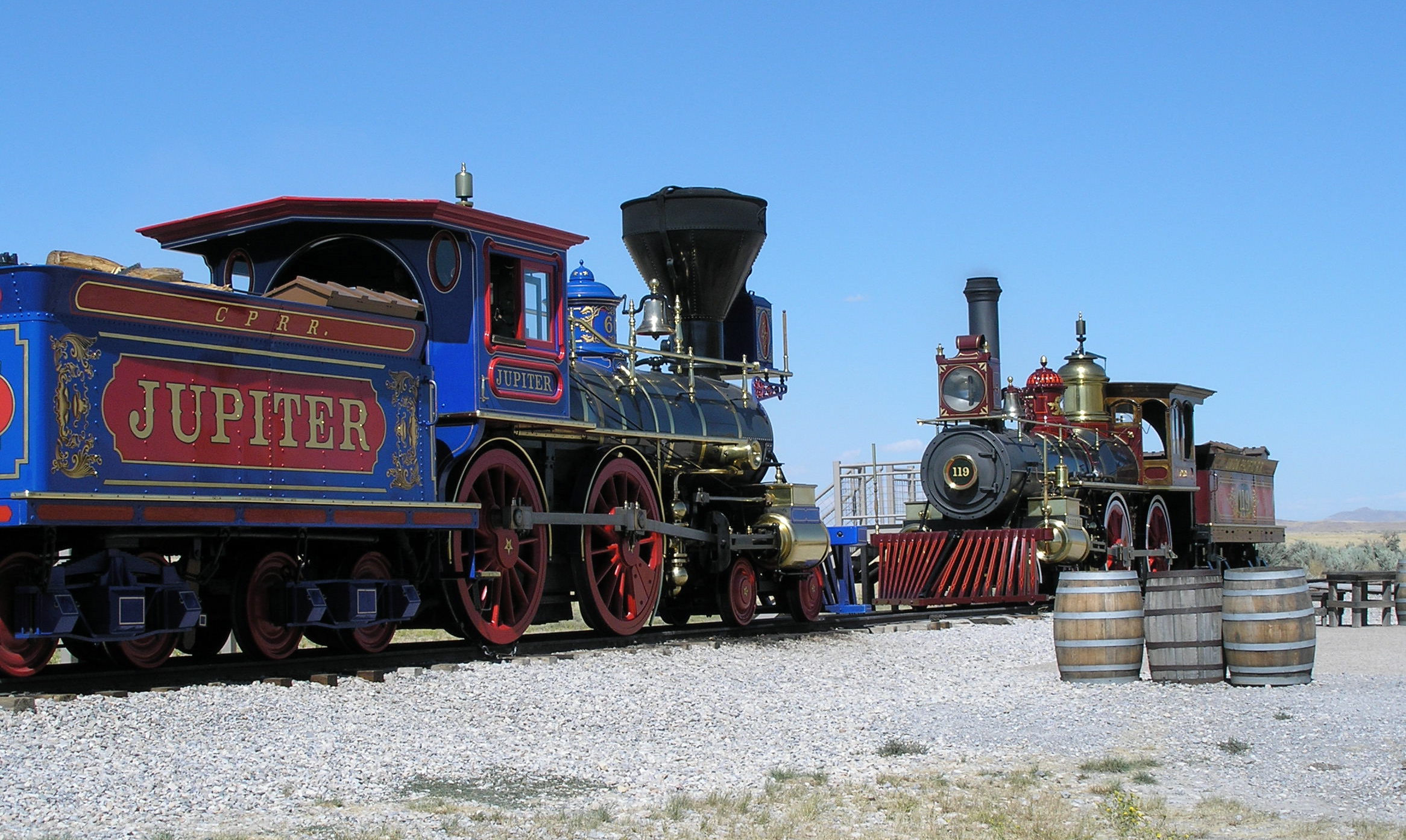
I am one of those folks who maintains romantic views of these old railroads. I find the whole history of the railroads wonderfully fascinating, and places like Golden Spike NHS enforce this fascination. They have two terrific, working replicas of the two locomotives: the Pacific Central’s Jupiter and the Union Pacific’s No. 119, sitting on rebuilt tracks on the original rail bed. The site itself is still remote, on the opposite side of the Great Salt Lake from Utah’s big metropolis. You can feel the winds of the plateau, smell the lake’s salt spray, and imagine yourself in this desolate land in 1869, laying the final tracks to unite a great nation.

Of course, our iconic and romantic imagery of these great railroads is not accurate. The railroads were not perfect. Because they were powered by burning coal, they were filthy. They were also noisy, uncomfortable, prone to breakdown and delay, and were occasionally assaulted and robbed. They gave rise to the Robber Barons, men of such wealth and influence they seemingly ran the nation from seats of financial power to the detriment of the nation and the ire of Teddy Roosevelt. Even the east-west joining of the railroads does not stand up to our romantic notions. In fact, this activity can be used to show how government interference into commerce and industry is inefficient and stupid.

You see, the government funded the creation of the transcontinental railroad, starting with the Pacific Railway Act of 1862. Through it and several other bills throughout the years, the government provided land grants across the vast unpopulated areas between Omaha and Sacramento. The government also paid railroads to lay track across the Great Plains, the Rocky Mountains, the Sierra Nevada, and the inaccessible plateaus in between. To this day, this still sounds like a shining example of the types of investments the federal government should make, investments whose resulting projects would provide great benefit to the entire nation.

Of course, the implementation itself proved to be horrid. First of all, the railroad land grants were far larger than they needed for these railroads, so they were able to sell parcels at tremendous profit, none of which made it back to government coffers. This, coupled with other forms of corruption during construction, means the government basically enabled the robber barons to become those tyrants and puppet masters we hear of today.

Then there were the foolish reimbursement formulas. The government basically paid the railroads by the mile, and also paid extra for crossing difficult terrain. This inspired the railroads to create winding and inefficient railways, and multiple cases of crossing difficult terrain instead of taking a simpler path in order to earn more government reimbursement. This led to that great anathema to those of us with engineering and scientific mindsets: tremendous inefficiency, idiocy, and profiteering displacing sound design and technological competence. Maddening, ever so maddening, and it is still a process that continues today in the form of pork-barrel projects, unnecessary weapon systems, and bridges to nowhere.

Promontory, Utah itself represents this misdirected mindset of federal funding. It has been debated that, had the railroads concentrated on building efficient East-West connections instead of taking advantage of flaky federal reimbursement rules, the railroads wouldn’t have been anywhere near Promontory. I’m not entirely sure that’s true, but it is definitely true that the spot was bypassed 35 years later, and hasn’t been a part of the transcontinental railroad since then. It is a dead, empty stretch of the Utah plateau, irrelevant except for a small plot of land celebrating the Golden Spike ceremony of 1869.

I still loved my short visit to this site. Regardless of the tainted history, it’s still an incredibly romantic, iconic moment in American history. And in an ironic way, the abandonment of Promontory by the transcontinental railroad has actually worked towards preserving the site as it was on a sunny day in May of 1869. Take a visit when you’re in the area, watch a steam engine demonstration, and imagine yourself in a bygone era, when a single moment changed the course of American history.

[The first two images are taken from the National Archives. The rest are my own photos and copyrighted as such.]

================================

Links:

Golden Spike National Historic Site

An essay on federal aid and the transcontinental railroad

Central Pacific Railroad Photographic History Museum

Google map to Promontory, Utah

Read Full Post »

Poor Old Upstate

It’s a shame what’s happened to Upstate New York. While the city and Westchester County prosper from the wealth (yes, it still exists) of our heady financial system, Upstate suffers. A trip through Upstate is a trip through a region in decline. Empty factories, empty homes, bankrupt farms, it’s sad really.

What’s really sad is it’s such a beautiful part of the country. You’ve got the Adirondacks, the largest state park in the country, with its dense forests and old, weathered mountains; microbreweries like Saranac, Ithaca, Ommegang, and Old Saratoga (to name but a few); the amazing Thousand Islands; the peaceful Finger Lakes region; and miles and miles of unspoiled farmland. But I guess that’s not enough in this age of globalization, financial ruin, the off-shoring of America’s industrial might and intellectual property, and perhaps the lousiest state government in the country.
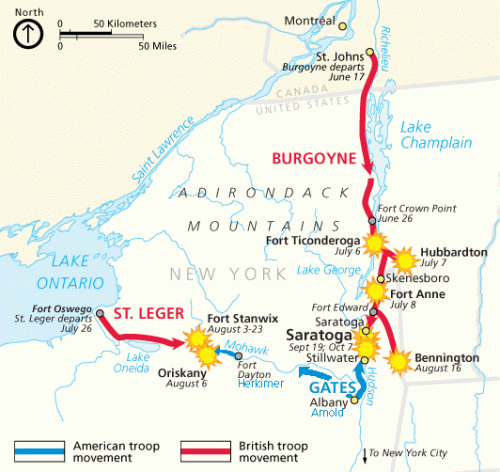
The other thing New York has to offer is a storied past. It can be argued that New York is a state with greater historic significance than any other state in the Union. This state was a central battleground in the French & Indian War, the Revolution, and the War of 1812. It didn’t factor heavily in the Civil War (other than contributing thousands of troops and the famous NYC draft riots), but during WWI and WWII the city was the great port for the embarkation of millions of troops. Ellis Island and the Statue of Liberty were seen by millions of immigrants, from which the majority of the population now descends. Three Presidents were born in the state, and one (William McKinley) was murdered there. There’s a lot of history in New York’s borders, and significant portions of that in Upstate.

Fort Stanwix is one of those historic spots in this great state. It’s smack-dab in the middle of Upstate, right outside Rome, NY. It, along with sister forts Ticonderoga and Saratoga, factored heavily in the Saratoga Campaign during the Revolutionary War. Today, it’s been reconstructed and is the sight of regular re-enactments and special events. Stop by next time you’re trucking across the state at 85 MPH, trying to get wherever you’re going in such a damned hurry. While you’re at it, stop by Howe Caverns, the Baseball Hall of Fame, any of the numerous covered bridges over the Hudson, Lake Placid’s Olympic training facility, the Herkimer Diamond Mines …

New York: much, much more than the Five Burroughs. Check it out. Tell ’em Barky sent ya. 🙂

[Sadly, I didn’t own a digital camera when I visited Fort Stanwix, or the Adirondacks, or anywhere else I visited during my two-week swing/stay through the state. But I do have fond memories of the place. Pics & graphic from the National Park Service.]

=============================================

Links:

Fort Stanwix National Monument

The pretty ugly, but pretty complete, Adirondacks.com

Everything you wanted to know about Herkimer diamonds

The Lake Placid Pub & Brewery

Google map to Fort Stanwix

Read Full Post »

Hazards of Time

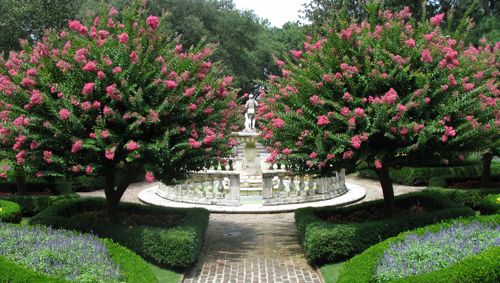
There are a few problems with blogging about collections. One is the problem I’m having blogging about Fort Raleigh. I know I was there, I remember crossing the bridge to Roanoke Island and taking the detour to a beautiful patch of flora along the Albemarle Sound.

But other than that, I don’t remember anything.

I can imagine the same problem with other collectors. “Who gave me this alpaca Beanie Baby?” “How did this otaku manga get mixed in with my Marvel comics?” “Where did I get this train car covered with illegal aliens?” … hmmm, actually a model train car covered with illegal aliens sounds pretty nifty. 🙂

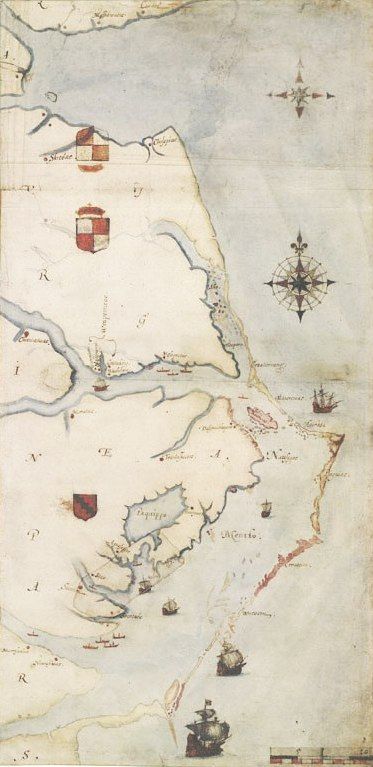
I guess it’s appropriate that the one site I seem to have forgotten is Fort Raleigh, for Fort Raleigh marks the site where a colony of 116 men, women & children simply disappeared while their captain sailed for supplies. To this day, it’s not known what happened. Some say they were slaughtered by nearby natives, others think they moved inland looking for food and died, others think a storm swept them all away. The truth, of course, is they were abducted by aliens.

Here’s what I really want to know: did I forget about Fort Raleigh because of time? Age? Maybe I was so giddy after visiting Kitty Hawk I didn’t absorb anything from Fort Raleigh. Or maybe Fort Raleigh doesn’t really have anything to teach us. The story of the Roanoke colony is taught in grade school (or at least it was, maybe it’s not on any No Child Left Behind test). One of the key reasons I travel to the parks is the opportunity for locational learning, where one can see and feel the space where an important event happened or a particular natural wonder is showcased.  But at Fort Raleigh, there’s really nothing to see. Yes, it’s a beautiful park, but other than that, there’s nothing really to connect one to the event it’s supposed to commemorate.

Without a connection, there’s no opportunity to learn and, for me at least, no reason to remember.

[I didn’t own a digital camera when I visited Fort Raleigh. Pics are from Wikipedia Commons (see comments).]

======================================

Links:

Fort Raleigh National Historic Site

America’s Lost Colony

25 Strangest Collections on the Web

Google map to Fort Raleigh

Read Full Post »

« Newer Posts - Older Posts »