Feeds:
Posts
Comments

Posts Tagged ‘travel’

The Good Life

A little while ago, in my post on Edgar Allan Poe, I talked about a creative genius whose life would suffer through poverty and hardship and end in tragedy and mystery.

Today, I’m posting about another great literary figure whose life progressed quite differently: Nobel- and Pulitzer-prize winning playright, Eugene O’Neill.

I am, admittedly, not “well read”. I’ve only read one or two of the classics, and only because certain college courses demanded it. I also don’t attend a lot of theater, although I will attend plays by Shakespeare whenever our local playhouses present one. So I really don’t know that much about O’Neill or his plays, other than a forced reading of “The Hairy Ape” for that three-credit “art domain” course at the state university. But there is no denying the man is one of the giants in American literature, having penned renowned plays such as “Morning Becomes Electra” and “The Iceman Cometh”.
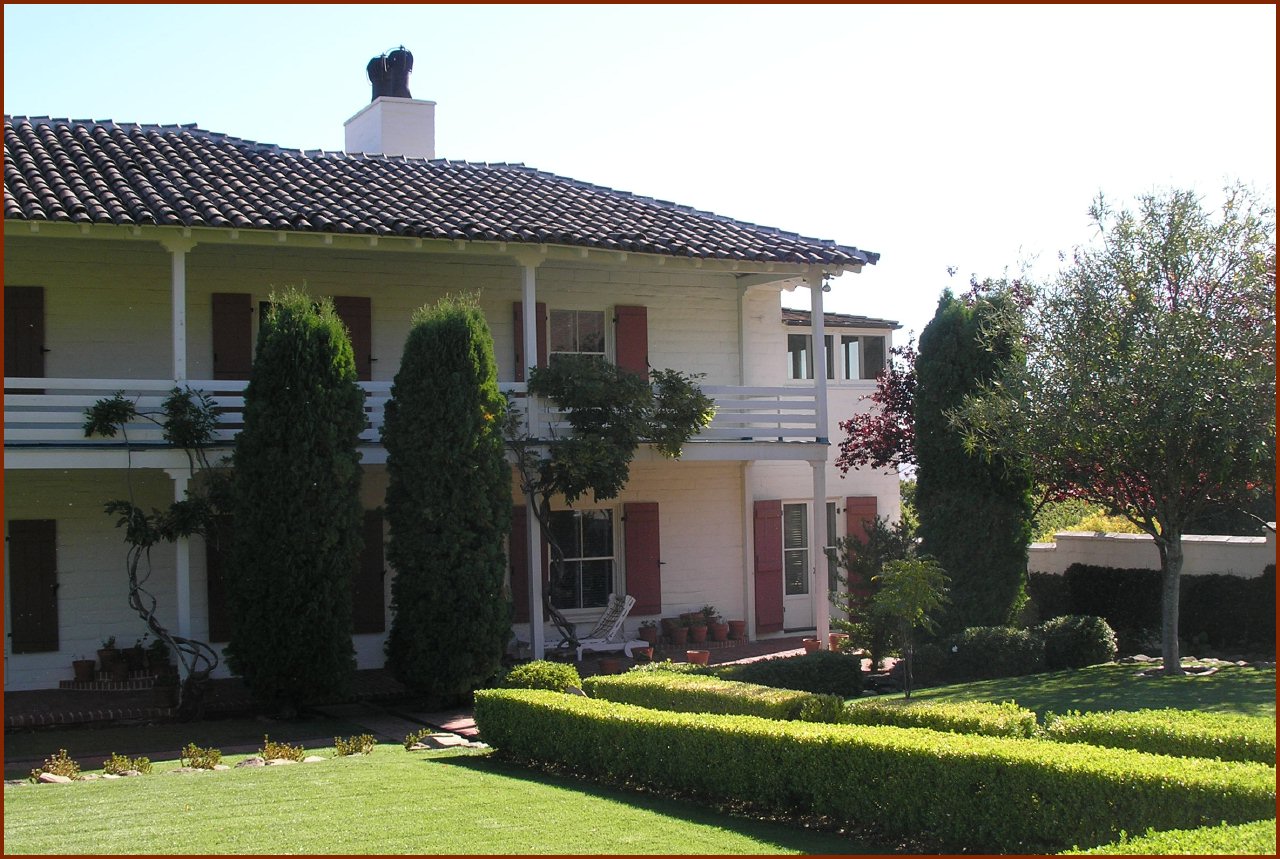
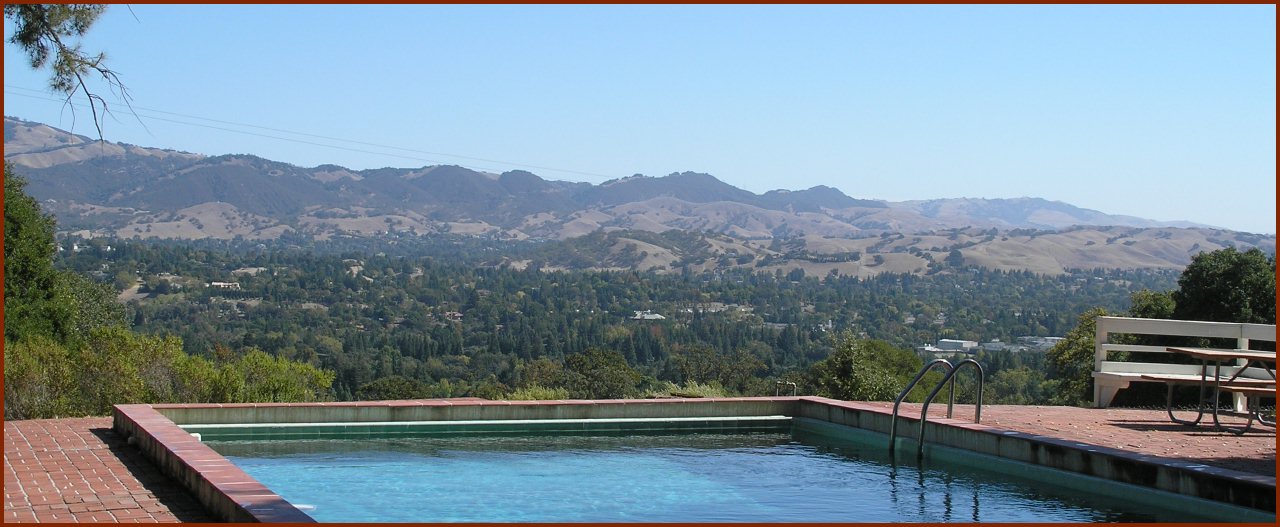
Porch © 2009 America In ContextWhen you visit his home in the hills of Contra Costa County, California, it becomes abundantly clear that he, unlike Poe, enjoyed the fruits of his labors. It’s a beautiful Spanish Colonial house, set on a wonderfully landscaped lot, overlooking the valley below, and backed by the rocky, wooded hills of the Las Trampas Regional Wilderness. It’s a truly elegant setting, fit for a man clearly loved for his dramatic creations. The only tragedy here is his wife, Carlotta, was extremely light-sensitive and kept the windows covered by thick wood blinds and shades. Such tremendous views wasted, although I don’t fault her. I suffer slightly from light sensitivity, I can empathize with her dilemma.

I’m not quite sure what else to say about Eugene O’Neill, except for this: I never begrudge artists, whether authors or playwrights or actors or musicians, from living well off their talents. Artists are special, and art advances us as a species like nothing else can. Art is more influential than technology or governance or business or medicine in that regard. Art is the gateway to the spirit of mankind, and it is that spirit that advances us.

I know this sounds trite and packaged. Aren’t we all supposed to say “art is the gateway to the spirit of mankind” or some such crud? Sounds like it’s right from the mouth of a guest star on Oprah. But I’m convinced it’s true. There’s something personal and unique about an encounter with art. You see it, or read it, or listen to it, or watch it, and your initial reaction is unique to you and you alone. Art tends to cut through all those social filters that muddy up our society and sends a message straight to the individual (instead of the huddled masses).
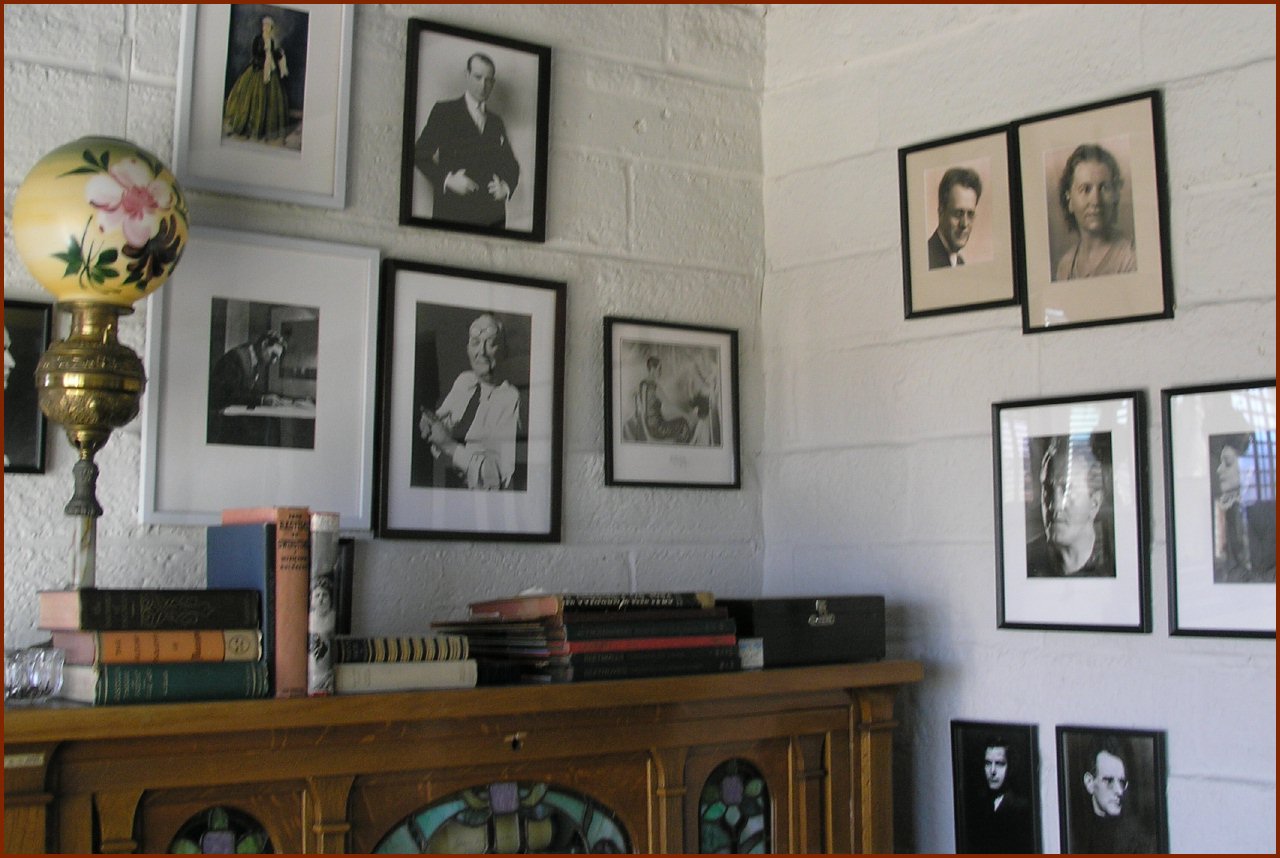
Friends © 2009 America In ContextNow, that message might be: “Hi. I’m really, really ugly. Please take note.” And that’s fine, because the next guy, totally independently, can receive a message: “Hi. I’m you. You really need to take a hard look at this, and change your life before it’s too late,” and that can be a really powerful message.

Famous and beloved artists tend to touch more people, send out those messages that give them hope, or give them insight, or give them motivation to change. Technology can’t do that, it only provides a vehicle to get things done. Politicians can’t do that, all they can do is further enslave us into dependency on government. Theocrats can’t do that, all they can do is entrap us deeper into the constraints of dogma. Only artists can do that. Or maybe a real, good friend.

Folks like O’Neill, Bob Dylan, George Carlin, Steven Spielberg, Robert Plant, Stephen King, and a host of others, all manage to reach out and touch lots and lots of people, and I have no problem when these folks living well. In fact, I hope they do so.

Now Brittany Spears, well, that’s an entirely different topic …
Front View © 2009 America In Context

On a side note, I do want to mention one key difference between Poe’s and O’Neill’s NPS sites. In my prior post, I remarked how the Poe site’s neighbors seemed to like having Poe in the neighborhood. They do readings for local kids, and no one has ever defaced that wonderful mural of the author, even though it doesn’t seem like a pleasant neighborhood. It’s sad to say so, but it certainly appears that O’Neill’s neighbors aren’t particularly interested in having his site in their neighborhood. It’s a very upscale, expensive neighborhood, and you have to be bused in from a commuter parking lot (no tourist cars are allowed), and there doesn’t seem to be the connection between the neighborhood and the site or the man. In all fairness, the winding roads and limited parking are not conducive to lots of tourists, but you definitely get the feeling folks int he area don’t care too much for having a National Park unit in their vicinity. It’s sad, and in my view, it doesn’t speak well to their character.

I hope someone from the area can post here contradicting me. It was just an observation, drawn from a particular moment in time and seen through my jaded eyes. Hopefully reality is different. If you have direct experience with this site and its neighborhoods, and you think I’m full of crap, please post & tell me (just keep it civil 😉 ).

[Photos on this post are mine and copyrighted thusly. See other photos of Eugene O’Neill’s home on my Photobucket page.]

========================================================

Links:

Eugene O’Neill National Historic Site

Eugene O’Neill Archives

Google map to E.O. NHS

Read Full Post »

America’s Queen Mum

I have a really weak system for selecting blog topics. When I started America In Context, I didn’t have a plan. I just started alphabetically, a pretty lame way of doing it if I do say so myself. It’s actually not that bad of a system, surprisingly I don’t repeat myself too often. One day it’s a natural preservation post, then something historical, then something cultural. Things stay fairly well mixed up. I suspect it’ll break down soon when I get to all the “Fort Something-or-Other” sites, but for now, it’s fine.

Actually, in the case of this week’s post, it’s better than fine. It seems fitting that my post on Dwight Eisenhower, Supreme Allied Commander in Europe during World War II, be immediately followed by a post on Eleanor Roosevelt, who could, perhaps, be called Supreme Commander of the U.S. Home Front. Having these posts bookend Memorial Day is fitting as well.

Eleanor Roosevelt with FalaI titled this post “America’s Queen Mum” for a reason. Eleanor Roosevelt, like Britain’s Queen Elizabeth (the current Queen Elizabeth’s mother, who passed away in 2002) was a beloved figure during terribly troubled times. Throughout the Depression and then the War, both women were strong role models for their beleaguered citizenry. These ladies did what leaders are supposed to do: walk amongst the people. With regular public addresses, newspaper articles, and visits to various cities and towns, they were inspirations to the people when they needed it most. Cowards sit in their undisclosed locations or corner offices or posh resorts when the shit hits the fan. Leaders stand in front and take the full spray. OK, I think that’s the most repulsive sentence I think I ever typed, but it makes the point….

Personally, I think the concept of “first lady” is anachronistic and inappropriate for a democratic nation. They are nothing more than the wife of a president, yet they are treated as cultural icons or, even worse, like royalty. I find all the current fawning over Michele Obama to be ludicrous. “Ooh look, she doesn’t have flabby arms!” Big damned deal. To this day, people still adore Jackie O. for no reason other than her fashion sense. The First Lady institution is not much more than a baseless cult of personality. First Ladies also have a penchant to support their pet causes, sitting in weak public service announcements nestled between the latest Ron Popeil Crap-O-Matic infomercial and some MTV “I Wanna Be a Teenage Hooker” reality show on late-night television. I’m so glad a First Lady sponsors literacy while her husband guts the public school system and his party disparages educated people as “liberal intelligentsia”.

Eleanor Roosevelt & Pete Seeger with WWII Troops

When it comes to Eleanor Roosevelt, however, I change my view. She was truly a great lady. Not only did she speak to the people during hard times as I noted earlier, but she was also directly involved in many great causes, from civil rights for African-Americans to equality for women to the spread of democracy across post-WWII Europe to the formation of the United Nations. She was also a shrewd political operator, directly sponsoring campaigns of those who supported her progressive agenda. Regardless of whether or not you support progressive causes, you have to admire her determination and activism in the causes she supported. She was no mere figurehead but an actual mover and a shaker and an inspiration for millions.

She has her own spot in the National Park Service for a good reason. Of all the First Ladies in our history, she truly stands out as an individual, separate from her husband, for her impact on the country (and the world).

Val-Kill Cottage

[Once again, I didn’t own a digital camera when I visited Eleanor Roosevelt’s NPS site. Pics are public domain, taken from Wikipedia or the National Park Service.]

========================================

Links:

Eleanor Roosevelt National Historic Site

Wikipedia’s Eleanor Roosevelt Media Gallery

Eleanor Roosevelt Center at Val-Kill

Google map to ER NHS

Read Full Post »

For Your Consideration: The Greatest American

Some time ago, on a long-forgotten internet message board, someone posed a question: who was the greatest American in history?

Of course, the internet being the internet, the argument soon disolved into a flame war (I’m sure someone mentioned “abortion” somewhere and it just devolved from there). Somewhere in the fray, however, I made a case for Dwight D. Eisenhower as the Greatest American. Now you can’t answer a question without understanding a question so, as I did on that tiny little  message board, I’ll start off explaining my interpretation of that particular question.

Ike Earrings

Most folks, upon hearing that question, will instinctively think only in terms of America itself, as in “which American did the most for America”. A logical answer here would be Abraham Lincoln, a man who not only kept the Union from dissolving, but also had the guts and fortitude to fight the greatest evil America has ever wrought: the continuation of slavery nearly 9 decades into its existence. Slavery was an unholy abomination that should have been extinguished when Thomas Jefferson put the last period on the Declaration of Independence, but it was allowed to exist through the sheer audacity (and utter cowardice) of founders and legislators and presidents alike. No President stood up to slavery until Lincoln, and his actions saved our country. We were not only saved literally (by stopping secession), but also morally. We had no moral fiber as a nation until slavery was abolished. It is as simple as that.

Ike and 101st AirborneThe only problem I have with proclaiming Lincoln as the “greatest American” is his actions really only saved the country. When I hear “greatest American”, I think globally: which American did the most for the world? Now that is an entirely different question. Sure, some could extrapolate “well, America is the greatest country, and Lincoln saved America, so Lincoln is the greatest”. That not only shows a grotesque level of hubris, it’s not really accurate. America wasn’t a world player for nearly a century after Lincoln’s time. We were an isolationist nation. We were protected on two fronts by mighty oceans, and only had two neighbors. No threats = no conflict = no interest in the world. Plus we were a nation of immigrants, collectively giving Europe the big middle finger as we went on our way, making our own prosperity (and driving the native population into their graves, but that’s the subject for yet another post). Saying Lincoln was a great world figure is simply disingenuous.

So, if we honestly answer “which American did the most good for the world”, well, you can come up with a lot of answers. Many (and perhaps rightly) say medical pioneers like Jonas Salk or inventors like Thomas Edison or scientists like Robert Oppenheimer deserve the title.  I appreciate these picks, but I have to ask: is science purely an American endeavor? Isn’t science simply the discovery and application of facts, principles and theorems? What makes it uniquely American? Doesn’t science transcend nationality? Jonas Salk could just have easily have been German, or Spanish, or Japanese. I’m not at all denigrating the work of these individuals in making my pick, I’m actually elevating them beyond simply being Americans.  Well, I suppose Edison was truly American: he was an incredibly shrewd businessman and power broker who set out to destroy his competitors, but, again, that’s a subject for another post …

5 StarsThis leads me to my own approach to the “Greatest American” question. First, did the individual have a postive, global impact; and second, did the individual act with the best of our core American principles (life, liberty, pursuit of happiness, etc.)? I say Ike deserves serious consideration as the Greatest American under that context, and I say it for one big reason: World War II.
World War II was the greatest conflagration the world has ever known. Never before, and thankfully never since, has the globe ever been covered in carnage and evil as horrid as during the period between 1939 and 1945. I don’t even know if people can comprehend that evil. I’m fairly convinced Americans can’t, we simply haven’t experienced war firsthand on our own soil since 1865. Let me tell you, it was nasty-horrid. And the Nazis, the Nazis were the worst. They epitomize evil to this very day. Every tyrant since 1945 is judged against Hitler, every evil movement has been compared to Nazism. These people were cold, heartless butchers; utterly disinterested in freedom and liberty; technocrats and bullies of the worst kind; the filthiest type of genetic bigots and medical torturers this world has ever seen. America saw this evil and (after much prodding by FDR) finally decided to confront it. But we brought more than men and equipment to Europe, we brought a secret weapon. We brought Ike.

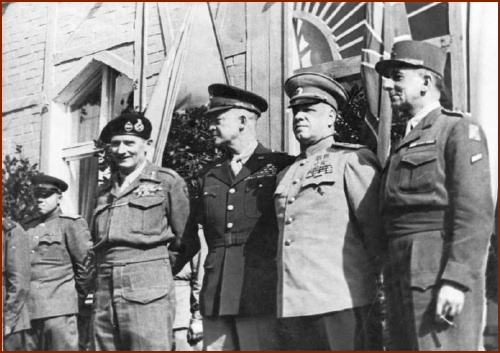
Montgomery Eisenhower Zhukov de Tassigny

I don’t know if I’ll make many friends with this paragraph, and I don’t mean any disrespect to any man or woman who ever served in our Armed Forces, but an army isn’t worth a damn unless it has good, strong leadership. Throughout history, there are lots of stories of brave armies led to their defeat and slaughter by lousy generals; and plenty of other stories of underpowered armies led to victory by great generals. Anyone who’s read about our Civil War knows stories like these, and they occur in European history as well. Victory and defeat don’t rest on the shoulders of the soldier, they reside in the brains of the generals.

Ike was one of the better ones. I don’t think he’s rated as the greatest American general ever (I think that title tends to fall on Lee or Patton or even George Washington), but there can be no doubt he had the greatest challenge of any of them. He had to face a highly skilled, highly entrenched opponent, who had (in some cases) superior weaponry and better planning (at least in the early parts of the war). Not only that, he had to rescue no less than an entire continent from the greatest scourge mankind has ever seen. This was an enemy unlike any faced by Americans in our entire history. This was an enemy who actually sat down, in offices, using businesslike precision, and plotted the extermination of, by some counts, 11 million people! [See link below for more on this]. This was much, much more than simple warfare. The stakes were much higher.

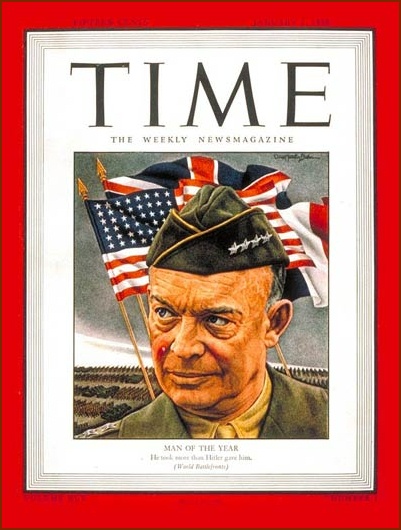
Man of the Year

I’m hoping that, by now, you see why I’m nominating Dwight D. Eisenhower, Supreme Allied Commander Europe, as the Greatest American. Yeah, he didn’t beat the Nazis all by himself (no one achieves anything by themselves). Yeah, he made a lot of blunders and mistakes and some (like the continued delay of the invasion of Europe) probably led to further deaths in the Soviet Union.  I still think his achievement earns him the title of Greatest American. He was a fine president, the 50’s were a good time in this country. He sponsored the interstate highway system, connecting us in a way we never were connected before. He started the battle against Communism (although he didn’t act to combat McCarthyism). He tried to integrate our racially divided nation (with admittedly limited success). He even tried to warn us about the growing power of the military-industrial complex, you don’t hear too many politicians doing that these days.

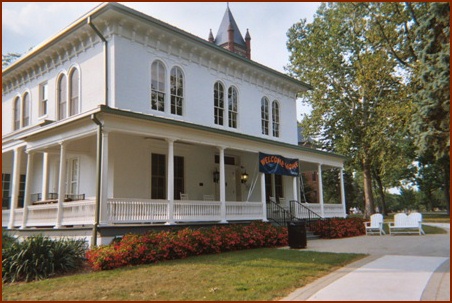
Most impressive, in my view at least, he was a humble man. His retirement home, now the Eisenhower National Historic Site near Gettysburg, Pennsylvania, is probably the humblest house ever inhabited by any former President. Hell, it’s not much different than the farmhouse next door to my own boyhood home. Personally, I think humility is one of the best characteristics a human being can ever have. Arrogance is for assholes, humility is for great people. Personally, I think Eisenhower was more of the latter and less of the former.

Eisenhower Home

[I normally don’t ask for direct feedback on a post, but I’d love to hear your thoughts on the “Greatest American” question. Also, I didn’t have a camera when I visited Ike’s house, all pictures on this post are public domain photos taken from the NPS or Wikipedia or other sources.]

===========================================

Links:

Eisenhower National Historic Site

PowerKills, R. J. Rummel’s works on democide

Atlantic Monthly’s Top 100 Americans and a contrary list

Google map to Ike NHS

Read Full Post »

American Classics

Edgar Allen Poe is a true American classic. I suspect that Poe is the second most recognized 19th Century American author (behind perennial favorite Mark Twain). Most everyone has heard of Poe through his well-known works like “The Raven”, “The Pit and the Pendulum”, “The Masque of the Red Death”, and that grade-school reader staple, “The Tell-tale Heart”. Some folks may have read one book by Herman Melville or Louisa May Alcott, and only college-level literature students have read anything by Emerson, Longfellow, or Thoreau, but most of us are familiar with Poe’s work and his influence on mystery and the macabre. I suppose it’s sad that he’s better known than his contemporaries (critically speaking Poe’s works pale in comparison to Emerson, Longfellow and Thoreau), but his visceral take on humanity made a huge impact on popular culture. You can trace so many mystery-thrillers directly back to Poe. It’s hard to imagine Hitchcock or Stephen King or even CSI would be here today without his influence.

But a visit to Poe’s old homestead in Philadelphia evokes a different sort of American classic.

The Window © 2009 America In ContextPhiladelphia wasn’t the only city Edgar Allan Poe called “home”.  Never a wealthy man, Poe and his family led a fairly hardscrabble life. They travelled a lot, always trying to find a new opportunity in another city. Consequently, they lived in many places, from Boston to Richmond to New York. The only Poe home that has been preserved is an old, faltering row house north of Independence Park, on the bad side of I-676. Yes, that’s right: the former home of Edgar Allan Poe, one of the premier poets and authors of his time, is a shitty house in a shitty part of town. And I find that terrific.

I visited Poe NHS on a crappy, drizzly day. I spent the prior gorgeous, sunny day strolling Independence NHS, the well-manicured core of touristy Philadelphia, with its horse-drawn carriages and Ben Franklin impersonators. But the day I visited Poe’s House was sodden and sopping. Rain doesn’t bother me, I threw on a raincoat and headed out. Of course, I didn’t realize I’d be walking about a mile into the slums of Philadelphia. Honestly, that part of town isn’t that bad, but I clearly stood out like a sore thumb. I have to admit I was pretty nervous, but I didn’t run into any trouble. In hindsight, I think it was a very appropriate walk. Too many of us, myself included, stick to the “good” parts of America, and daren’t venture into the rougher sections. A brilliant thing about my National Park Site collection is you see virtually all of America, including some slums. You get a pretty complete picture that way, in my opinion.

The Cupboard © 2009 America In ContextBy the time I got to the Poe house I was pretty soaked. I entered and took off my coat, leaving puddles in my wake. A retired couple were there, their Lincoln parked in the lot, water beaded from a fresh waxing. We were just in time for a tour. Our guide (a really sharp and well-versed lady, a credit to the NPS) took us through the outwardly rickety building, and told us of Poe. A troubled man, a restless man, a man who struggled with success (both commercial and in life). A man who always tried to find his way, a man who seemingly lost his mind and eventually died a very mysterious death, yet a man who left us with some of the most beloved works in American literary history.

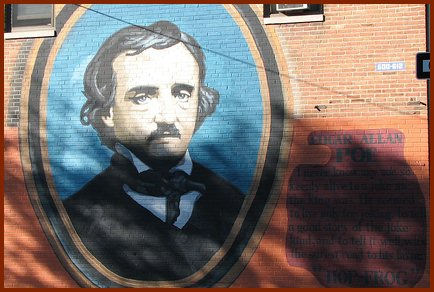
Poe’s story was intriguing, but what I found more intriguing was the relationship the Poe site and the NPS has with the local residents. Obviously that part of Philadelphia has a typical, urban, African-American population: undereducated, underemployed, living their own hardscrabble lives built on single-parent households, gang warfare, drug abuse, and a collage of government entities that don’t give a crap about them. But the folks at Poe NHS have worked really hard to get in touch with the community. They are constantly hosting children from local schools for tours and storytelling and events, and that ranger clearly loved to do it. There was no pretension or hypocrisy in her voice when she told those stories, even when she was talking to three Whiteys from the ‘Burbs. Her love of her job and the locals was pretty evident, and appreciated. She also pointed out the brilliant mural of Poe on a nearby building, and the fact that it has never been defaced by graffiti in all the years it’s existed. That is a telling factoid and really shows that either Poe’s works unites us on a fundamental level, or that if you respect people, they will respect you back.

The Raven © 2009 America In Context

Poe NHS doesn’t just tell the story of a famous American author, it tells the story of a rough life, a life led by many millions of Americans before and many more millions who came after. Rough living in a rough house in a rough neighborhood, a life lived by more of us than we care to think about. I doubt my tour companions really got the point of Poe NHS. The retired gentleman, who was supposedly making a coffee table book about “homes of great Americans”, clearly missed it when he said “I doubt this house will make my book.” We all didn’t grow up in marble mansions, doofus.

If you want to experience America, you need to experience all of it, including tilting houses in seedy neighborhoods. That is an idea worthy of a coffee table book.

The Mural

[Pics on this post are mine and copyrighted thusly, except for the mural. I didn’t get a good picture of it (crappy photog that I am), so I had to pirate one.]

========================================================

Links:

Edgar Allan Poe National Historic Site

Poe Museum (Richmond, Virginia)

Tabula Rasa’s History of Horror

Google map to Poe NHS

Read Full Post »

« Newer Posts - Older Posts »