Feeds:
Posts
Comments

Screw the Rich

[Note to my sensitive readers: there’s some pretty strong language in this post, just thought I’d warn ya. Also, this post is not meant to insult or demean the NPS or the fine staff & volunteers at Hampton NHS. They were friendly & terrific and I thank them for the job they do. — Barky]

In the tony suburbs north of Baltimore sits the magnificent mansion and grounds of a wealthy, “old money” family: the Ridgleys. Tourists traipse through the buildings, marvel at the architecture and rare collectibles (like Chinese pottery, Swiss grandfather clocks, silk-upholstered Queen Anne furniture, and ivory-handled cutlery). They meander through the grounds and ogle the symmetrical gardens and flowering shrubs, oohing and aahing all the way. If they’re feeling adventurous, they may trundle to the old farmhouse and sigh “oh dear, slaves once lived here”, followed shortly by “let’s get to Denny’s before the Early Bird Special expires”.

Who gives a fuck.

Seriously, I couldn’t give a rabid rat’s ass about fawning over treasures or discussing “the history of wealth in America”. Why? Because that history is a nasty, sordid one. By and large, the truly wealthy are nothing but a pack of leeches and have been for most of our history. From human traffickers to slave owners to Civil War profiteers to robber barons to market speculators to environmental rapists to “offshorers” to Bernie Madoff to the Koch brothers, these soulless bastards have screwed over this country time and time again, and continue to do so to this day.

It wasn’t always this way. Way back in the beginning, many of the wealthiest people on the continent gathered together to overthrow the yoke of British imperialism. Benjamin Franklin was an inventor, entrepreneur, and visionary businessman. To this day, adjusted for inflation, he solidly sits amongst the 50 wealthiest men in America. John Hancock also sits on this list, he ran one of the most powerful trading companies on the Atlantic coast. Many of the other signers of the Declaration of Independence, the crafters of the Constitution, and the financial backers of the Continental Army were wealthy businessmen and landowners. These folks risked their fortunes, put their necks in the metaphorical noose, and stood up to oppression for the good of all.

The rich don’t have to be jerks today, either. There are all sorts of good guys in business, folks who provide good value for a fair price, use innovation and provide quality products and services to the public and turn a tidy yet fair profit. There are business people who support noble causes, stand up against injustice, and work as much for their employees as they do for them. Sadly, though, these people will never become one of the “uber wealthy”, that gaggle of cocksuckers who connive and conspire to screw over the country for the sole purpose of lining their own pockets and stroking their own ego.

Folks like those have been here since the beginning of the country. Shortly after we gained our independence, the wealthy began to be part of the problem instead of part of the solution. A mere 35 years later, wealthy merchantmen pressured James Madison and Congress to declare war on Great Britain. Publicly, they wanted “honor”, but in reality, their businesses were in jeopardy due to the British execution of naval power. In the eyes of these rich Americans, war was a small price to pay to return to profitability.

Wealthy Southerners prevented the nation from handling the slave issue. Slaves were dirt-cheap labor, the source of Southern wealth, and the foundation for the entire Southern economy. Of course, it was a double-edge sword, for the slave economy also prevented entrepreneurism, invention, and advancement in the South. But it was what gave the wealthied gentry their power, their prestige, their income, and therefore they influenced Congress for decades to ignore their “peculiar institution” until 600,000 Americans died horribly painful deaths to end the barbaric practice. Of course, some folks became wealthy as war profiteers, which I guess proves the point that the rich almost always prosper at the hands of the rest of us, one way or another.

The rest of our history is equally sordid. Railroad magnates paid pseudo-slave wages, cared little for the safety of workers, used well-practiced fraud to steal millions from the government, and influenced the pace of the near-annihilation of the native Americans. Oil magnates displaced homeowners, despoiled huge tracts of land, crafted vertical monopolies to control the nation’s commerce, and formed holding companies to hide their tracks. In the industrial age, the rich burned people alive in shoddy New York City garment factories, flooded the entire city of Johnstown because they didn’t maintain the dam at their country club, violently cracked down on mine safety protests and spread cancer and misery across the land by polluting the air we breath and the water we drink.

Nowadays, they don’t act in nearly as bloody a manner as in the past. Instead, they use scam after scam to steal from the common man and bribe and cajole lawmakers to let them do so. They’ve moved far from simply convincing lawmakers to look the other way. They’re packing the courts so they can have free reign, paying off Congress to legalize their schemes, and use phony “grass roots” organizations to convince the voting public to support more scams intended to fatten their wallets and enable the continuing screwing of America. Oh, and occasionally they rape the maid.

So here’s the question: what good does the rich do for America today? None. Do they create jobs? Yeah, overseas, where they can (again) get cheap labor and work the local population so hard they jump to their deaths from high windows. Do they provide quality products and services to the public? Yeah, as if: the richest men in the country today sell technology so weak and treat our personal privacy so poorly, I’d bet a Russian crime syndicate knows more about your private life than you do.

Do today’s fat cats even use their wealth to support charitable endeavors? Frankly, I’m not even convinced that’s true. Look at right-wing nonprofits like the Heritage Foundation, who preach the screwing of America. Who funds that? Not middle-American bake sales or bike-a-thons, those things are funded by rich fuckers trying to “prove” that screwing over America is good for America. I would love to see an honest study of charitable giving by the rich. I’d bet far more goes to private “shell game” foundations (set up to protect their trust funds) or supports  right-wing “foundations” preaching the Gospel of Screw-You and buying off Congressmen than goes towards curing cancer, buying ambulances, feeding the hungry or rebuilding communities devastated by tragedy.

This long-winded diatribe is not intended to encourage or condone another Bolshevik revolution. I fully understand that we are a nation that succeeds because we are allowed to succeed, and that becoming rich is one part of the American dream. What it is intended to do is call out the wealthy in America for their thoughtlessness and greed.

In that spirit, I will address the rest of this post directly to them, the top 1% of income earners who control 40% of the nation’s wealth: there is nothing on heaven or earth that gives you the right to abuse your wealth and power. There is nothing on heaven or earth that gives you the right to profit off the misery of others. There is nothing on heaven or earth that gives you the right to scam millions off your customers whilst providing nothing of value or (even worse) causing harm to them. There is nothing on heaven or earth that gives you the right to earn 300 times the income your employees earn while your bad decisions ruin the company.

What does exist is your responsibility to act as much in the good of the country as the next guy. It could even be said that because you have more wealth and power than the average man, you have more responsibility to contribute to the nation in which you live in a positive and constructive manner. You are rich and powerful because of the freedoms this nation affords (witness a certain oil executive living life in a Russian prison if you doubt what I am saying), and you owe this nation your honest and kind-hearted support.

Bottom line: you need to stop being douche bags. Not all of you are. You can be rich, you can be successful, you can have power, but you can also be  decent human beings.

[All pictures on this post, and the post itself, are mine and mine alone and are not to be copied without my express written permission. My other photos of Hampton are here.]

============================================================

Links:

Hampton National Historic Site

By the Numbers: Wealth in America

Warren Buffet on Taxes

Does Income Inequality Matter?

An Editorial

This year (April 12th, to be exact), marks the 150th anniversary of the shelling of Fort Sumter, the first act of the Civil War.

As usual, this anniversary is controversial. Brooks at Crossroads has been blogging about this controversy for the last few months, he’s stated the issues and inanities far better than I could, so pop over there and catch up if you’d like.

You can probably imagine the various debates: should Confederate soldiers be honored, should slavery be included in any remembrances, was the war really about “states rights” or something far more sinister, etc. There are groups out there trying to use this anniversary for their own political advantage as well, whether drumming up support for unrestricted gun rights, nullification, secession, or even outright rebellion against the current administration/government, or something else. Most of these folks are, of course, nutjobs. But that’s to be expected: every anniversary celebration, whether it’s Independence Day, 9/11, or the sesquicentennial of the War of Northern Aggression, brings out the nutjobs trying to rally support for their own cause. They need to do so, for their cause doesn’t stand on its own, it needs the crutch of misrepresented history to lean on.

In my view, we definitely should honor this sesquicentennial with reverence, respect, and honesty. Yes, the war was about slavery. Yes, the Confederacy was wrong about seceding to “preserve the peculiar institution”. Yes, “states’ rights” arguments were used to dupe Confederate soldiers into fighting. Yes, Lincoln was wrong about suspending habeus corpus. Yes, the draft riots were handled badly. Yes, Reconstruction failed and led to the rise of Jim Crow and the KKK. Yes, yes, yes, nearly every horrible thing that led up to and occurred during that war was tragic and contemptible and disgusting and true. War is like that, war is nasty, miserable business, and always results from failures of leadership and integrity on at least one side, but usually by both.

But yes, we still need to respect and honor the soldiers who gave their lives on either side. Yes, we need to respect that these men were fighting for a cause they thought was just. Yes, we need to allow such ceremonies to take place on either side of the Mason-Dixon. Yes we should have wreath-laying ceremonies at Union and Confederate cemeteries. But yes, we should also recognize the slaves who suffered under the yoke of oppression, and honor those who ran the Underground Railroad and abolitionist movements, or who acted as conscientious objectors to the whole thing. Yes, yes, and yes again.

People need to realize that these events occurred 150 years ago. We are generations and generations removed from those events. There is no longer any need to take any of this stuff personally. It is behind us. Let’s not act like those barbarous regions of the world, areas still waging wars of hate because one country oppressed another 100 years ago, or one king conquered another 500 years ago, or two brothers hated each other 1500 years ago, or some tyrant murdered a prophet 2000 years ago. People and cultures who hold onto these historical transgressions (real or imagined) and allow them to torment them in the current age are weak, foolish, and stupid. When you’re stuck in the past you never move forward. We are Americans, we should be better than that. We need to look at the now, and at the future, and not dwell on what was (or what we erroneously thought it was).

Here’s what we should honor on this 150th anniversary of the War Between the States: we survived the greatest man-made catastrophe to ever occur on North American soil. We never regressed back into further military conflict amongst ourselves in 150 years. How many other nations in the world can claim that? Precious few, that’s for sure. Look around: some regions have been fighting civil wars for 20 years or more! We are “one and done” in terms of civil war. I find that truly remarkable.

Not only that, but we have absolutely thrived in the aftermath. We stretched our influence across the continent, across the world, and into the reaches of space. We have excelled in economics and business to become the world’s leading economic power. We have excelled in science and technology, harnessing the atom, conquering horrible diseases, cracking DNA and connecting the world with electrons and photons. We have turned our slaveholding society into an artistic machine, spawning the blues, folk, gospel, rockabilly, bluegrass, rock-and-roll, country, soul, and R&B. We have done a lot of cool shit, folks, since the end of the Civil War. Yeah, we’re troubled now, things don’t look too rosy, but we still have it pretty good (whether you live in the North or the South).

Here’s my advice for appreciating this Sesquicentennial: take the opportunity to learn about history, and reflect on how far we, as a complete nation, have come since those unenlightened times 150 years ago.

And let the past be the past.

The South: Not Just for Civil War Geeks

Yankees typically vacation in the South for two reasons. Most of the time, we cross the Potomac and head to the beautiful beaches and sea towns along the Atlantic and Gulf coasts. Once there, we race rented jet-skis, play golf, crowd ocean-view restaurants, soak in the sun, and make general drunken nuisances of ourselves. We likely complain a lot, occasionally tip well (but more likely not), and then scurry back to our cul-de-sacs in the suburbs and harp on “funny sounding southerners” while trying to figure out how to screw our neighbors out of something or other.

The other reason vacationers head south is to tour Civil War sites. The greater Fredericksburg area is popular, but Richmond,  Appomatox,  Fort Sumter, Chickamauga, and Vicksburg are on that list as well. This is pretty good for the southern states. Most of these sites are well away from the coast in areas that could use some tourist dollars. And I like to think “history tourists” are better behaved than their sunburned, drunken brethren (although I’m sure we’re annoying in our own special way).

But here’s what’s forgotten, even by the history tourist: the South was crucial to colonial victory in the Revolutionary War, and has a lot to offer for students of that conflict. North and South Carolina had special significance during the Revolution, perhaps even more so than they had in the Civil War. South Carolina was literally riddled with battles of all shapes and sizes, and North Carolina was the site of one of the most pivotal battles of that entire conflict: the seldom-discussed Battle of Guilford Court House.
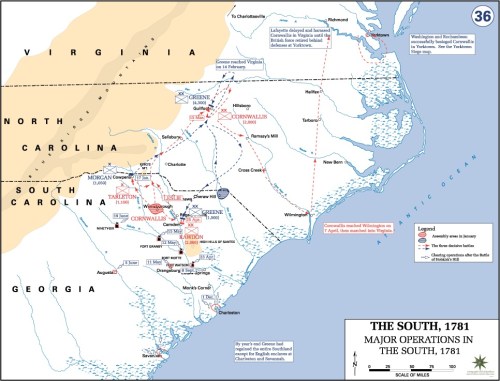
The early stages of the war were fought in the troublesome northern colonies, home of the original irksome Tea Partiers and a certain troupe of rabble-rousers in Philadelphia and New York. Those battles are legendary and often-taught in schools and shown on the History Channel: Lexington and Concord, Ticonderoga, Bunker Hill, Trenton, Saratoga. Those sites get all the visitors and all the attention when it comes to Revolutionary War tourism. Little attention is paid to the Southern Theater of that war, except Yorktown of course. That’s really sad: what happened in the Carolinas actually assured victory for all the colonies and assured the new United States would be as big and bi-coastal as it is today. What started in the North concluded successfully in the South.

The battle had shifted in upstate New York. The battle of Saratoga was a huge victory for the Continental Army and colonial militias. General Horatio Gates defeated and surrounded General Burgoyne’s redcoat troops in a humiliating defeat for the British. It was quite a stunning victory, really, and not only cost the British dearly in men and arms but also encouraged the French and Spanish to enter the fray on the side of the fledgling Americans. The Brits were going down for a defeat, something that simply would not stand in the eyes of the landed gentry, Parliamentarians, and King George. So the Brits came up with a new strategy.

Their new goal became not subduing all the colonies, but weakening their power by attacking the supposedly “soft” underbelly: Georgia and the Carolinas. The Brits were convinced the lower colonies were full of Loyalists, unwilling to surrender the honor of being part of the Empire to join with a band of Puritanical misfits and wannabes. All the Brits had to do was get past the coastal defenses and move into the interior where the North American landed gentry would gladly join them. With the low colonies firmly in British hands, resource-rich Virginia would fall, and to hell with the miscreants in Pennsylvania and Massachusetts. They could have their little country, firmly surrounded and contained by Britain and her loyal followers.

In March of 1780, they besieged and eventually conquered Charleston,  the biggest port south of the Chesapeake. They then moved inland, fighting and skirmishing all over interior South Carolina, picking up some Loyalists along the way but also (foolishly) stretching their supply lines and slowly whittling away at their core group of highly trained soldiers. But in their eyes, they were doing exactly what they wanted to do. Georgia was effectively out of the fray, South Carolina was theirs, and North Carolina (theoretically full of loyal British subjects) would be won. Then they could gather their strength and take back the Chesapeake Bay ports and the colony of Virginia.

After a series of mixed-result battles throughout South Carolina, bold Lord Cornwallis (descendant of barons and earls and nephew of archbishops and governors) lightened the load of his armies by abandoning equipment and supplies, and led them all into North Carolina in hot pursuit of the fleet-of-foot Continentals led by that much-beloved Quaker, General Nathanael Greene of Rhode Island. A brave and very astute commander, Greene’s motto became “we fight, get beat, rise, and fight again”, directly copying a strategy made famous by Fabius Maximus centuries earlier: war through attrition.

Greene did that over and over in the southern campaign, and culminated that strategy at Guilford Courthouse near Greensboro. He met Cornwallis’ 1900 crack troops with over 4000 of is own. He knew his men didn’t have the skill or fortitude to defeat Cornwallis, but he’d have them pound the British as much as they could. Worked, too. Worked fabulously well. The Brits won the battle due to superior tactics and arms (and, supposedly, through the use of nasty friendly-fire tactics), but they paid a high price for their victory. Cornwallis lost a quarter of his men and (due to “lightening the load” weeks earlier) most of their supplies. Cornwallis had no choice but to retreat over inhospitable land to coastal Wilmington. The British lost their chance to split the Colonies forever, and were eventually met with defeat in Yorktown months later.

There’s a lot we don’t know about the history of our own country. We tend to remember a few key events (poorly), but miss the whole. It’s quite interesting, actually, how one event leads to another, how  a series of small defeats can lead to a great victory and the eventual redirection of history. The Battle of Guilford Courthouse is one such event.

Oh, and North Carolina is my favorite Southern state. Just thought I’d toss that out there. 🙂

[I didn’t own a digital camera when I visited Guilford Courthouse, so no pictures. All illustrations & maps are public domain.]

==============================================

Links

Guilford Courthouse National Military Park

The order of battle

Natty Green’s Brewing Company

Google map to Guilford Courthouse

Mistakes Were Made

I really screwed up my trip to the Smokies. For some strange reason, I decided to stay at a resort named Fontana Village, south of the park boundary in North Carolina. It was close to the park, yet away from the tourist trap of Gatlinburg. It sounded nice enough: cabins, horses, kayaking, bike rentals, sports fields, etc. I thought it’d be a good place to unwind and enjoy nature without a lot of noise or nonsense. So I booked it and made my way down.

I had a light breakfast as usual, I get so nervous flying I try not to eat much beforehand. I flew into Charlotte, picked up a rental car and then drove all the way to Fontana. It’s pretty remote, about a four hour drive, didn’t stop for lunch, just grabbed some snacks from a Quik-E-Mart. Got to Fontana just as it was getting dark, and because it’s off the beaten path, it was really dark. Nice, windy roads as well. I knew that once I got there, that was it for the night. I arrived, check in and, well, the place was dead. Right away, I realized what a horrible mistake I made. It was October, way off-season. I was one of maybe 8 guests in the whole place, just about everything was closed. Dinner in the hotel restaurant was trucked in from God-knows-where, and it was lousy: some sort of overcooked chicken tetrazzini nightmare. Restaurants were hours away, I was beat, so I choked down what I could (not much) and went to bed.

Morning came, and there was not much available for breakfast, either. Single-serving corn flakes, 6-oz cups of OJ. Disastrous. But hey, I was near the park. Forget about the lousy accommodations, I didn’t travel all that way to sit in a hotel room anyway. So I grabbed my gear, and headed to the woods (the Twentymile Trail, to be specific).

Oh good God it was awful! The prior day’s malnutrition hit me like a sledgehammer to the sternum. I was so low on energy, I could only walk about 10 minutes before needing a breather. I was sitting on every stump, lump, rock and log I came across. It was torture. The peanut-butter crackers I brought weren’t doing the trick, either. Why, oh why, didn’t I swallow my pride and eat more tetrazzini? Why didn’t I grab a yogurt at the weak breakfast buffet (there was yogurt, wasn’t there)? I felt like I was on a forced march in Bataan or something, except it was a chilly autumn in North Carolina instead of summertime in the fetid tropics. Every step was agony. Every breath was labored. I could hear the pulse from my pounding heart in my eardrums. It was awful.


I met a man, 20 years my senior, trotting happily down the trail, not a care in the world. Definitely walking a faster pace than I. Cheerful and friendly, he piped up. “Good morning” he chirped. “Top of the trails just around the bend, wait till you see it!” “Thanks” I groaned, trying to conceal my fatigue through a hearty façade. I waited until he passed behind the trees, and continued the slow, painful, protein-deficient struggle to the top of the hill … and then I saw it.

Around a bend, a gap formed in the trees. The morning fog burned off, the sun started to peak through. I lifted my weary head, and looked out. The sight took whatever feeble breath I had clean away. I was overlooking a sunlit carpet of red, orange, and gold, as far as the eye could see. I was looking at the majestic, glorious tops of the great forest of Smoky Mountains National Park, and it was fabulous. I felt like Bilbo Baggins, poking his head from the gloominess of Mirkwood and seeing hope in the butterflies. It was spectacular, and awesome, and inspiring, and rewarding.

I turned back down the trail, and with gravity’s assistance, I made it back to the lodge. After a quick shower and nap, I hopped in the car and drove an hour or so to the nearest restaurant, sat down, and ate a steak the size of a toilet seat.

It’s a truly spectacular park, after this ill-fated hike I spent another 3 days in the area and it was wonderful. I only spent one night at Fontana Village, though :-P. Now before folks complain, let me just say I went off-season, and it was 15 years ago. Whether Fontana Village is any better in the summer, or has improved the place since then, I cannot say. But I can definitely say an autumn trip to the Smokies is well worth any lodging hassles.

===========================================

[I didn’t own a camera when I took my trip to the Smokies. Pictures are all in the public domain as far as I can tell. If you know of any copyrights that apply, please let me know. Bilbo’s image is copyright 1977 by Rankin/Bass Productions.]
Links:

Great Smoky Mountains National Park

Fontana Village

The Story of the Fontana Dam

Google map of GSM NP