Feeds:
Posts
Comments

Beep! Beep! Honk! Honk! — Curse of the Drive-By Tourists

It’s an odd sort of thing: a National Park that’s really just a stretch of road. But that’s what the Blue Ridge Parkway is: a stretch of road. It’s a terrific stretch of road, however. It runs between Shenandoah National Park in Virginia, and Great Smoky Mountains National Park in North Carolina, and contains some of the nicest scenery east of the Mississippi. There are great swaths of sparsely developed land on both sides of the road, and plenty of small towns and great diners and other out-of-the-way places up and down the Parkway.

Courtesy of National Park Service

The big problem with the Parkway is the phenomenon of the drive-by nature tourist. Growing up in Western Massachusetts means growing up loathing one particular type of tourist: the leaf-peeper, that sightseer who comes up once a year, clogging our roads, looking at the world through their side window. It’s even worse when they won’t even get out of their cars to have lunch & help the local economy: they just turn around and go back to Rhode Island or Boston or wherever they come from. Eventually, it’s safe for the locals to get back on the roads, but by then, fall’s over and the roads to the mall get overloaded with Christmas shoppers….

Ah well, at least it’s only once a year. On the Blue Ridge Parkway, however, you get these types all year round. But unlike the roadways of Western Mass., the Parkway isn’t a real travellers road, it is just for the tourists. They’re not clogging up roads that working folk have to travel, so that’s fine. But I still get peeved by these drive-by tourists, even on roads built for them.

Courtesy of National Park ServiceMy big beef is this: nature is meant to be experienced, up close. It cannot be appreciated from the air-conditioned comfort of your Lexus SUV. You need to get out, put feet to ground (or paddle to water, or snowshoe to snow, or mountain-bike tire to trail, or whatever your modus operandi may be). That’s how you see the glory of nature. Get off your butts, and climb that ridgeline. Not only will you get some exercise, but then the views and vistas will be truly earned! And earning the reward makes the reward so much more satisfying.

Beyond that, in my opinion, roadside tourism leads to a misunderstanding of nature. It leads to a belief that nature is this broad, sturdy, indestructible everything, and that’s just not true. It also leads to this belief that nature is this serene, safe place, devoid of danger, and that’s not true, either. Nature can harm and can be harmed, it is strong yet delicate, it is diverse yet encompassing. Nature is so much more than just treetops and mountains visible from a roadside turn-off. It is trees and moss and roots and rocks and newts and squirrels and flowers and worms and all those other things not visible from behind a windshield.

So next time your driving along some scenic road, pull over, get off your butts, and walk the woods!

Courtesy of National Park ServiceI’ll talk about Shenandoah & the Smokeys later on, but here are a few non-National Park System sights I visited along the Blue Ridge Parkway:

  • Eastern Virginia has a lot of cave attractions, most are west of the Parkway. I visited Luray Caverns in New Market, Virginia. It was OK, rather touristy, but has some nice formations.
  • Charlottesville, Virginia is a great small town. It’s both the home of Thomas Jefferson and Dave Matthews. You can visit the former’s home (Monticello). I don’t think the latter would appreciate an uninvited visitor, however. 😉
  • Montpelier, the home of our 4th President, and the man creditted with writing much of the Constitution, James Madison, is in nearby Orange, Virginia.
  • The Natural Bridge is further south in, oddly enough, Natural Bridge, Virginia. It is said George Washington himself carved his initials into the stone, they’re clearly visible from the walkway.
  • The National D-Day Memorial is just off the Parkway in Bedford, Virginia. I didn’t care for it, however. Far too grandiose in my mind. I’ll comment on this in later posts, but I like simple memorials & monuments, not something that belongs on a Franklin Mint collectible. I did take a few unspectacular pics when I was there in spring of ’07.
  • Roanoke, Virginia has a surprisingly hip downtown area with some good restaurants & interesting shops. No brewpubs, though. 😦
  • Asheville, North Carolina is another nice little town. The famed manse, the Biltmore Estates, are nearby. I hear they’re a “must see”, which is, of course, why I didn’t visit them. 😛

Courtesy of National Park Service[Sadly, I didn’t own a camera when I toured the Blue Ridge Parkway. All pictures on this post courtesy of the National Park Service]

Links:

Blue Ridge Parkway

Luray Caverns

Monticello

Montpelier

Natural Bridge

National D-Day Memorial

Google map to the Blue Ridge Parkway

Nightmare World

When I started this little quest of mine, there were a handful of sites that I knew I absolutely must see. I wanted to see Alaska’s glaciers and the tundra. I wanted to see giant sequoias. I wanted to see Devil’s Tower. And I absolutely wanted to see the Badlands.

Badlands. Badlands. BADLANDS. Oof, what a name! The word itself evokes harsh visions of a struggle for survival. If you’re a writer, you can’t go wrong if you include “Badlands” in the title of your Western novel. “Death on the Badlands”. “Terror on the Badlands”. “Vengeance on the Badlands”. “Ghosts of the Badlands”. Kick-ass names for what would hopefully be kick-ass books. And the name is so appropriate for the place. The Badlands of South Dakota is its own metaphor, exuding toughness and courage and evil and triumph. Even the native tribes of old didn’t like this place. “Mako sica” the Lakota Sioux called it: Badlands.

Badlands — © 2008 America In Context

And boy oh boy, Badlands National Park doesn’t disappoint. The elements scar this land like battery acid on new jeans. Water gouges at the exposed ground, leaving an eerie, yet oddly beautiful, jagged landscape. Dust chokes the lungs when the wind picks up. Even the dirt itself is harsh: when dry, it’s a hard, crusty material, unsuitable for supporting life. Add a little water, it adheres then hardens like concrete. Add more water and it becomes an unnavigable slick.

The Badlands is really nothing more than a separation between two levels of prairie. To the north is the high plains, to the south is the low plains. Erosional forces slowly move “the wall”, separating high from low, to the northwest. In the interim, infrequent rain scars the dividing line. And it’s not really dead, there are plenty of trees and shrubs and grasses and deer and rabbits and hawks. It’s just another facet of nature at work, acting in its own way. It is ugly, it is bad, it is dangerous, but it is beautiful. “Cool as shit” would be an apt phrase.

The Wall — © 2008 America In Context

The first day I went to the Badlands was intended as just a drive-through. I had visited the Crazy Horse Memorial earlier that day, and was running out of daylight, but I wanted to swing by the Wounded Knee site, and then take a short drive up this little trail labeled, innocuously enough, Sheep Mountain Table. What a wretched mistake! The Sheep Mountain Table road is a horribly rutted, muddy, dead-end trail. I ended up slip-sliding my way around, fearful of getting stuck, finally finding my way out with a filth-sodden rental car. What a mess!

The next day was much better: I got out of the car and hiked along The Wall for a few hours. So utterly fascinating, yet still so dangerous. Dehydration is a serious problem, as is the choking dust and the burning sun. But, as I said, immensely cool. It’s like a stroll through the Mos Eisley spaceport or something. Definitely a place to be experienced! Life, and especially nature, is not all sweetness and light. Some parts are tough, but that’s part of the fun. Get off your butts, get out of your car, take a rough trail, and put some toughness into your life!

Mos Eisley — © 2008 America In ContextA couple of recommendations:

For some good shopping, stop at the Cedar Pass Lodge near the Ben Reifel Visitor Center. They sell locally-made native art, really nice stuff. Got a few pieces for my collection.

For a good laugh, take a stop at Wall, South Dakota. This tourist trap spells “kitsch” with a capital K. Ludicrous gift shops, overpriced crappy restaurants, biker bars, the whole nine yards!

For a good cry, go to the site of the Wounded Knee Massacre on the Pine Ridge Indian Reservation. It’s not the history that’s the real sad part, it’s the surroundings. If you doubt that true poverty exists in America, go to the Pine Ridge Indian Reservation.

For a good beer, go to the Firehouse Brewing Company in Rapid City. A most excellent place! Also take a walk amongst the statues of the Presidents, and shop in some of the neat stores downtown. Rapid City is one of the better small-city downtowns left in America.

I thoroughly enjoyed my trip to the Dakotas. I’ll make other posts about the other National Park Service sites in the Dakotas in the future, but for now, I can only recommend that you go and visit, if nothing else, The Badlands.

Green in the Valley —  © 2008 America In Context

[All photos on this post are originals © 2008 America In Context. To see more original photos of The Badlands, click here.]

Links:

Live Blooms — © 2008 America In ContextBadlands National Park

The Battle of Wounded Knee

Firehouse Brewing Company

Google map to the Badlands

Love the Ocean … Hate Love the Beach

I love the ocean. I just love the vastness of it all (similar to my love of the Great Plains). I love the power of it, how it carves and weathers the rock and land around it. I love how it can create storms of such immensity men cower in fear, and how it also provides a tremendous bounty for mankind to eat. I love how it’s the giver of life, for we all can trace our roots back to its nutrient-rich waters. I love the serenity of it, how the waves lap the shores in a soothing, rhythmic, sexual fashion. The sea caresses the land, then, during moments of great power, parts the shoals and penetrates inward, over and over and over and …

Um, wait, where was I? Oh yes …

Ocean City T-Shirts — © 2008 America In ContextI love the ocean, but I hate the beach. I really can’t stand it, and it’s not just because I’m a fair-skinned freak who fries easily. It’s also not because it’s freakin’ hot (but that doesn’t help). I hate the beach because most of them are crowded, and filthy, and full of miscreants. Here’s a question: why do Goths hang out at the beach, going out of their way to alienate people? Aren’t they pretending to be vampires or something? Can’t they hang out in caves? Why do they hang out at the beach?

For that matter, why do bikers in full leather hang out at the beach? Don’t they cook in their black outfits? I don’t think that percolating in one’s own filth in a black leather suit is a great idea. And why do people squeeze into bathing suits against all the rules of physics to lay in the sun and broil themselves? Is the baked-potato look really that fashionable? Yeah, sure, there’s occasional eye candy at the beach, but for every hot babe, there are a dozen drunken louts frying their brain cells while aggravating all who pass. Bah!

Beaches are a pain to get to, impossible to park at, and surrounded by the sleaziest bars, restaurants, and crip-crap shops imaginable. Try to get a decent burger, or a good beer, or anything else, on a beach strip. Just ain’t gonna happen, not at a good price, anyway. And I dare you to walk across a beach without stepping on a cigarette butt … it’s mathematically impossible, I’m sure Stephen Hawking would agree.

Or, if you do find a beautiful beach, odds are it’s blockaded by tony, extravagant homes, owned by slimewads who think their money puts their beach rights over everyone else’s (well la dee dah). Why don’t the hurricanes target those dipweeds and leave the poor folks alone … if they want the beach to themselves, they can have the ruddy cyclones to themselves, too.
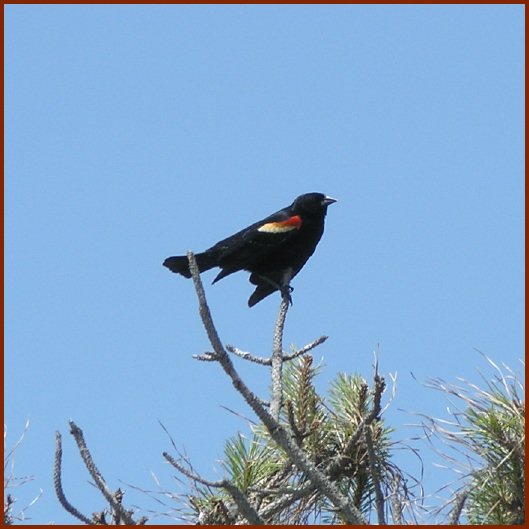
Red Wing — © 2008 America In ContextI originally planned to avoid all the National Seashores under the National Park System because of my natural antipathy to beaches. I figured the NPS just protected the little sliver of land between ocean and the t-shirt shop, and the rest was up for grabs by Goths and snobs. Who needs that?

Assateague Island changed my mind.

Assateague Island is a barrier island south of Ocean City, Maryland. It has a strip of beautiful, pristine beach that stretches for miles and miles. It’s totally clean, almost totally natural, and (at least when I was there) unencumbered by throngs of beach-goers. Yes, there are people, but on the day I went, I walked down two miles of gorgeous beachfront, just me and the sea and the birds. It was a gorgeous day, sunny yet temperate, breezy yet quiet. Yes, there were a few people, but they kept to themselves, and I to myself, all of us thoroughly enjoying one of the most spectacular stretches of land on the East Coast.

Assateague is a place where you can absolutely just stand in one spot, and stare out at the ocean, and wonder just what the heck is over that horizon. Looking back, I’m not even sure if I saw any shipping. I may be romantizing the island too much, but seriously, I can’t recall seeing anything: no freighters, no jet-skis, no parasailers, nothing. Nothing but birds, and seashells, and sand dollars, and that’s it. No industrial sounds, either. No horns, no ghetto blasters, nothing but wind and waves and that’s it.

Just Me and the Birds — © 2008 America In Context

The other side of Assateague is bounded by the Chincoteague Bay. Although the western side does have its share of boat docks and marinas, the eastern side, against the island, is still pristine and beautiful. Rent a kayak and spend an hour or two paddling around all the inlets and coves, it’s a great way to spend an afternoon. It was past bird-migration time when I was there, but there were still plenty of egrets, pelicans, and storks to see.

Of course, Assateague is most famous for its wild horses. Apparently, a couple of centuries ago, local farmers abandoned their horses on the island (perhaps in an early tax evasion scheme), and they thrived and bred on the island (smaller, of course, because of Foster’s Rule). Today, descendants of these horses remain.

I wanted to find these horses and snap some pictures of them in their environment. So I beat through the brush and walked along the waterways, hoping to take some spectacular photos. Oddly, though, they were nowhere to be seen … until I stumbled across an RV campground. There they were … eating scraps left for them by campers, totally against NPS rules. Yep, even on remote, protected Assateague Island, people have to muck around with nature. People just can’t leave things be, can they? No, they have to get their perfect picture from the comfort of their folding chair, while idiots like me traipse through the woods, trying to see wildlife as nature intended.

OK, to be fair, these horses aren’t really there as nature intended. Man put the horses on the island and left them there, but still, it would be cool to see them just living on their own, instead of begging for scraps at mankind’s overladen table. I did take some pics, I had to use some clever angles and cropping to make them look “native”. Such a shame.

I guess even the pristine beaches have their share of spoilers.

Wild Ponies — © 2008 America In Context

[See more of my Assateague photos, plus a couple from other sites in the area (including Atlantic City, where I won $2K at the slots — I don’t just hang around in the woods, ya know) here.]

Sand Toad — © 2008 America In ContextLinks:

Assateague Island National Seashore

Clean Beaches Council

Google map to Assateague Island

——————-

Just for the heck of it, here’s a picture of a sand toad…

As I mentioned in my last post, I talked a lot about the Civil War lately. Five out of the last 6 posts referenced the Civil War! Well, of course the War Between the States would factor prominently in a blog about the National Park System: so much of our history depends on that war in some form or another. You can’t really put America in context without an understanding of that conflict, it’s vital in any study of American history (it’s not just for Civil War geeks, that’s for sure 😉 ). That’s why so many sites in the NPS revolve around the Civil War, and that’s all for the best.

In the 7th post of this cycle, I thought I’d post about another of my favorite books: Jay Winik’s April 1865.

The Month that Saved America

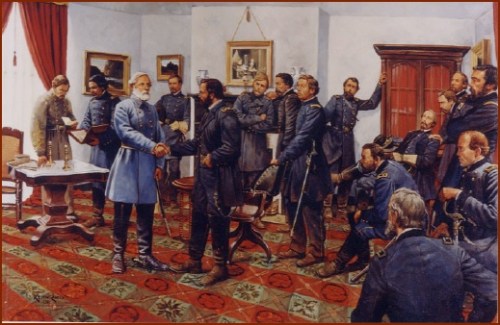
Winik was brilliant in his choice of topic. All of those key events at the end of the Civil War occurred in April of 1865: the end of the siege of Petersburg, the evacuation of Richmond, Lee’s surrender at Appomattox, the assassination of Abraham Lincoln, his succession by the incapable Andrew Johnson, the chase and capture of John Wilkes Booth, the defeat of Confederate cavalry Gen. Nathan Bedford Forrest, the surrender of Confederate Gen. Joseph Johnston to stern-hearted William Tecumseh Sherman in South Carolina, and the subsequent surrender of other Confederate commands throughout the South. Shortly thereafter, in the first weeks of May, the Civil War would be over entirely, Confederate Pres. Jefferson Davis would be captured, and a reformed nation would begin to rise from the ashes.

 Winik not only describes these events in an exciting, narrative style; he also gives plenty of backstory and context to make the entire work incredibly interesting. I found this book nearly impossible to put down (causing many problems trying to get to work on time). I think April 1865 is a great book, even for those who simply want a good read and aren’t particularly enthusiastic about American history.

[It was also made into a History Channel documentary for those of you not quite enthusiastic about reading 🙂 ]