The Glories of Innovation
I love innovation, I really do. I guess I’m just an old techno-geek. I love stumbling across things that are so brilliant, inventions that show not only the intelligence, but the sheer drive and willpower of idea-men and those who craft those ideas into reality. One of those happy little discoveries was the Allegheny Portage Railroad.
This is one of those stories that takes a little while to tell. Way back in the early 1800’s, we really were the United States of America. We were just a collection of states assembled under one flag, instead of the Conforming States of Generica we seem to be now. The only difference between us back then and the modern day European Union is we were all illiterate under a common language. Other than that, the states were really separate entities, each culturally and economically different from the other.
Of course, every state competed with every other state. Who had the better industry? Who had the better cities? Who could attract the most immigrants (imagine that in this day and age)? Most importantly, who had the best economy? Then, as now, wealth begat power, wealth begat influence, wealth begat more wealth. Competition would be quite stiff at times, especially amongst rival Northern states.
 In the early 1800’s, westward expansion was really gearing up. The frontier represented opportunity. For settlers, it was the opportunity to find a new life. To the merchants in the eastern states, the frontier represented money. Settlers needed tools, and supplies, and seed. Settlers needed to sell their own products (timber, crops, cattle) to buy those tools, supplies, and seed. The merchants were ready to handle both sides of the equation. The nation, as today, ran on commerce. There were riches to be had on the frontier, that much was certain. But how do you transport all these people and goods back and forth? The answer was water.
The railroads hadn’t begun their dominance over the land yet. So America used its great waterways: the Ohio, the Mississippi, and the Great Lakes. Of course, there’s a small problem: how do you get goods from the wealthy merchant cities of Boston, Baltimore, New York, and Philadelphia, to these great waterways, and back? Well, by wagon, of course … oh wait, small problem: a little thing called the Appalachian Mountains. Sure, compared to the then-irrelevant Rocky Mountains, the Appalachians are nothing, mere bumps on the ground. But to a young nation with nothing more than mules and wooden wagons, these bumps formed a most impressive obstacle, to some states more than others.
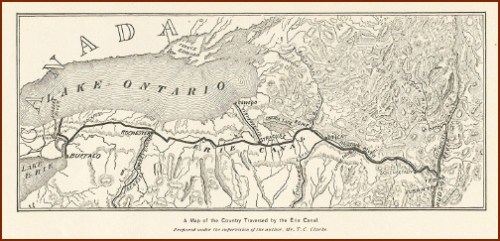
New York managed quite well. They had a wonderful thing called the Hudson River that just so happened to run into the Mohawk River, which just so happened to run in a natural channel through the Adirondacks (thank you, Ice Age glaciers!). A little bit of digging across a reasonably forgiving stretch of land, and voila! They finished a little thing called the Erie Canal by 1825. This little gem of a project catapulted slimy little New York City into the financial powerhouse it is today.
Maryland was soon following right along. They had a nice little waterway called the Potomac River running along their southern border. They still had to cross the mountains to match the superiority of the Erie Canal, but their canal system got them pretty durn close. It was only a matter of time before they figured out how to cross the great mountains of what is now West Virginia. Oh wait, what’s that whistling noise? Oh yes, it’s called the railroad. Still in its infancy, the engineers of that famous Monopoly space — the B&O Railroad — figured out how to keep their crude engines carrying freight to the Ohio River and beyond. They would be carrying frontier goods very soon.
But Pennsylvania, oh poor Pennsylvania! What to do? If they didn’t carve a path to the frontier, they would be ruined! New York already took over Philadelphia’s preeminence, and now Maryland? Pennsylvania had a river leading up to the mountains (the Susquehanna). They had a river leading away from them (the Ohio). But what about that spur of the Appalachians, the blasted Alleghenies! The glaciers didn’t come far enough south to scour great grooves in those escarpments. The Keystone State was, basically, screwed. So, what to do?
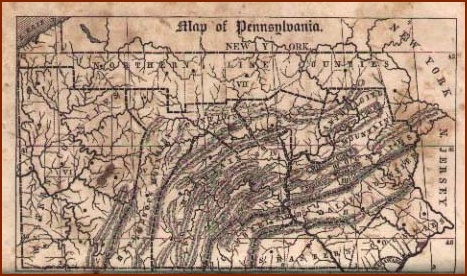
This is where the brilliance came in. What do you do with mountains? You climb them, of course (well, duh!).
The Allegheny Portage Railroad was the resultant masterpiece. It was a series of inclined railways, powered by fixed engines at various locations. You throw a freight car on it, hoist it up one side and down the other, simple! They even invented canal boats on wheels: you paddle up, hook up one end, and tow it up and down to the next river! Fixed engines made it simple and manageable, and less problematic, than the early railroad engines. The whole thing was brilliant and ingenious, and saved Pennsylvania from ruin.
Well, not really. It ran poorly. It broke a lot, there were a lot of devastating accidents. Have you ever seen a heavily-laden cable snap? It’s called “mass beheading”. Yeah, it wasn’t the best operating system in the world, but it did what it needed to do for 20 years, when the steam engine really came into its prime and men figured out how to lay good track and blast holes through mountains.
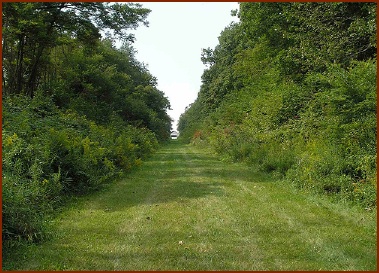
Even though, I really love the notion of the Allegheny Portage Railroad. Image floating along on a fine autumn afternoon, watching fisherman, and farmers, and children playing tag. Hawks circling above, looking for some stray rabbit for dinner. Your passenger barge pulls up to the Allegheny Portage Railroad, and you’re hoisted up the mountains. The crisp, cool air refreshes your lungs, the foliage-laden Alleghenies are a perfect backdrop for a perfect day. You toast your crossing with fellow passengers, and are lowered down to the other river, where your future awaits on the Great Frontier!
All great fun, until someone gets beheaded.

To my knowledge, no one was actually beheaded by a cable during the operation of the railroad. A steam boiler did explode on Incline Plane #6, killing four people, and there were plenty of other injuries. But nothing livens up a story like a good beheading, don’t you think?
[Original photos © 2008 America In Context. Historical maps found through http://www.maphistory.info/]
Sadly, due to poor CD management, many of my Allegheny photos are gone. The few I have, such as they are, are here.
Links:
Allegheny Portage Railroad National Historic Site
Historical Maps of Pennsylvania
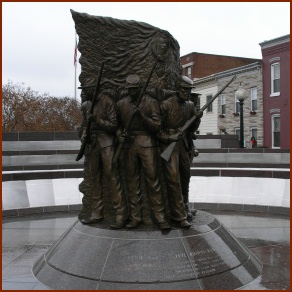 I wanted to post an essay about the courage of black soldiers during the Civil War; about their bravery, their sacrifice, and the difficulties they faced. There is so much to tell, so much the average American doesn’t know. But I find myself distracted with more immediate concerns.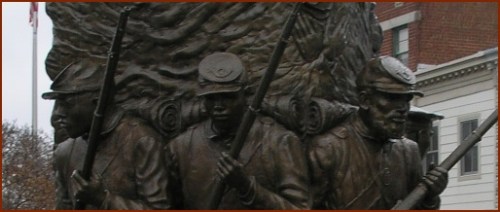
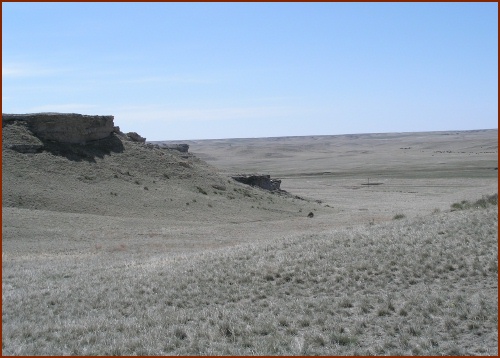
 Agate Fossil Beds itself is nothing special. It’s just a couple of knolls in the prairie. But it does tell a fascinating paleontologic story. See, a couple of million years ago, there was this watering hole. Big herbivores loved this watering hole. Then, one day, it dried up. The herbivores started to starve. Then the predators came and ate them all up, but they too started to starve, for there were no more herbivores. Then the scavengers showed up and ate all the dead predators, but then they, too died, for there was nothing left to scavenge. All of them died in this big heap. A few million years later, paleontologists showed up, and wondered just what the hell happened! Was this some cultic suicide, did these Miocene animals drink some prehistoric Kool-Aid at the bidding of a dinosaur with a bad haircut wearing Ray-Bans? Or was it something more natural? It’s a neat story to those so inclined.

 Adams was not only obnoxious and ignored, he was also a rarity: a brilliant ideologue. I’m not overly fond of ideologues. Generally, I find them horribly lacking in any real insight or knowledge, they hide behind their ideology like a shield, avoiding true understanding (because that’s too hard). I prefer pragmatism and practicality. How do we solve problems? That question sparks brilliance, not some high-minded ideal of how the world should work.
 As a diplomat, he oversaw the acquisition of Florida (so we’d have a place to dump our elderly), and fabricated the Monroe Doctrine, which drew a line in the sand to European colonization in the Americas. To Adams, this was a moral obligation of the United States. Europe must not further muck around in the affairs of the Americas. He didn’t advocate imperialism of our own, his idea was to allow the Americas to evolve into nations of their own, without outside interference. He was right, absolutely right. To this day, we are still dealing with the problems of long-terminated European colonization in Africa, the Middle East, and the Indian subcontinent. The problems of America are our problems, fomented internally, which is much better than problems foisted upon you by outsiders. Sadly, the Monroe Doctrine would later be used to justify invasions and actions on our own (like the Spanish-American War, a topic for a later time).