Feeds:
Posts
Comments

Posts Tagged ‘history’

Charisma is My Dump Stat

Ever since I was a young pup, growing up in the Western Massachusetts confluence of mill towns and dairy farms, people routinely sang the praises of Franklin Delano Roosevelt. “He saved the country and the people” was the mantra. If you were a blue-collar worker, FDR was a hero. If you were a farmer, FDR was a hero. If you held degrees in the arts or sciences, FDR was a hero. His name was always spoken with reverence. “He got us out of the Great Depression”. As a kid, I never understood it, but it was taught to me from a very early age. Actually, “taught” may not even be the operative word here, it was almost genetic.

This reverent view was especially held by those who actually lived through the Depression. My grandparents – disinterested in politics otherwise – loved FDR, as did their brothers & sisters, family friends, and others of the same generation. My parents’ generation, mere tweens during the 30’s & 40’s, also spoke lovingly of the man. It’s only now, with my grandparents’ generation is 20 years dead and my parents’ rapidly disappearing, that FDR is receiving critical attention by the general public.

I find this utterly fascinating. Sure, pundits & partisans would complain about the economics of the New Deal and the court packing scandal, but FDR had to be dead 60 years before the common man started questioning his Presidency and leadership. That’s almost three generations! I can’t think of anyone short of George Washington and perhaps Thomas Jefferson who escaped such criticism for so long. The people of FDR’s time had to basically die before public opinion turned against him. Today, we decry the previous loser the day after Election Day.

How in the world does this happen? How is it even remotely possible that any leader can earn such true devotion amongst his people? His wasn’t based on fear, nor was it based on indoctrination (contrary to right-wing conspiracy theorists). The devotion FDR enjoyed was real, and true, and long-lasting. This is the real story of FDR: not the impact of his policies but the power of his charisma. Utterly fascinating!

I have many flaws. Perhaps the most striking one is my near-total lack of charisma. I’m not particularly likable, and have virtually no leadership skills. I couldn’t convince people to escape from a burning building. If I was at a picnic and implored people to not eat the botulism-tainted potato salad, a score of ambulances would be needed to cart away the doubled-over masses. To me, strong & genuine leadership qualities are as alien as an iPhone to Neanderthals. That is why I find FDR so fascinating. His charisma is akin to string theory: practically unknowable.

Here’s my own take on why Roosevelt inspired such devotion: he had the “perfect storm” of confidence, communication, competence, and empathy. His family, especially his mother, Sara, gave him a good education and instilled in him a measure of self-confidence absolutely required of a good leader. FDR was a great communicator. His speeches are the stuff of legend and they were delivered, not as oratory, but as conversation, meaning they were genuine. Was FDR competent? Sure, you could say his policies weren’t necessarily wise, but he got them done. People respect people who get things done, action is rewarded far greater than thought or bearing. And FDR did accomplish an awful lot in his 12 years as President.

So that leaves empathy. Empathy is the capacity to care about your fellow human being: to see, understand and relate to other people and their troubles. In the beginning, FDR (like most bluebloods) didn’t have much in the way of empathy. He was “upper crust”, raised in the bubble of Hudson Valley prestige and private school. He was not fit to lead the U.S., at least not in a manner to receive such a tremendous amount of public adulation. But something happened that gave him the empathy he needed to be one of the top five Presidents in history. That something? Polio. To alleviate the pain of polio (or perhaps Guillain-Barre syndrome), FDR would visit Warm Springs, Georgia. There he’d meet poor farmers and others trying to live in impoverished conditions. It’s there he learned to empathize with the common man, and where he gained the final skill required to be a strong leader.

It’s both sad and relieving that presidents like FDR are far and few between. On the one hand, we could certainly use more competence in our nation’s capitol. We are certainly sick and tired of politico-speak (the near opposite of  good communication). And empathy? If there’s a skill that’s dead in Washington, it’s empathy. That’s why our government is failing us, that’s why Congress has minute approval ratings, why our President — like the one before him — barely holds 50%, why no one trusts the courts and dissatisfaction rules the land.

But on the other hand, imagine what leaders like FDR can do. He inspired such huge devotion, devotion that lasted for decades, can you imagine what would have happened if he wasn’t an honorable man? Well, carnage, that’s what. If history has taught us anything, it’s “beware the charismatic man.” It’s the people who inspire loyalty and devotion in others who are the most dangerous.

We got lucky with FDR. We may not be so lucky with the next one.
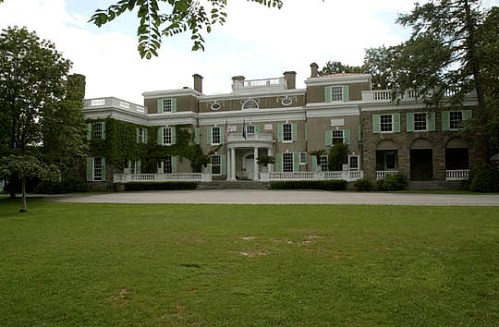
[I did not own a camera when I visited Hyde Park. All photos are in the public domain and pulled from various sources, including those links given below].

=======================================================

Links:

Home of Franklin Delano Roosevelt National Historic Site

FDR Presidential Library and Museum

FDR’s Ties to Georgia (University of Georgia site)

American Rhetoric: Top 100 Speeches

Google map to FDR’s home

Read Full Post »

The Death of Technology

In 1985, a group of engineers discovered a flaw in a design. Using engineer’s diligence, this team collected data, performed tests, ran some models, and came to a very scientific conclusion: under certain conditions, the most complex machinery in existence on Earth had a fatal flaw, and something needed to be done. They followed the chain of command, and told the appropriate management team.

That team ignored the report.

On January 28, 1986, the exact conditions specified in that report came to be, and the well-formulated set of conclusions derived by those same engineers six months prior came to pass.

Due to unusually cold conditions on the ground, the o-ring seals on two solid rocket boosters gave way. High-intensity flames erupted from the casing in the wrong place, forcing the booster into the main liquid fuel tank, rupturing the entire assembly. The resulting explosion and erratic expulsion of the two solid rocket boosters left a cloud of smoke whose shape has indelibly etched itself on the minds of all Americans (and especially all engineers). The passenger compartment of the vessel continued on its ascent until, at 65,000 feet elevation, gravity finally beat inertia. The compartment, and the seven brave souls still strapped inside, plummeted horrifically into the Atlantic Ocean. The vehicle known as the Space Shuttle Challenger ceased to exist.

That management team was wrong, dead wrong. I hope they’ve led miserable lives since the day they put facts aside for the sake of a government contract.

The engineering team, however, was right on the money. They did their best to avoid this tragedy, but were ignored. The lead man of that team, Roger Boisjoly, quit Morton-Thiokol and toured the country, speaking to engineering conferences about the value of quality; the failure of arrogance, ambition, and haste; and the ugly reality of corporate malfeasance. Roger died on January 6th, 2012. In my view, Roger and that entire team of engineers were American heroes.

I was working in the college computer lab on that day, trying to turn a Motorola 68000 processor into something other than a hotplate. We had the launch on the small TV, but were barely paying attention. By this time, shuttle launches were so routine the countdowns and announcements were as mundane as elevator music. But there is something special about the droning of repetitive launch instructions: the minute something is amiss, you know it. The tone changes: the monotone becomes the emotional, the drone of hard facts becomes the stuttering of uncertainty. Something was wrong. We turned, and saw the corkscrew plumes of death through that tiny screen.

My heart sank that day. Here I was, studying fervently to become a skilled technician. Technology was always my dream job, from the first time I saw Scotty fret over his dilithium chamber. I took apart my Pong game, my radios, the family TV. I taught people how to work their VCRs and had to constantly clean the gunk out of my stepbrother’s Nintendo. I was programming in assembly and machine language and BASIC, but was really a hardware weenie. Circuit boards, op-amps, laser diodes, these were the shiz-nit. I loved physics, excelled at mathematics, and, plain and simply, loved making things work.

Yet there I was, watching technology die.

It’s not that technology ceased to exist. Au contraire, we were at the very beginning of the greatest technological revolution ever. It would simplify our lives, improve our productivity, extend our life, and connect the world. One cannot even compare the technology of 1986 with today. Touch screens? Optical chips? Dense wavelength digital multiplexing? Microminiature cameras? Still highly theoretical, if that, back then. We’ve made tremendous advancements, that 16-bit processor I would soon turn to slag is now a mere wafer in the I/O chip of that crappy PC your grandma uses to play Scrabble.

But technology is still dead.

I say it’s dead because we don’t care for it. We don’t respect it. We don’t cherish it. We don’t put our heart and soul into it. We throw something together, slap a fancy label on it, shove it in an appliance, and then hope — not for it to work, but to make us a big, hefty profit. And if it doesn’t, oh well, right into the scrap heap. Look, a newer, shinier bauble just got released at E3!!!

The Challenger tragedy was my first experience with poor quality and the disinterest that leads to it. And look around you, what do we have today? Microsoft, the foremost manufacturer of operating systems since the early 80’s, still can’t make an operating system worth a shit.  American car companies suffered from decades of quality neglect, only recently turning themselves around (whether this trend continues remains to be seen), and some of the murmurings coming from airplane mechanics make your head spin. Union Carbide failed to properly maintain one of their facilities and kills thousands. BP and its shoddy suppliers dumped millions of gallons of oil into the Gulf of Mexico (the environmental effects of which are still undeterminable); and the Japanese, once paragons of quality, can’t even apply their own earthquake remediation science to their own nuclear reactors! Technology, as bright-and-shiny as it is, fails us on a daily basis, often with disastrous results. Why is that?

It fails us because we don’t care about it. We don’t want to care for it, nurture it, respect it. We want to use it and abuse it and toss it away. Do people want that hand-crafted North Carolina furniture that will live longer than you? No, they flock to IKEA to buy that cheap-ass particle-board shit that’ll degenerate to it’s natural elements within 18 months (and exude toxic gasses the whole way). Cheapcheapcheap, and tosstosstoss. And God forbid if you want to apply quality to your  job. If you want to take the time to fine-tune that dilithium chamber for optimal performance, safety, and long life, you’ll be fired for wasting your time and energy that could be better spent polishing Powerpoint presentations that prove just how smart your executives are.

Quality is dead. And therefore technology is dead. And therefore, people are dead and will continue to die. God bless you, Roger Boisjoly, and any other engineer who has risked his career in the name of quality and safety.

[Photo of Roger Boisjoly is copyrighted to the New York Times.]

Read Full Post »

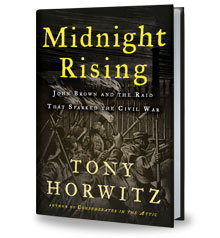
Last year, it dawned on me that I simply don’t read enough. I don’t do a lot of things enough (like exercise, or travel, or any of a number of things I want to do but don’t). So last October I bought myself a Kindle. I also had to create a post on Harper’s Ferry, and I found the story of John Brown so compelling, I knew that post had to be about him. So I went ahead and downloaded my first e-book:  Midnight Rising: John Brown and the Raid that Sparked the Civil War by Tony Horwitz.

And I found it brilliant.

It’s really hard to write good, compelling history books. Most of the time, authors simply tell what happened. The last print book I read, The French & Indian War: Deciding the Fate of North America by Walter R. Borneman, suffers from this in spades. It’s just a straight, dry retelling of the war, from young George Washington’s encounter with French soldiers along the Youghiogheny River to the French defeat in Montreal and the loss of Canada. Reading that book has so far (for I am still not done) been a chore.

So now some of you may cry “shenanigans!” on this. History, after all, is just a story of what happened. Well, yes, but the elements of storytelling are important whether it’s fiction or nonfiction, and one of the biggest elements of storytelling is character. You’ve got to make these people interesting, you’ve got to give the reader enough to make them really care about who these people are, what motivates them, and why. This is how people get invested in the story. Do we care that some guy sailed a boat to the far reaches to find a whale, or do we care that Captain Ahab was a hard-nosed fanatic who was willing to risk his entire crew for vengeance, even though he knew it would not earn him any reward? We care about the story because we care about the character.

Far too many history authors miss this point. Borneman does this: he tells the story of the French & Indian War but does not make the reader interested in the characters involved. A lot on what Lord Amherst did, not a lot on who he was, and the same for his French adversaries, the various colonial commanders, and the hodgepodge native tribal chieftains. A story without character is just a chain of events. It’s a Wikipedia article.

Horwitz, however, succeeds at this in Midnight Rising. He gets into John Brown’s head: his rough childhood, his business failings, his drive and passion, and even the creepier aspects of his behavior (like his notion that he should be Commander In Chief over the entire U.S. government). Because we become invested in John Brown, we become invested in a story, right down to the disastrous consequences.

Horwitz also doesn’t stop with John Brown. He infuses life into most of the characters in the story, from Brown’s extremely sad wife, to his children (forever damaged from their father’s actions), to his followers, to the few slaves he managed to free, to the men who fought back, took him prisoner, and eventually hanged him. All along the path, Horwitz develops these characters, gives them life, and you either love them, or hate them, or pity them, or at least understand them and their motivations.

This tie-in to the people involved is what makes this book compelling. I heartily recommend it to not only fans of American history, but even for those interested in the psychology of fanaticism. There’s a lot in this book that directly translates to today’s terrorism and the dangerously extreme measures we’re taking to counter it.

Big fan. Permanent spot on the “recommendations” page.

Read Full Post »

Old John Brown: Martyr? Hero? Madman? Terrorist?

Harper’s Ferry NHP was one of the first historic sites I visited outside my home New England, and is still one of my favorites. It’s a sleepy little hamlet, nestled in a valley at the fork of the Shenandoah and Potomac rivers, with interesting Old Frontier architecture (like the church pictured below) and a calm, relaxed atmosphere.  Visit in the fall, when the air is crisp, the foliage is out, and the fog is on the river in the early morning.

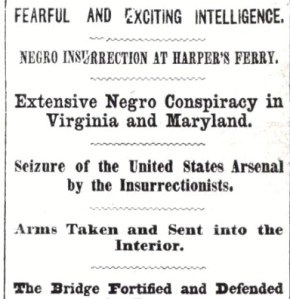
Harper’s Ferry, with two major rivers, a proximity to the Mason-Dixon, and one of the last stops between the colonies and the Frontier, was a true nexus point in early American history. Jefferson and Washington both surveyed the land, it served as a launching point for westward expansion, and was used by the military as a base and weapons depot. But the town is most famously known for the Raid that Started the Civil War.

—-

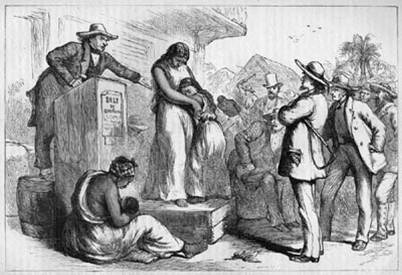
The time between the founding of the country and the fall of 1859 was most definitely the Dark Ages for America. People like to strut around today and say “our rights are threatened”, and that may well be, but this is nothing like it was back in the early 19th century. According to census figures, over 3.2 million free-thinking people were held as slaves in 1850. It was pervasive everywhere in the South, slaves accounted for one out of three souls living south of the Mason-Dixon line. It was no “curious institution”, it was a massive abomination. The work was hard, the treatment harsh. Families were routinely broken up as they were sold to different bidders at auction. In some cases, treatment even got worse in the 19th century. Constant fear of slave rebellion sparked states and counties to restrict slave movements. States passed laws forbidding teaching slaves to read or write, or form groups in the evening, or celebrating weddings, or traveling without a master (even to walk to a creek for water).

But it wasn’t just slaves whose liberties were restricted: the slave laws foisted upon the Union by southern aristocrats (and unopposed by cowardly Northern presidents), challenged the liberties of free men as well. It was illegal to aid in the escape of slaves, which basically forced every citizen (even those in the so-called “free states”) to participate in the captivity of a fellow human being. The states had no say: the Wisconsin supreme court declared the Fugitive Slave Act unconstitutional and would not uphold it, only to be told by the U.S. Supreme Court that they must uphold it whether they liked it or not. Nullification, indeed! Looking back, the honorable free states should have been the ones to secede from a corrupt, anti-liberty federal government right then and there!

Even the very notion of “one man one vote” was bastardized into the 3/5th rule, which gave the Southern gentry undeserved power in the Congress and the Electoral College. The notion that slaves could be counted in apportionment for a democratic society was disgusting, and is wholly responsible for the decades of tyranny foisted upon the nation. That horrible rule  gave the slave states nearly 20 more seats in the 1850 House of Representatives and votes in the 1848 Electoral College than they justly deserved, creating a Congress that passed the dastardly Compromise of 1850 and gave us one of the worst presidents in U.S. history, Millard Fillmore. The North should have been able to railroad the South into giving up that horrendous institution, but instead the Founding Fathers’ greatest mistake led to a wholly unjust government, the enslavement of an entire race of men, and a society teetering on the boundaries of pure evil.

It was into this world that John Brown was born.

A heavily devout Christian, John Brown saw the entire institution of slavery, and the flaws in our political process that enabled it, as a crime against man and a sin against God. He took it so far as to say there was no way the United States could possibly have been founded as a Christian nation, because no true Christian would ever start a country with slavery as part of its core values. He was even more infuriated by individuals like John C. Calhoun, who said slavery was good and rooted in the Bible. To John Brown, that was apostasy, nearly as great a crime as slavery itself. John Brown was more than  prepped for the forthcoming battle, at least on a spiritual level. Then came Kansas.

For over sixty years, the balance between slave state vs. free state was kept through a series of compromises. In 1812, the tally was even: 9 slave states and 9 free states. There was parity in the Senate, and the coveted Electoral College, and close tallies in the House (thanks to the 3/5ths rule). In order to keep the peace, states would be admitted in pairs: one free, one slave. Indiana & Mississippi, Illinois & Alabama, Maine & Missouri. However, in 1854, the anti-slavery faction in Congress won a minor victory: the residents of a territory, upon application for statehood, could vote themselves as to whether or not they would be free or slave. This put the pro-slavery faction in a terrible position: popular opinion in the new territories beyond Missouri was decidedly anti-slavery.  The slave states would soon be outnumbered in the Senate and  would surely lose their political clout and, therefore, their economic foundation. Drastic action was necessary, and drastic action was undertaken.

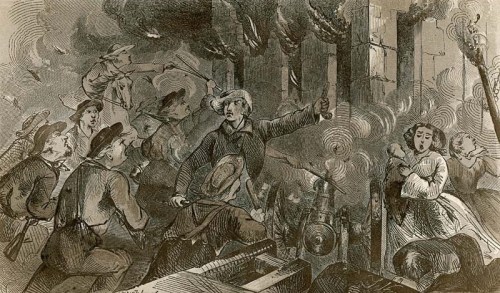
A cabal of slave-owners and -supporters organized dozens of bands of men called the Border Ruffians to rush to Kansas, create fake homesteads, and engage, not in farming, but in massive voter intimidation and fraud. They managed to elect a pro-slavery legislature for the territory. To counter the threat, abolitionists joined forces to form the Topeka Convention and create a state constitution marking Kansas as a free state. Presidential coward Franklin Pierce decreed the pro-slavery forces were legitimate, and that’s when all hell broke loose. The Ruffians burned and ransacked Lawrence, and John Brown headed to Pottawatomie, and eventually to Harper’s Ferry, leaving a trail of bodies (both friends and foes) in his wake.

What happens next are the opening salvos of the greatest war ever fought on North American soil, a terrible stream of carnage that resulted in the emancipation of not only slaves but also of the American soul. Slavery, regardless of the opinions of the slaveowning aristocracy, was the albatross around the neck of the United States. It was preventing our rise to greatness, and even now, 150 years later, we’re still battling with the demons of our past. But at least they are now in our past, thanks to John Brown. He was like the interventionist to a drug addict: that person who holds up the mirror and says, in a very blunt manner, “look what you’re doing to yourself!!”

The full story of John Brown is a fascinating one, full of character and drive and madness. But it’s also admittedly troubling. Was John Brown a terrorist? He led his devout followers to their near-certain deaths. He committed acts of violence on American soil that took the lives of civilians. He instilled great fear amongst the citizenry, especially amongst the border counties of Virginia. His actions led the United States, especially the southern states, to crack down on civil liberties even harder. His actions ended up instigating a war.

So was he a terrorist? Or should we take into consideration what he was fighting for? He wasn’t grandstanding for an upcoming book tour, there is no doubt he was ardently opposed to slavery and wanted the institution destroyed. He knew the institution was destroying America, and he knew that nothing short of bold action would change the nation’s course. And that course had to be changed: over 3 million lives, and the lives of all their future generations, depended on it.

Before you read on, here are some things to ponder. Do people have the right, or even perhaps the duty, to take bold and deadly action in the face of true evil? It’s a tough question. Is terrorism ever justified? Did John Brown act appropriately? Should he be regarded as a hero or as a demon, especially in light of what he was fighting for?

Made up your mind?

Now think about this: in preparation for his attack on Harper’s Ferry, John Brown worked on a document, to be released to the public if and when he managed to instigate the change he desired. A new Constitution for the United States, with guaranteed rights for all men of any race, a reworking of the system of representation, and a modification of the roles & responsibilities of the three branches of government: Congress, the Presidency and the courts.

All with him as the Commander in Chief in charge of the whole thing.

Now re-ask yourself those questions. You can probably even think up some better ones.

============================================================================

[Sadly, I didn’t own a digital camera when I visited Harper’s Ferry. Photo of St. Peter’s Church is used with permission of Patty Hankins. Check out her website, she specializes in close-up floral photos (something I enjoy doing on my own National Park trips). John Brown Birthplace postcard is available at www.vintagepostcards.org. Photo of John Brown’s tombstone is from the Wikipedia Commons (original). All other works are in the public domain.]

Links:

Harper’s Ferry National Historical Park

Modernizing a Slave Economy

Republicanism and the Compromise of 1850

Google map to Harpers Ferry

Read Full Post »

« Newer Posts - Older Posts »