Feeds:
Posts
Comments

Posts Tagged ‘history’

An Editorial

This year (April 12th, to be exact), marks the 150th anniversary of the shelling of Fort Sumter, the first act of the Civil War.

As usual, this anniversary is controversial. Brooks at Crossroads has been blogging about this controversy for the last few months, he’s stated the issues and inanities far better than I could, so pop over there and catch up if you’d like.

You can probably imagine the various debates: should Confederate soldiers be honored, should slavery be included in any remembrances, was the war really about “states rights” or something far more sinister, etc. There are groups out there trying to use this anniversary for their own political advantage as well, whether drumming up support for unrestricted gun rights, nullification, secession, or even outright rebellion against the current administration/government, or something else. Most of these folks are, of course, nutjobs. But that’s to be expected: every anniversary celebration, whether it’s Independence Day, 9/11, or the sesquicentennial of the War of Northern Aggression, brings out the nutjobs trying to rally support for their own cause. They need to do so, for their cause doesn’t stand on its own, it needs the crutch of misrepresented history to lean on.

In my view, we definitely should honor this sesquicentennial with reverence, respect, and honesty. Yes, the war was about slavery. Yes, the Confederacy was wrong about seceding to “preserve the peculiar institution”. Yes, “states’ rights” arguments were used to dupe Confederate soldiers into fighting. Yes, Lincoln was wrong about suspending habeus corpus. Yes, the draft riots were handled badly. Yes, Reconstruction failed and led to the rise of Jim Crow and the KKK. Yes, yes, yes, nearly every horrible thing that led up to and occurred during that war was tragic and contemptible and disgusting and true. War is like that, war is nasty, miserable business, and always results from failures of leadership and integrity on at least one side, but usually by both.

But yes, we still need to respect and honor the soldiers who gave their lives on either side. Yes, we need to respect that these men were fighting for a cause they thought was just. Yes, we need to allow such ceremonies to take place on either side of the Mason-Dixon. Yes we should have wreath-laying ceremonies at Union and Confederate cemeteries. But yes, we should also recognize the slaves who suffered under the yoke of oppression, and honor those who ran the Underground Railroad and abolitionist movements, or who acted as conscientious objectors to the whole thing. Yes, yes, and yes again.

People need to realize that these events occurred 150 years ago. We are generations and generations removed from those events. There is no longer any need to take any of this stuff personally. It is behind us. Let’s not act like those barbarous regions of the world, areas still waging wars of hate because one country oppressed another 100 years ago, or one king conquered another 500 years ago, or two brothers hated each other 1500 years ago, or some tyrant murdered a prophet 2000 years ago. People and cultures who hold onto these historical transgressions (real or imagined) and allow them to torment them in the current age are weak, foolish, and stupid. When you’re stuck in the past you never move forward. We are Americans, we should be better than that. We need to look at the now, and at the future, and not dwell on what was (or what we erroneously thought it was).

Here’s what we should honor on this 150th anniversary of the War Between the States: we survived the greatest man-made catastrophe to ever occur on North American soil. We never regressed back into further military conflict amongst ourselves in 150 years. How many other nations in the world can claim that? Precious few, that’s for sure. Look around: some regions have been fighting civil wars for 20 years or more! We are “one and done” in terms of civil war. I find that truly remarkable.

Not only that, but we have absolutely thrived in the aftermath. We stretched our influence across the continent, across the world, and into the reaches of space. We have excelled in economics and business to become the world’s leading economic power. We have excelled in science and technology, harnessing the atom, conquering horrible diseases, cracking DNA and connecting the world with electrons and photons. We have turned our slaveholding society into an artistic machine, spawning the blues, folk, gospel, rockabilly, bluegrass, rock-and-roll, country, soul, and R&B. We have done a lot of cool shit, folks, since the end of the Civil War. Yeah, we’re troubled now, things don’t look too rosy, but we still have it pretty good (whether you live in the North or the South).

Here’s my advice for appreciating this Sesquicentennial: take the opportunity to learn about history, and reflect on how far we, as a complete nation, have come since those unenlightened times 150 years ago.

And let the past be the past.

Read Full Post »

The South: Not Just for Civil War Geeks

Yankees typically vacation in the South for two reasons. Most of the time, we cross the Potomac and head to the beautiful beaches and sea towns along the Atlantic and Gulf coasts. Once there, we race rented jet-skis, play golf, crowd ocean-view restaurants, soak in the sun, and make general drunken nuisances of ourselves. We likely complain a lot, occasionally tip well (but more likely not), and then scurry back to our cul-de-sacs in the suburbs and harp on “funny sounding southerners” while trying to figure out how to screw our neighbors out of something or other.

The other reason vacationers head south is to tour Civil War sites. The greater Fredericksburg area is popular, but Richmond,  Appomatox,  Fort Sumter, Chickamauga, and Vicksburg are on that list as well. This is pretty good for the southern states. Most of these sites are well away from the coast in areas that could use some tourist dollars. And I like to think “history tourists” are better behaved than their sunburned, drunken brethren (although I’m sure we’re annoying in our own special way).

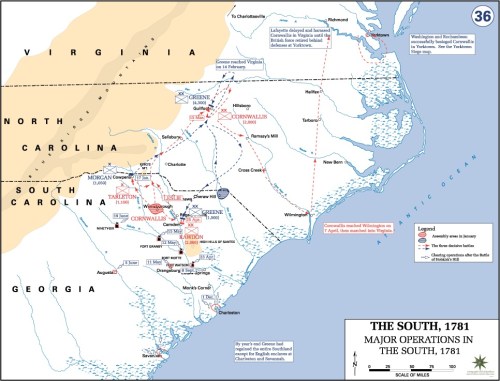
But here’s what’s forgotten, even by the history tourist: the South was crucial to colonial victory in the Revolutionary War, and has a lot to offer for students of that conflict. North and South Carolina had special significance during the Revolution, perhaps even more so than they had in the Civil War. South Carolina was literally riddled with battles of all shapes and sizes, and North Carolina was the site of one of the most pivotal battles of that entire conflict: the seldom-discussed Battle of Guilford Court House.

The early stages of the war were fought in the troublesome northern colonies, home of the original irksome Tea Partiers and a certain troupe of rabble-rousers in Philadelphia and New York. Those battles are legendary and often-taught in schools and shown on the History Channel: Lexington and Concord, Ticonderoga, Bunker Hill, Trenton, Saratoga. Those sites get all the visitors and all the attention when it comes to Revolutionary War tourism. Little attention is paid to the Southern Theater of that war, except Yorktown of course. That’s really sad: what happened in the Carolinas actually assured victory for all the colonies and assured the new United States would be as big and bi-coastal as it is today. What started in the North concluded successfully in the South.

The battle had shifted in upstate New York. The battle of Saratoga was a huge victory for the Continental Army and colonial militias. General Horatio Gates defeated and surrounded General Burgoyne’s redcoat troops in a humiliating defeat for the British. It was quite a stunning victory, really, and not only cost the British dearly in men and arms but also encouraged the French and Spanish to enter the fray on the side of the fledgling Americans. The Brits were going down for a defeat, something that simply would not stand in the eyes of the landed gentry, Parliamentarians, and King George. So the Brits came up with a new strategy.

Their new goal became not subduing all the colonies, but weakening their power by attacking the supposedly “soft” underbelly: Georgia and the Carolinas. The Brits were convinced the lower colonies were full of Loyalists, unwilling to surrender the honor of being part of the Empire to join with a band of Puritanical misfits and wannabes. All the Brits had to do was get past the coastal defenses and move into the interior where the North American landed gentry would gladly join them. With the low colonies firmly in British hands, resource-rich Virginia would fall, and to hell with the miscreants in Pennsylvania and Massachusetts. They could have their little country, firmly surrounded and contained by Britain and her loyal followers.

In March of 1780, they besieged and eventually conquered Charleston,  the biggest port south of the Chesapeake. They then moved inland, fighting and skirmishing all over interior South Carolina, picking up some Loyalists along the way but also (foolishly) stretching their supply lines and slowly whittling away at their core group of highly trained soldiers. But in their eyes, they were doing exactly what they wanted to do. Georgia was effectively out of the fray, South Carolina was theirs, and North Carolina (theoretically full of loyal British subjects) would be won. Then they could gather their strength and take back the Chesapeake Bay ports and the colony of Virginia.

After a series of mixed-result battles throughout South Carolina, bold Lord Cornwallis (descendant of barons and earls and nephew of archbishops and governors) lightened the load of his armies by abandoning equipment and supplies, and led them all into North Carolina in hot pursuit of the fleet-of-foot Continentals led by that much-beloved Quaker, General Nathanael Greene of Rhode Island. A brave and very astute commander, Greene’s motto became “we fight, get beat, rise, and fight again”, directly copying a strategy made famous by Fabius Maximus centuries earlier: war through attrition.

Greene did that over and over in the southern campaign, and culminated that strategy at Guilford Courthouse near Greensboro. He met Cornwallis’ 1900 crack troops with over 4000 of is own. He knew his men didn’t have the skill or fortitude to defeat Cornwallis, but he’d have them pound the British as much as they could. Worked, too. Worked fabulously well. The Brits won the battle due to superior tactics and arms (and, supposedly, through the use of nasty friendly-fire tactics), but they paid a high price for their victory. Cornwallis lost a quarter of his men and (due to “lightening the load” weeks earlier) most of their supplies. Cornwallis had no choice but to retreat over inhospitable land to coastal Wilmington. The British lost their chance to split the Colonies forever, and were eventually met with defeat in Yorktown months later.

There’s a lot we don’t know about the history of our own country. We tend to remember a few key events (poorly), but miss the whole. It’s quite interesting, actually, how one event leads to another, how  a series of small defeats can lead to a great victory and the eventual redirection of history. The Battle of Guilford Courthouse is one such event.

Oh, and North Carolina is my favorite Southern state. Just thought I’d toss that out there. 🙂

[I didn’t own a digital camera when I visited Guilford Courthouse, so no pictures. All illustrations & maps are public domain.]

==============================================

Links

Guilford Courthouse National Military Park

The order of battle

Natty Green’s Brewing Company

Google map to Guilford Courthouse

Read Full Post »

Iconography and Foolishness

How incredibly iconic is this image?

This is a picture taken in 1869 at the joining of two great railroads — the Union and the Central Pacific — in 1869. Setting aside the poor quality of mid-19th century photography, this is terrific photo. How better to depict years of labor by hardworking Americans and immigrants, and the importance of joining the battle-scarred and reconstructing East to the Pacific Coast, a land of wealth and promise, than this image? You see the engineers and work crews of the two big railroads, sharing champagne and smiles at the importance of the moment. This event was celebrated with drink and fiddles, dance and jubilation, pomp and circumstance. The joining of the railroads, one of those moments that marked significant change for this nation, beautifully captured for all time in this great iconic image.

Important it was, too, for this country was made strong by the railroads. Like the Internet of today, the railroads meant everything to 19th century America. They expanded commerce. They enabled safe travel. Because the telegraph shared the right-of-way, they improved communications. Most importantly, they tied the country together, and they eventually did more to unite the country than the War Between the States. No longer would you have to spend weeks of misery traveling across the country on horseback or in wagon trains, subjected to the harshness of the elements and the dangers from bandits and natives. You could now board a train in Philadelphia and — depending on your fortitude — eventually disembark in San Francisco.

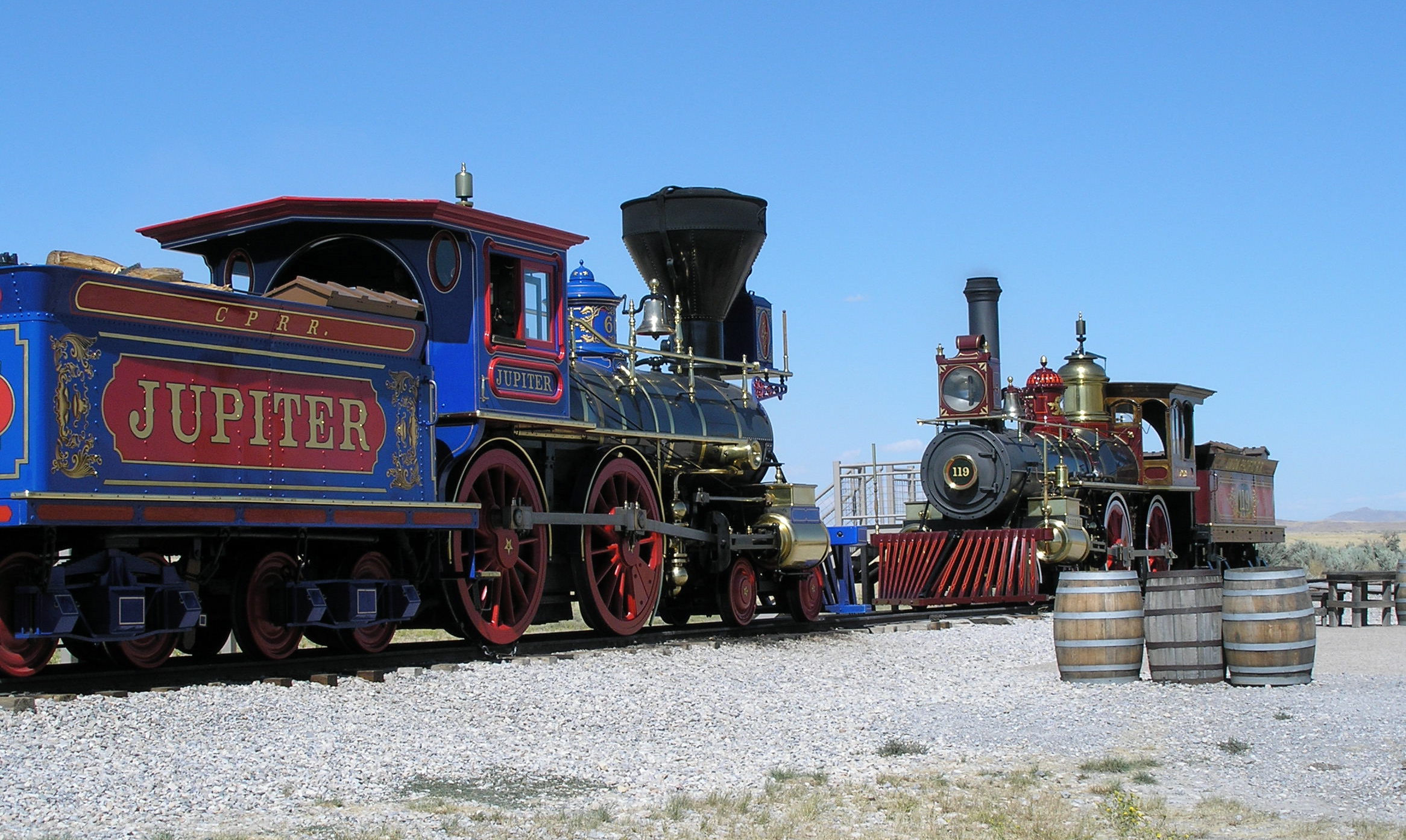
I am one of those folks who maintains romantic views of these old railroads. I find the whole history of the railroads wonderfully fascinating, and places like Golden Spike NHS enforce this fascination. They have two terrific, working replicas of the two locomotives: the Pacific Central’s Jupiter and the Union Pacific’s No. 119, sitting on rebuilt tracks on the original rail bed. The site itself is still remote, on the opposite side of the Great Salt Lake from Utah’s big metropolis. You can feel the winds of the plateau, smell the lake’s salt spray, and imagine yourself in this desolate land in 1869, laying the final tracks to unite a great nation.

Of course, our iconic and romantic imagery of these great railroads is not accurate. The railroads were not perfect. Because they were powered by burning coal, they were filthy. They were also noisy, uncomfortable, prone to breakdown and delay, and were occasionally assaulted and robbed. They gave rise to the Robber Barons, men of such wealth and influence they seemingly ran the nation from seats of financial power to the detriment of the nation and the ire of Teddy Roosevelt. Even the east-west joining of the railroads does not stand up to our romantic notions. In fact, this activity can be used to show how government interference into commerce and industry is inefficient and stupid.

You see, the government funded the creation of the transcontinental railroad, starting with the Pacific Railway Act of 1862. Through it and several other bills throughout the years, the government provided land grants across the vast unpopulated areas between Omaha and Sacramento. The government also paid railroads to lay track across the Great Plains, the Rocky Mountains, the Sierra Nevada, and the inaccessible plateaus in between. To this day, this still sounds like a shining example of the types of investments the federal government should make, investments whose resulting projects would provide great benefit to the entire nation.

Of course, the implementation itself proved to be horrid. First of all, the railroad land grants were far larger than they needed for these railroads, so they were able to sell parcels at tremendous profit, none of which made it back to government coffers. This, coupled with other forms of corruption during construction, means the government basically enabled the robber barons to become those tyrants and puppet masters we hear of today.

Then there were the foolish reimbursement formulas. The government basically paid the railroads by the mile, and also paid extra for crossing difficult terrain. This inspired the railroads to create winding and inefficient railways, and multiple cases of crossing difficult terrain instead of taking a simpler path in order to earn more government reimbursement. This led to that great anathema to those of us with engineering and scientific mindsets: tremendous inefficiency, idiocy, and profiteering displacing sound design and technological competence. Maddening, ever so maddening, and it is still a process that continues today in the form of pork-barrel projects, unnecessary weapon systems, and bridges to nowhere.

Promontory, Utah itself represents this misdirected mindset of federal funding. It has been debated that, had the railroads concentrated on building efficient East-West connections instead of taking advantage of flaky federal reimbursement rules, the railroads wouldn’t have been anywhere near Promontory. I’m not entirely sure that’s true, but it is definitely true that the spot was bypassed 35 years later, and hasn’t been a part of the transcontinental railroad since then. It is a dead, empty stretch of the Utah plateau, irrelevant except for a small plot of land celebrating the Golden Spike ceremony of 1869.

I still loved my short visit to this site. Regardless of the tainted history, it’s still an incredibly romantic, iconic moment in American history. And in an ironic way, the abandonment of Promontory by the transcontinental railroad has actually worked towards preserving the site as it was on a sunny day in May of 1869. Take a visit when you’re in the area, watch a steam engine demonstration, and imagine yourself in a bygone era, when a single moment changed the course of American history.

[The first two images are taken from the National Archives. The rest are my own photos and copyrighted as such.]

================================

Links:

Golden Spike National Historic Site

An essay on federal aid and the transcontinental railroad

Central Pacific Railroad Photographic History Museum

Google map to Promontory, Utah

Read Full Post »

Hope, Perserverance, and Strength

2010 has been a tough year. It’s been a tough year for me, for my family, and for my friends. It has been a tough year for most of the citizens of this great nation of ours, from the lobster coast of Maine to the shrimp coast of Louisiana; from the suburbs of California to Las Vegas to Cleveland, Ohio; from the financial houses of our major cities to the small businesses in your hometown. From sea to shining sea, people have lost their jobs, lost their homes, lost their pride. Some have lost their marriages, lost their children, or even lost their freedom to a government which seems to have lost its mind. Some have lost loved ones in battles overseas, to the debilitating effects drugs or alcohol, or to highway accidents at the hands of the thoughtless and careless. Some have lost their farms, lost their businesses, lost their pensions, or lost their minds due to debilitating dementia in their older years. Even those of us fortunate enough not to have lost any of these things are still feeling the stresses of a horrible economy and a nation seemingly going astray. For we know we could be next, we could fall, we could fail, we could lose, we could succumb to the great malaise that has crept over the country. Most of us are only one paycheck, one bad performance review, one missed mortgage payment, or one cancerous lesion away from total financial ruin and a life spent in a cardboard box under an I-84 overpass.

But today, on the eve of our only near-universal High Holy Day, there are still opportunities for hope. The source of that hope is not only in the kind messages carried across a faraway land by a humble man two millenia ago, there is also a source of hope in our own history, a source of hope in the perseverance of the best of mankind.

As a people, we’ve suffered a lot over 400 years of history. Our ancestors suffered the savageness of the frontier; under the harsh yoke of slavery; from the invisible demons of imported diseases run amok. They suffered life in filthy tenement buildings in New York City, festering sweatshops in Chicago, indentured servitude on Western railroads, or the penniless existence of Depression-era Appalachia. They suffered in the poisonous foxholes of France, on marches of pain in the Philippines, in the frozen mountains of Korea, and in the steamy jungles of Vietnam.

Yet through all this suffering, all this pain, all this trauma, we’ve survived. We’ve not only survived, but we’ve come out stronger and better than before. Sure we’ve strayed from time to time, for we are only human, but the trend is still upward. This should be, must be, a source of hope for all of us. We’ve gotten ourselves through all of that, and we’ll get through this as well. There is a way out, a way through, and a shining light at the end of it all. It requires hope, and perseverance, and strength.

———————

There exists a great, philosophical synergy between Christmas and New Year’s Day. Christmas is a celebration of hope, hope brought to the world by a great prophet long, long ago. It is also a time to reinforce the bonds of family and friends and neighbors, for those bonds should give us strength. It is also a time to regroup, rethink, catch one’s breath and propel yourself into the New Year with the strength and hope to enable you to persevere, overcome, and succeed.

I wish all my readers a very Merry Christmas, and much success in the New Year. 🙂

Read Full Post »

« Newer Posts - Older Posts »