Old John Brown: Martyr? Hero? Madman? Terrorist?
Harper’s Ferry NHP was one of the first historic sites I visited outside my home New England, and is still one of my favorites. It’s a sleepy little hamlet, nestled in a valley at the fork of the Shenandoah and Potomac rivers, with interesting Old Frontier architecture (like the church pictured below) and a calm, relaxed atmosphere. Visit in the fall, when the air is crisp, the foliage is out, and the fog is on the river in the early morning.
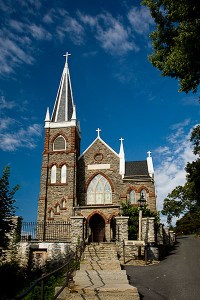
Harper’s Ferry, with two major rivers, a proximity to the Mason-Dixon, and one of the last stops between the colonies and the Frontier, was a true nexus point in early American history. Jefferson and Washington both surveyed the land, it served as a launching point for westward expansion, and was used by the military as a base and weapons depot. But the town is most famously known for the Raid that Started the Civil War.
—-
The time between the founding of the country and the fall of 1859 was most definitely the Dark Ages for America. People like to strut around today and say “our rights are threatened”, and that may well be, but this is nothing like it was back in the early 19th century. According to census figures, over 3.2 million free-thinking people were held as slaves in 1850. It was pervasive everywhere in the South, slaves accounted for one out of three souls living south of the Mason-Dixon line. It was no “curious institution”, it was a massive abomination. The work was hard, the treatment harsh. Families were routinely broken up as they were sold to different bidders at auction. In some cases, treatment even got worse in the 19th century. Constant fear of slave rebellion sparked states and counties to restrict slave movements. States passed laws forbidding teaching slaves to read or write, or form groups in the evening, or celebrating weddings, or traveling without a master (even to walk to a creek for water).
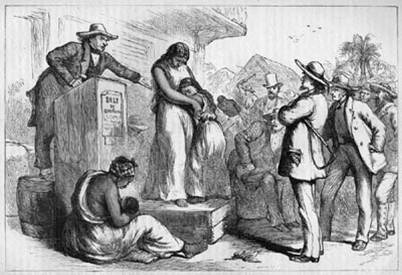
But it wasn’t just slaves whose liberties were restricted: the slave laws foisted upon the Union by southern aristocrats (and unopposed by cowardly Northern presidents), challenged the liberties of free men as well. It was illegal to aid in the escape of slaves, which basically forced every citizen (even those in the so-called “free states”) to participate in the captivity of a fellow human being. The states had no say: the Wisconsin supreme court declared the Fugitive Slave Act unconstitutional and would not uphold it, only to be told by the U.S. Supreme Court that they must uphold it whether they liked it or not. Nullification, indeed! Looking back, the honorable free states should have been the ones to secede from a corrupt, anti-liberty federal government right then and there!
Even the very notion of “one man one vote” was bastardized into the 3/5th rule, which gave the Southern gentry undeserved power in the Congress and the Electoral College. The notion that slaves could be counted in apportionment for a democratic society was disgusting, and is wholly responsible for the decades of tyranny foisted upon the nation. That horrible rule gave the slave states nearly 20 more seats in the 1850 House of Representatives and votes in the 1848 Electoral College than they justly deserved, creating a Congress that passed the dastardly Compromise of 1850 and gave us one of the worst presidents in U.S. history, Millard Fillmore. The North should have been able to railroad the South into giving up that horrendous institution, but instead the Founding Fathers’ greatest mistake led to a wholly unjust government, the enslavement of an entire race of men, and a society teetering on the boundaries of pure evil.
It was into this world that John Brown was born.

A heavily devout Christian, John Brown saw the entire institution of slavery, and the flaws in our political process that enabled it, as a crime against man and a sin against God. He took it so far as to say there was no way the United States could possibly have been founded as a Christian nation, because no true Christian would ever start a country with slavery as part of its core values. He was even more infuriated by individuals like John C. Calhoun, who said slavery was good and rooted in the Bible. To John Brown, that was apostasy, nearly as great a crime as slavery itself. John Brown was more than prepped for the forthcoming battle, at least on a spiritual level. Then came Kansas.
For over sixty years, the balance between slave state vs. free state was kept through a series of compromises. In 1812, the tally was even: 9 slave states and 9 free states. There was parity in the Senate, and the coveted Electoral College, and close tallies in the House (thanks to the 3/5ths rule). In order to keep the peace, states would be admitted in pairs: one free, one slave. Indiana & Mississippi, Illinois & Alabama, Maine & Missouri. However, in 1854, the anti-slavery faction in Congress won a minor victory: the residents of a territory, upon application for statehood, could vote themselves as to whether or not they would be free or slave. This put the pro-slavery faction in a terrible position: popular opinion in the new territories beyond Missouri was decidedly anti-slavery. The slave states would soon be outnumbered in the Senate and would surely lose their political clout and, therefore, their economic foundation. Drastic action was necessary, and drastic action was undertaken.
A cabal of slave-owners and -supporters organized dozens of bands of men called the Border Ruffians to rush to Kansas, create fake homesteads, and engage, not in farming, but in massive voter intimidation and fraud. They managed to elect a pro-slavery legislature for the territory. To counter the threat, abolitionists joined forces to form the Topeka Convention and create a state constitution marking Kansas as a free state. Presidential coward Franklin Pierce decreed the pro-slavery forces were legitimate, and that’s when all hell broke loose. The Ruffians burned and ransacked Lawrence, and John Brown headed to Pottawatomie, and eventually to Harper’s Ferry, leaving a trail of bodies (both friends and foes) in his wake.
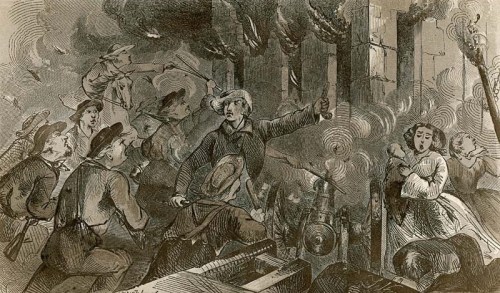
What happens next are the opening salvos of the greatest war ever fought on North American soil, a terrible stream of carnage that resulted in the emancipation of not only slaves but also of the American soul. Slavery, regardless of the opinions of the slaveowning aristocracy, was the albatross around the neck of the United States. It was preventing our rise to greatness, and even now, 150 years later, we’re still battling with the demons of our past. But at least they are now in our past, thanks to John Brown. He was like the interventionist to a drug addict: that person who holds up the mirror and says, in a very blunt manner, “look what you’re doing to yourself!!”
The full story of John Brown is a fascinating one, full of character and drive and madness. But it’s also admittedly troubling. Was John Brown a terrorist? He led his devout followers to their near-certain deaths. He committed acts of violence on American soil that took the lives of civilians. He instilled great fear amongst the citizenry, especially amongst the border counties of Virginia. His actions led the United States, especially the southern states, to crack down on civil liberties even harder. His actions ended up instigating a war.
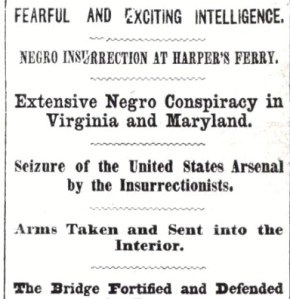
So was he a terrorist? Or should we take into consideration what he was fighting for? He wasn’t grandstanding for an upcoming book tour, there is no doubt he was ardently opposed to slavery and wanted the institution destroyed. He knew the institution was destroying America, and he knew that nothing short of bold action would change the nation’s course. And that course had to be changed: over 3 million lives, and the lives of all their future generations, depended on it.
Before you read on, here are some things to ponder. Do people have the right, or even perhaps the duty, to take bold and deadly action in the face of true evil? It’s a tough question. Is terrorism ever justified? Did John Brown act appropriately? Should he be regarded as a hero or as a demon, especially in light of what he was fighting for?
Made up your mind?
Now think about this: in preparation for his attack on Harper’s Ferry, John Brown worked on a document, to be released to the public if and when he managed to instigate the change he desired. A new Constitution for the United States, with guaranteed rights for all men of any race, a reworking of the system of representation, and a modification of the roles & responsibilities of the three branches of government: Congress, the Presidency and the courts.
All with him as the Commander in Chief in charge of the whole thing.
Now re-ask yourself those questions. You can probably even think up some better ones.


============================================================================
[Sadly, I didn’t own a digital camera when I visited Harper’s Ferry. Photo of St. Peter’s Church is used with permission of Patty Hankins. Check out her website, she specializes in close-up floral photos (something I enjoy doing on my own National Park trips). John Brown Birthplace postcard is available at www.vintagepostcards.org. Photo of John Brown’s tombstone is from the Wikipedia Commons (original). All other works are in the public domain.]
Links:
Harper’s Ferry National Historical Park
Modernizing a Slave Economy
Republicanism and the Compromise of 1850
Google map to Harpers Ferry
Read Full Post »
 I find this utterly fascinating. Sure, pundits & partisans would complain about the economics of the New Deal and the court packing scandal, but FDR had to be dead 60 years before the common man started questioning his Presidency and leadership. That’s almost three generations! I can’t think of anyone short of George Washington and perhaps Thomas Jefferson who escaped such criticism for so long. The people of FDR’s time had to basically die before public opinion turned against him. Today, we decry the previous loser the day after Election Day.
 Here’s my own take on why Roosevelt inspired such devotion: he had the “perfect storm” of confidence, communication, competence, and empathy. His family, especially his mother, Sara, gave him a good education and instilled in him a measure of self-confidence absolutely required of a good leader. FDR was a great communicator. His speeches are the stuff of legend and they were delivered, not as oratory, but as conversation, meaning they were genuine. Was FDR competent? Sure, you could say his policies weren’t necessarily wise, but he got them done. People respect people who get things done, action is rewarded far greater than thought or bearing. And FDR did accomplish an awful lot in his 12 years as President.