Screw the Rich
[Note to my sensitive readers: there’s some pretty strong language in this post, just thought I’d warn ya. Also, this post is not meant to insult or demean the NPS or the fine staff & volunteers at Hampton NHS. They were friendly & terrific and I thank them for the job they do. — Barky]

In the tony suburbs north of Baltimore sits the magnificent mansion and grounds of a wealthy, “old money” family: the Ridgleys. Tourists traipse through the buildings, marvel at the architecture and rare collectibles (like Chinese pottery, Swiss grandfather clocks, silk-upholstered Queen Anne furniture, and ivory-handled cutlery). They meander through the grounds and ogle the symmetrical gardens and flowering shrubs, oohing and aahing all the way. If they’re feeling adventurous, they may trundle to the old farmhouse and sigh “oh dear, slaves once lived here”, followed shortly by “let’s get to Denny’s before the Early Bird Special expires”.
Who gives a fuck.
 Seriously, I couldn’t give a rabid rat’s ass about fawning over treasures or discussing “the history of wealth in America”. Why? Because that history is a nasty, sordid one. By and large, the truly wealthy are nothing but a pack of leeches and have been for most of our history. From human traffickers to slave owners to Civil War profiteers to robber barons to market speculators to environmental rapists to “offshorers” to Bernie Madoff to the Koch brothers, these soulless bastards have screwed over this country time and time again, and continue to do so to this day.
It wasn’t always this way. Way back in the beginning, many of the wealthiest people on the continent gathered together to overthrow the yoke of British imperialism. Benjamin Franklin was an inventor, entrepreneur, and visionary businessman. To this day, adjusted for inflation, he solidly sits amongst the 50 wealthiest men in America. John Hancock also sits on this list, he ran one of the most powerful trading companies on the Atlantic coast. Many of the other signers of the Declaration of Independence, the crafters of the Constitution, and the financial backers of the Continental Army were wealthy businessmen and landowners. These folks risked their fortunes, put their necks in the metaphorical noose, and stood up to oppression for the good of all.
 The rich don’t have to be jerks today, either. There are all sorts of good guys in business, folks who provide good value for a fair price, use innovation and provide quality products and services to the public and turn a tidy yet fair profit. There are business people who support noble causes, stand up against injustice, and work as much for their employees as they do for them. Sadly, though, these people will never become one of the “uber wealthy”, that gaggle of cocksuckers who connive and conspire to screw over the country for the sole purpose of lining their own pockets and stroking their own ego.
Folks like those have been here since the beginning of the country. Shortly after we gained our independence, the wealthy began to be part of the problem instead of part of the solution. A mere 35 years later, wealthy merchantmen pressured James Madison and Congress to declare war on Great Britain. Publicly, they wanted “honor”, but in reality, their businesses were in jeopardy due to the British execution of naval power. In the eyes of these rich Americans, war was a small price to pay to return to profitability.
 Wealthy Southerners prevented the nation from handling the slave issue. Slaves were dirt-cheap labor, the source of Southern wealth, and the foundation for the entire Southern economy. Of course, it was a double-edge sword, for the slave economy also prevented entrepreneurism, invention, and advancement in the South. But it was what gave the wealthied gentry their power, their prestige, their income, and therefore they influenced Congress for decades to ignore their “peculiar institution” until 600,000 Americans died horribly painful deaths to end the barbaric practice. Of course, some folks became wealthy as war profiteers, which I guess proves the point that the rich almost always prosper at the hands of the rest of us, one way or another.
The rest of our history is equally sordid. Railroad magnates paid pseudo-slave wages, cared little for the safety of workers, used well-practiced fraud to steal millions from the government, and influenced the pace of the near-annihilation of the native Americans. Oil magnates displaced homeowners, despoiled huge tracts of land, crafted vertical monopolies to control the nation’s commerce, and formed holding companies to hide their tracks. In the industrial age, the rich burned people alive in shoddy New York City garment factories, flooded the entire city of Johnstown because they didn’t maintain the dam at their country club, violently cracked down on mine safety protests and spread cancer and misery across the land by polluting the air we breath and the water we drink.

Nowadays, they don’t act in nearly as bloody a manner as in the past. Instead, they use scam after scam to steal from the common man and bribe and cajole lawmakers to let them do so. They’ve moved far from simply convincing lawmakers to look the other way. They’re packing the courts so they can have free reign, paying off Congress to legalize their schemes, and use phony “grass roots” organizations to convince the voting public to support more scams intended to fatten their wallets and enable the continuing screwing of America. Oh, and occasionally they rape the maid.
So here’s the question: what good does the rich do for America today? None. Do they create jobs? Yeah, overseas, where they can (again) get cheap labor and work the local population so hard they jump to their deaths from high windows. Do they provide quality products and services to the public? Yeah, as if: the richest men in the country today sell technology so weak and treat our personal privacy so poorly, I’d bet a Russian crime syndicate knows more about your private life than you do.
 Do today’s fat cats even use their wealth to support charitable endeavors? Frankly, I’m not even convinced that’s true. Look at right-wing nonprofits like the Heritage Foundation, who preach the screwing of America. Who funds that? Not middle-American bake sales or bike-a-thons, those things are funded by rich fuckers trying to “prove” that screwing over America is good for America. I would love to see an honest study of charitable giving by the rich. I’d bet far more goes to private “shell game” foundations (set up to protect their trust funds) or supports right-wing “foundations” preaching the Gospel of Screw-You and buying off Congressmen than goes towards curing cancer, buying ambulances, feeding the hungry or rebuilding communities devastated by tragedy.
This long-winded diatribe is not intended to encourage or condone another Bolshevik revolution. I fully understand that we are a nation that succeeds because we are allowed to succeed, and that becoming rich is one part of the American dream. What it is intended to do is call out the wealthy in America for their thoughtlessness and greed.
 In that spirit, I will address the rest of this post directly to them, the top 1% of income earners who control 40% of the nation’s wealth: there is nothing on heaven or earth that gives you the right to abuse your wealth and power. There is nothing on heaven or earth that gives you the right to profit off the misery of others. There is nothing on heaven or earth that gives you the right to scam millions off your customers whilst providing nothing of value or (even worse) causing harm to them. There is nothing on heaven or earth that gives you the right to earn 300 times the income your employees earn while your bad decisions ruin the company.
What does exist is your responsibility to act as much in the good of the country as the next guy. It could even be said that because you have more wealth and power than the average man, you have more responsibility to contribute to the nation in which you live in a positive and constructive manner. You are rich and powerful because of the freedoms this nation affords (witness a certain oil executive living life in a Russian prison if you doubt what I am saying), and you owe this nation your honest and kind-hearted support.
Bottom line: you need to stop being douche bags. Not all of you are. You can be rich, you can be successful, you can have power, but you can also be decent human beings.

[All pictures on this post, and the post itself, are mine and mine alone and are not to be copied without my express written permission. My other photos of Hampton are here.]
============================================================
Links:
Hampton National Historic Site
By the Numbers: Wealth in America

 Oh good God it was awful! The prior day’s malnutrition hit me like a sledgehammer to the sternum. I was so low on energy, I could only walk about 10 minutes before needing a breather. I was sitting on every stump, lump, rock and log I came across. It was torture. The peanut-butter crackers I brought weren’t doing the trick, either. Why, oh why, didn’t I swallow my pride and eat more tetrazzini? Why didn’t I grab a yogurt at the weak breakfast buffet (there was yogurt, wasn’t there)? I felt like I was on a forced march in Bataan or something, except it was a chilly autumn in North Carolina instead of summertime in the fetid tropics. Every step was agony. Every breath was labored. I could hear the pulse from my pounding heart in my eardrums. It was awful.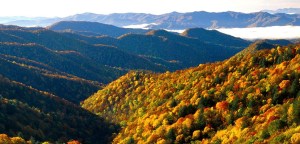
 [I didn’t own a camera when I took my trip to the Smokies. Pictures are all in the public domain as far as I can tell. If you know of any copyrights that apply, please let me know. Bilbo’s image is copyright 1977 by Rankin/Bass Productions.]